


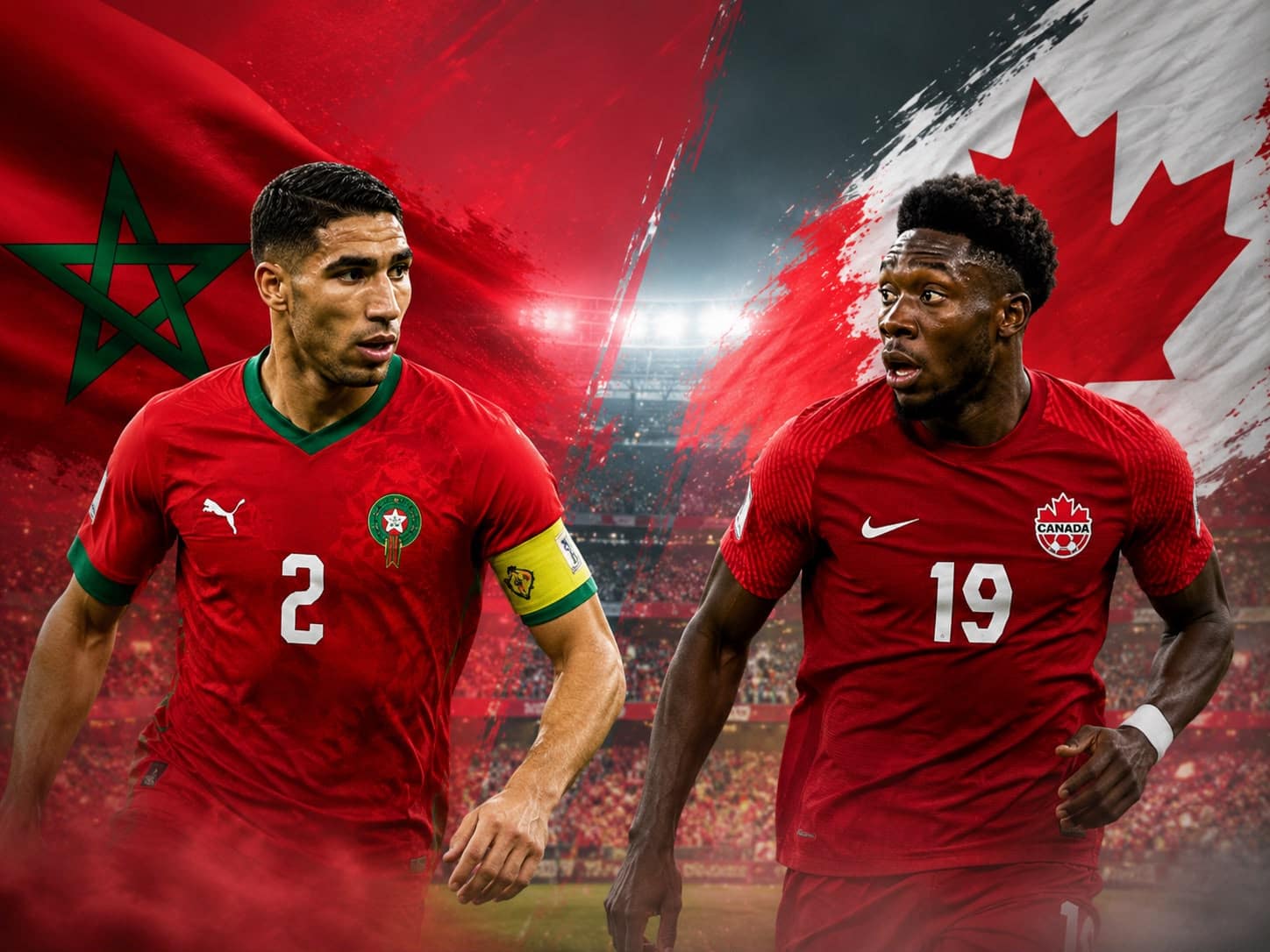
Morocco’s Round of 16 meeting with co-hosts Canada on Saturday is about far more than a place in the quarter-finals: the make-up of the Atlas Lions’ squad has become a case study in how dramatically the rules of international football allegiance have shifted, at a World Cup reshaped by a bigger format and looser eligibility rules.
According to Politico, 18 of the 26 players in Morocco’s squad were born in Europe, the majority of them in France. It is a striking statistic for a team representing North Africa, but one that reflects a wider pattern across this year’s tournament, where dozens of squads now feature so-called dual nationals — players eligible to represent more than one country through birth, citizenship or family heritage.
Canada is one of the clearest examples of the same trend from the other direction. Once a middling force in world football, the co-hosts have explicitly built their squad around recruiting dual nationals from across the globe. Midfielder Stephen Eustáquio, whose late goal against South Africa sent Canada into Saturday’s match, represented Portugal at youth level before choosing to declare for Canada instead.
Few countries, however, have built a modern roster quite like Morocco, semi-finalists at the last World Cup in 2022. For decades, players of Arab and African descent — many from families that migrated to Europe during the colonial era — tended to end up representing European nations, which historically held a disproportionate share of World Cup places. This year’s expansion of the tournament to 48 teams, which has nearly doubled the number of qualifying slots available to Asian and African countries, has begun to change that calculation, giving Europe-based players with North African or Arab heritage a clearer route to a World Cup place by choosing their ancestral nation instead. FIFA’s eligibility rules have also loosened steadily since 2004, allowing players to qualify through birthplace, citizenship or heritage, and, in some circumstances, to switch allegiance later in their careers. Ongoing debates over immigration, integration and Muslim identity in countries such as France, Belgium and the Netherlands have added further weight to that decision for some players.
Morocco’s rise has not rested on recruitment alone. Since 2009, the country has invested heavily in domestic football infrastructure and academy systems, according to reporting from The Athletic, part of the New York Times — a domestic pipeline that now works alongside its European talent pool rather than instead of it.
The stakes of Saturday’s match are sharpened by Morocco’s form so far this tournament. Now managed by Mohamed Ouahbi, who took charge only in March after the departure of Walid Regragui — the man who led the 2022 run to the semi-finals — Morocco opened this year’s tournament with a 1-1 draw against five-time champions Brazil, before beating Scotland and Haiti to finish second in their group on goal difference. In the Round of 32, they overcame the Netherlands on penalties after Issa Diop’s 91st-minute equaliser forced extra time, extending an unbeaten run that now stands at 33 matches, including a contentious Africa Cup of Nations final earlier this year. Morocco enter the Canada match ranked seventh in the world, the highest-placed African side in the tournament.
Several individual stories embody the diaspora theme at the heart of the squad. Captain Achraf Hakimi, born in Madrid and the player whose penalty eliminated Spain during Morocco’s 2022 run, earned his 100th cap for the country during this tournament. Brahim Díaz, who plays his club football for Real Madrid, switched his international allegiance to Morocco in 2024 after representing Spain at youth level, and has provided two assists so far. Ismael Saibari, a summer signing for Bayern Munich after a breakout spell at PSV, has scored three goals in four appearances and struck the decisive penalty that sent Morocco past the Dutch.
Beyond the result of any single match, this tournament looks increasingly like a hinge point for Moroccan football. A serious run in 2026 would confirm that the breakthrough four years ago was no one-off, and would arrive just as the country prepares for its status as a co-host of the 2030 World Cup alongside Spain and Portugal. As the Atlas Lions take the field against Canada, they do so not simply as a rising African footballing power, but as a team whose very make-up reflects a broader, more fluid sense of who gets to belong to a national side — and one that carries symbolic weight far beyond Morocco’s own borders, across the Maghreb, the Arab world and the global Muslim public.
