


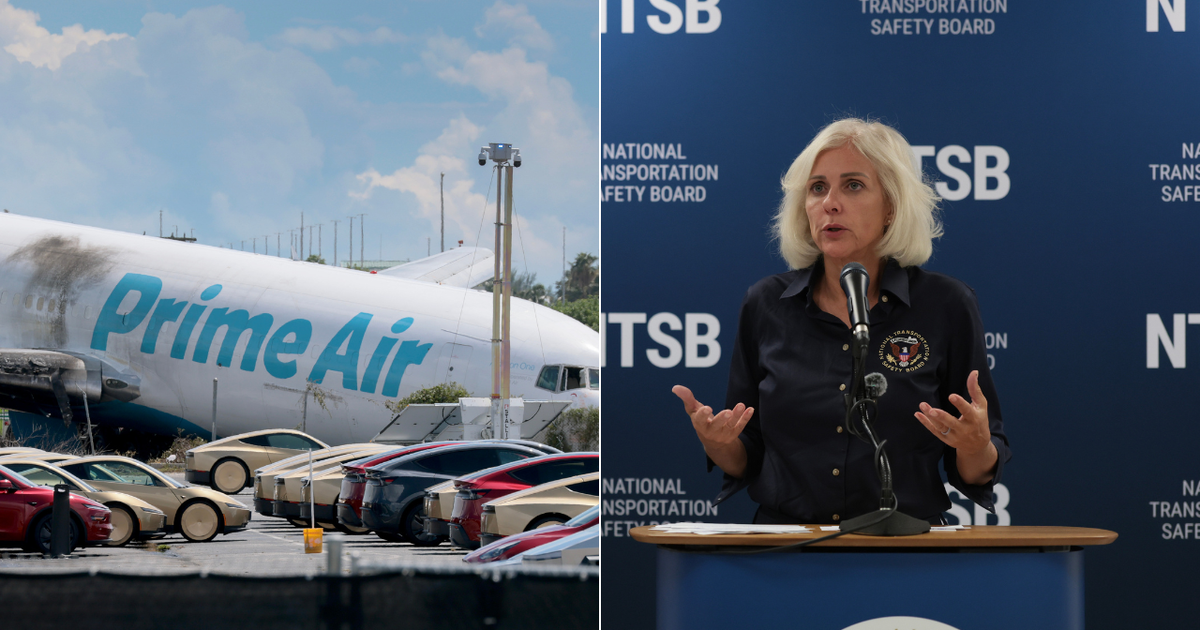
Investigators were due to interview the pilots of an Amazon cargo plane on Wednesday as they seek to establish why it overran a runway at Miami International Airport, killing five people on the ground.
The National Transportation Safety Board (NTSB) has recovered both the cockpit voice recorder and flight data recorder from 21 Air Flight 7598, a Boeing 767-33A operating for Amazon. The aircraft crashed while landing on Sunday, 6 September, after arriving from San Juan, Puerto Rico.
Captain Joseph Carroll, 55, and first officer Jaime Felipe Silva Molina, 37, were released from hospital after suffering minor injuries. Carroll had logged 7,145 flight hours as of 31 March, while Silva Molina had 2,655 hours as of 31 August, officials said.
NTSB chair Jennifer Homendy said the voice recorder contained more than two hours of good-quality audio, while the flight data recorder held about 55 hours of information. Investigators have said they will not publicly release a readout of the cockpit recording until after speaking to the pilots.
“What we need to do is talk to the crew and get their account to understand how they’re manipulating the controls to get a better understanding of the situation,” lead investigator Chihoon Shin told reporters.
He said the pilots’ accounts would help investigators interpret the recorded data and fill in gaps in the sequence of events. Air traffic controllers, dispatchers and other witnesses are also expected to be questioned.
Flight data offers clues about failed landing
Initial information from the flight recorder indicates the aircraft touched down at a ground speed of 158 knots, or about 182mph. Brakes were applied 23 seconds before the recording ended, then released 15 seconds later when the aircraft was travelling at 120 knots.
The throttles were subsequently increased to levels consistent with go-around thrust, suggesting the crew may have begun attempting to abort the landing before the aircraft left the runway. Investigators have not yet determined whether a full go-around was carried out or why the aircraft failed to stop.
Shin said there was no indication that the speed brakes or thrust reversers had been deployed. Both systems are designed to help slow an aircraft after landing, but he cautioned against drawing conclusions before the full performance analysis had been completed.
“I’m not gonna speculate on what should have been right now,” he said. Investigators will examine the aircraft’s speed, engine performance, braking and other recorded parameters to determine what was functioning normally.
The Boeing 767, which weighed about 252,000lb at take-off and was carrying roughly 32,000lb of cargo, travelled around 1,300ft beyond the paved end of runway 30. Its cargo consisted largely of contact lenses and no hazardous materials were found, according to the NTSB.
The jet struck a van carrying workers from Professional Ocean Service Corp, a company that cleans aircraft, before passing through a fence and hitting an SUV on a public road. All five people killed were inside the van, which had been carrying seven occupants.
Three other people remained in hospital on Tuesday, including two in critical condition. The pilots were the only people aboard the aircraft.
Investigators spent Tuesday documenting evidence that could deteriorate or be lost, including drone footage, videos of the wreckage and tyre marks on the runway and surrounding ground. They also inspected the remains of the aircraft, including a burned engine.
The NTSB has said Miami International Airport does not have an engineered materials arresting system, a bed of crushable material designed to stop aircraft that run beyond a runway. The agency is examining the airport’s layout and the circumstances surrounding the overrun, although officials have not suggested that the absence of such a system caused the crash.
Two of the airport’s four runways remained closed while the investigation continued, although a third was partially reopened for departures. The NTSB said the runway would be returned to airport authorities once investigators had completed their work at the scene.
