


Aleksandar Vucic has conceded defeat in Serbia’s parliamentary election after the student-backed Students’ List won a closely watched contest, ending the Serbian Progressive Party’s 14-year grip on power.
The result marks a major shift in the Balkan nation, where university students have led protests against Mr Vucic for almost two years. The movement’s candidates were selected from among academics, professionals and public figures, with cardiologist Ilija Srdanovic at the top of its list.
“The Students’ List has won,” Mr Vucic told supporters at his party’s election-night event. He said the SNS had received about 1.7 million votes, compared with roughly 2.2 million for the student-backed bloc.
Mr Vucic blamed Serbia’s independent media, alleged interference by unnamed European countries and what he called an “American deep state” for the defeat. He also urged supporters not to respond with violence.
“I do not want unrest, I do not want killings, I do not want anything like that on the streets,” he said. “We never wanted that, unlike them. They destroyed two years of life in this country; they will succeed in destroying more.”
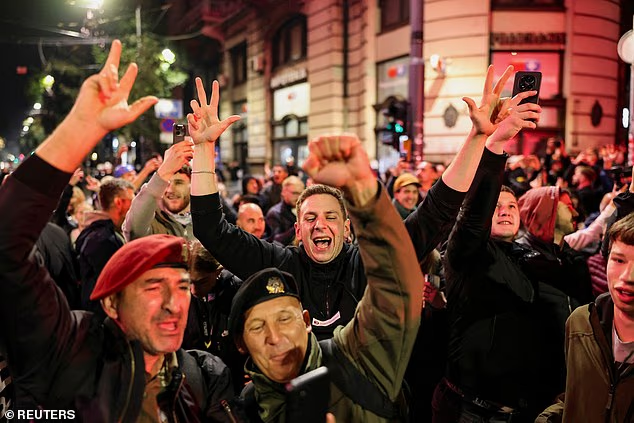
Supporters of the Students’ List poured into Belgrade and other Serbian cities, honking car horns and chanting: “Aleksandar is gone.” Celebrations continued as voters waved Serbian flags and held up three fingers, a gesture associated with the Holy Trinity that has become a symbol of protection among student protesters.
Ivo Petrovic, a 31-year-old software developer and supporter of the movement, said: “It’s unbelievable, I mean most people don’t even realise yet what a victory we’ve won today. I haven’t cried yet, which tells me that I haven’t processed it. It’s going to take a while.”
“Everyone is ecstatic, everywhere you go people are blaring their horns and putting up three fingers,” he added.
Student-backed movement turns protest into election victory
The Students’ List was formed by university students, although none of the students stood as candidates. Its 250 nominees included little-known experts, athletes, farmers and artists, with the campaign presenting itself as a non-partisan effort to rebuild Serbia’s economy and restore democracy.
The movement grew out of protests after 16 people were killed in 2024 when a concrete canopy collapsed at a railway station in Novi Sad. Demonstrators blamed high-level corruption, cronyism and graft during renovation work at the station.
Mr Vucic had remained a powerful figure despite the protests and had been endorsed by Russian President Vladimir Putin. He described the student movement as a foreign-backed attempt to remove him from power.
He had been seeking to become prime minister after serving almost two full terms as president, resigning from the presidency last month to lead the election campaign.
The students travelled by bicycle and on foot through rural areas, traditionally strong territory for Mr Vucic, as they sought to attract voters disillusioned with established politicians. Their victory came against a background of near-total government control over the media, according to concerns raised by monitors, along with reports of surveillance and cyberattacks targeting activists.
Turnout was expected to approach 70 per cent, a level not seen in Serbia since 2000. Long queues formed at polling stations at home and abroad, with some members of the Serbian diaspora voting during the night after polling hours were linked to Serbian local time.
Police in anti-riot gear surrounded part of central Belgrade near the election commission headquarters. Special police vehicles were also seen near a park where Vucic loyalists have been camping for more than a year, while groups of black-clad men gathered at several points across the city.
Independent election monitors reported dozens of alleged irregularities, including ballot photography suggesting pressure on voters and attempted vote-buying. The campaign had also been marked by detentions and attacks on journalists and activists, while the previous parliamentary election in 2023 was followed by opposition protests alleging fraud.
European Commission President Ursula von der Leyen congratulated the Students’ List and said the bloc was ready to support reforms involving the rule of law, media freedom, the fight against corruption and democratic institutions.
Marta Kos, the European Commissioner for Enlargement, said Serbian voters had “raised its voice” after almost two years of protests for democracy, the rule of law and action against corruption.
The immediate political future remains uncertain. Although Srdanovic tops the Students’ List, he will not necessarily become prime minister after the movement’s election victory.
