


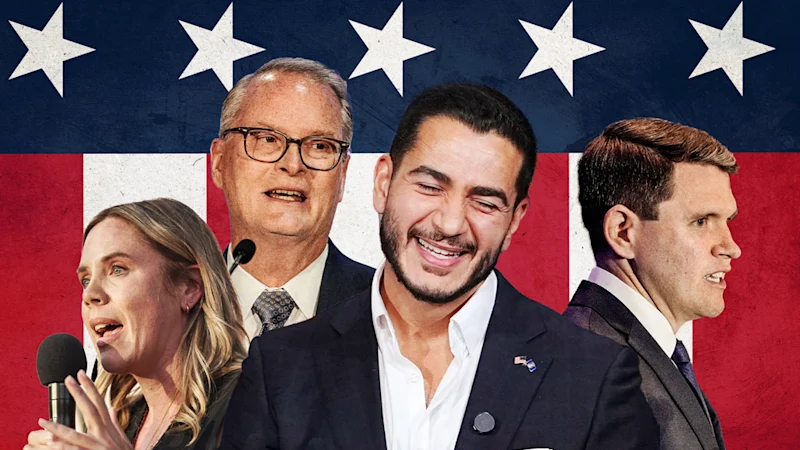
Democrats have secured a historic takeover of the US Senate after recruiting an unusually diverse group of candidates, including a mega-church pastor, a Paralympian, a paediatrician, a Muslim public health professor and a Texas theologian.
The victory was secured despite a political landscape that had appeared heavily stacked against them. Donald Trump entered the period after winning the White House and both chambers of Congress in 2024, while Republican candidates benefited from substantial backing from wealthy technology donors.
Democrats had needed to defend all their own Senate seats while taking four from Republicans, including two in states Mr Trump had won by double-digit margins. Their success is now expected to make Chuck Schumer, the party’s current Senate minority leader, the majority leader.
The candidates behind the Democratic Senate victory
In Texas, James Talarico, a 37-year-old former teacher and theological student, defeated Ken Paxton, the Trump-backed candidate. Elon Musk spent more than 300 million US dollars backing Mr Paxton.
Mr Talarico entered politics after becoming frustrated by inequality. During eight years in state office, he campaigned for cheaper medicines and against a proposed requirement for the Ten Commandments to be displayed in schools.
He has also positioned himself as a Christian opponent of Christian nationalism. In a 2023 sermon, he described it as “the worship of power – social power, economic power, political power, in the name of Christ”.
After his victory, Mr Talarico told supporters: “We just sent a message to every billionaire mega-donor, every trillionaire mega-donor, every corrupt defender of this broken political system in this state, in this country. Power belongs to the people.”
His victory, alongside Gina Hinojosa becoming the first Latina governor in Texas, suggested that Democrats could become competitive in the traditionally Republican state during presidential elections.
In South Carolina, paediatrician Annie Andrews defeated Darline Graham after a Republican contest marked by internal divisions. Dr Andrews had been drawn into political activism by the 2018 Parkland high school shooting, in which 17 people were killed, and linked gun violence directly to her work treating children.
Her opponent had been installed by Mr Trump after the sudden death of Lindsey Graham in July. The decision angered established South Carolina Republicans, who objected to an outsider being imposed on the party to complete Mr Graham’s term and contest the election.
While Republicans fought among themselves, Dr Andrews built her campaign and improved her public performances. Late injections of money failed to rescue the Republican campaign, ending the Graham family’s political dominance in the state and dealing a setback to Mr Trump’s influence there.
Adam Hamilton, the founder of the United Methodist Church of the Resurrection in Kansas, ran as a pragmatic Democrat in a state that had not elected a Democratic senator for 94 years.
Mr Hamilton had supported the Republican Party throughout his life before deciding that government power was being used to harm rather than help people. He rejected an independent campaign, fearing it would divide the opposition vote, and focused on healthcare, the cost of living and corruption.
His church, founded with his wife, LaVon, in 1990, grew from four members into the largest United Methodist congregation in the United States. Mr Hamilton also delivered the sermon at Barack Obama’s presidential inaugural national prayer service in 2013.
In Iowa, Josh Turek, a two-time Paralympian, campaigned against reductions to healthcare and welfare programmes. Born with club feet, scoliosis and serious back problems, he underwent his first operation as a newborn and has used a wheelchair throughout his life.
Mr Turek described himself as a “prairie populist”. He avoided culture-war arguments and promised to defend the assistance programmes used by rural families, which he said were being dismantled by the Trump administration.
He was prompted to run after the passage of Mr Trump’s main legislative achievement, the One Big Beautiful Bill Act. The package is expected to remove about one trillion US dollars from healthcare and a further one trillion dollars from welfare programmes in order to fund tax cuts for high earners.
Abdul El-Sayed becomes first Muslim US senator
Michigan produced another landmark result when Abdul El-Sayed became the first Muslim elected to the US Senate. The son of Egyptian immigrants, he is a professor of epidemiology, a Rhodes Scholar and a former public health director.
His campaign combined detailed discussion of public health with upbeat rallies and the slogan: “Money out of politics, money in your pocket, and Medicare for all.”
Mr El-Sayed’s victory followed a bitter contest. His defeated Democratic primary opponent, Haley Stevens, endorsed Republican challenger Mike Rogers in a last-minute intervention.
Mr Trump launched a racist attack on Mr El-Sayed, labelling him a “jihadist” and a communist. Mr El-Sayed responded by presenting the attacks as an assault on his supporters and on the country’s democratic ideals.
“My name is Abdulrahman Mohamed El-Sayed,” he told a cheering crowd after his victory. “As I was campaigning, some of you would come up and ask, ‘How come you don’t hit back? How come you don’t call them racist or hateful?’ They weren’t targeting me. They weren’t just attacking me. They were targeting and attacking you. They were targeting and attacking the very idea of America.”
He ended his speech with the words “Inshallah” and “Alhamdulillah”, meaning “God willing” and “Praise be to God”. Mr El-Sayed is also a strong critic of the Israeli government and its conduct of the war in Gaza, a position condemned by the non-partisan American Jewish Committee.
Elsewhere, former logger Troy Jackson captured Maine from five-term Republican senator Susan Collins. Roy Cooper, a lawyer and former governor, became the first Democrat to win a Senate race in North Carolina since 2008, while former senator Sherrod Brown returned Ohio to Democratic hands two years after losing his re-election bid.
Chuck Schumer’s strategy
Behind the candidates was Mr Schumer, a veteran fundraiser and tactician who has been criticised by progressive Democrats as too close to the establishment and too willing to compromise with Republicans.
As minority leader, he helped choose candidates, directed funding and shaped the party’s message. His approach focused on pragmatism, household finances and attacks on political corruption.
Mr Schumer did not always support the eventual winners. He backed Ms Stevens rather than Mr El-Sayed in Michigan’s Democratic primary. Once the field had been settled, however, he helped reopen funding channels from a 350 million US dollar political action committee war chest aligned with him.
Rebecca Katz, a veteran adviser who worked on Mr El-Sayed’s campaign, described the eventual partnership between the party establishment and its progressive grassroots as a “shotgun marriage”. Both sides, she said, understood the need to take control of the chamber.
Senator Richard Blumenthal called Mr Schumer the “principal architect” of the victory.
Mr Schumer attributed the result to listening to voters. “We listened to the American people, what they wanted,” he said. “We listened; they [Republicans] didn’t. And the American people reduced the red brick wall to a pile of bricks.”
