


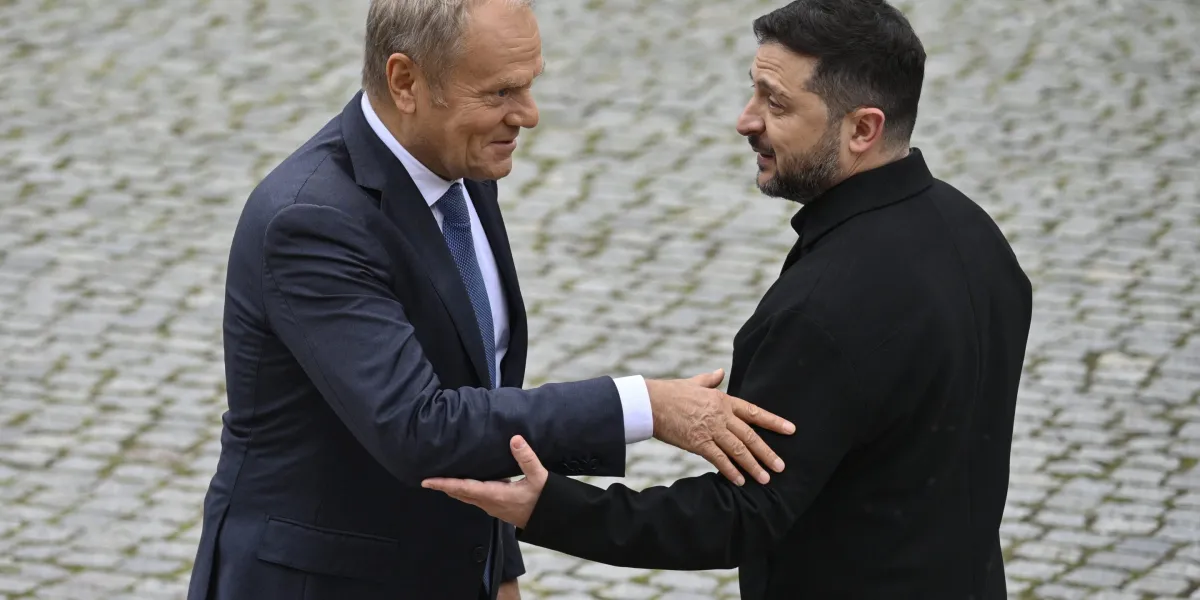
Ukraine’s President Volodymyr Zelenskyy has hosted the inaugural Carpathian Eight summit in western Ukraine, as Russian strikes killed and injured people and European governments warned of growing hybrid threats from Moscow.
The meeting at the ski resort of Bukovel, in the Ivano-Frankivsk region, brought together Ukraine, Romania, Serbia, Poland, Slovakia, the Czech Republic, Austria and Hungary, with the European Union also involved.
Zelenskyy described the summit as a “significant beginning” aimed at strengthening ties between the participating countries and creating “another strong element of cooperation at the EU level”. Discussions are focused on security, energy, logistics, cross-border economic links and support for local communities.
The gathering comes as US-mediated efforts to end Russia’s full-scale invasion of Ukraine have stalled. Territorial concessions in eastern Ukraine remain a central obstacle, while Kyiv is seeking security guarantees from its partners as part of any agreement.
Poland and Romania have been among Ukraine’s strongest supporters, while Hungary, Serbia and Slovakia have declined to provide direct military assistance to Kyiv.
European countries warn of Russian hybrid threats
European governments are increasingly concerned about alleged Russian activity including sabotage, cyberattacks, disinformation and possible drone incursions into Nato territory.
Polish Prime Minister Donald Tusk warned before travelling to Ukraine that Moscow was planning hybrid attacks using drones or rockets against European countries supporting Kyiv, including Poland.
Officials in Poland, Germany and Denmark have recently accused Russia of involvement in drone incursions, sabotage, arson, surveillance of defence facilities and plans to use a drone carrying explosives against an airport.
European Commission president Ursula von der Leyen has called for an EU mechanism similar to Nato’s to improve the bloc’s response to hybrid attacks. She said member states needed agreement on how to respond to incidents that fall short of armed aggression but still threaten national security.
Russia has denied having hostile intentions towards Europe. Speaking at a meeting of a government commission on new weapons, President Vladimir Putin said Western claims about Russian aggression were being used to justify increased defence spending.
He warned that Moscow would respond to what it considered aggressive action, including the seizure of Russian-operated merchant vessels. “Let’s live in peace, otherwise we will be forced to respond in kind – it must be quite obvious to everyone,” he said.
Putin previously described Western seizures of Russian commercial vessels as “piracy” and warned that any retaliation would not necessarily take place in the waters where the ships were detained.
France and the UK have detained tankers suspected of belonging to Russia’s so-called shadow fleet, while the EU has sanctioned hundreds of such vessels. Russia has recently begun deploying warships to escort its commercial ships.
Russia’s Foreign Ministry also said it had summoned the British chargé d’affaires to protest against the UK’s continuing supply of drones and other weapons to Ukraine. It accused Britain of trying to prolong and escalate the conflict and said British military facilities in Ukraine used to strike Russian territory would be considered legitimate targets.
The Foreign Office said the UK would continue supplying Ukraine with equipment needed for its defence, describing the Russian protest as an attempt to divert attention from its “barbaric full scale invasion of Ukraine” and discredit Britain internationally.
Overnight strikes kill and injure civilians
Russian attacks overnight killed two people and injured two others in Ukraine’s Zhytomyr region, west of Kyiv, according to the country’s State Emergency Service. Fires broke out at warehouse and production buildings, with rescuers forced to withdraw during repeated air-raid alerts before firefighters extinguished the blazes.
A separate drone attack hit an electric train at a railway station in the Kharkiv region, killing one person and injuring six. Two carriages caught fire in the Novovodolazka community.
Russia’s state nuclear corporation Rosatom said a Ukrainian drone had struck a cooling tower at a reactor unit at the Kursk nuclear power plant the previous day. It said the incident had caused no radiation threat and had not affected operations.
Russia’s Defence Ministry said its air defences had intercepted and destroyed 629 Ukrainian drones overnight across 14 Russian regions, Crimea, and areas of the Azov and Black seas. Moscow’s mayor, Sergei Sobyanin, said more than 350 drones had been heading towards the capital, with 64 destroyed as they approached the city.
The Russian military said it had also carried out overnight drone strikes against Ukrainian ports, vessels and a military logistics centre. A bulk carrier in the port of Chornomorsk and a Nova Poshta logistics facility near Odesa were among the locations it said had been hit.
Meanwhile, Zelenskyy said Ukraine had received a 3.3 billion euro tranche, worth roughly 3.8 billion US dollars, from an EU support package intended to strengthen the country’s defence capabilities, including the purchase of missiles and drones.
He said the funding came as Ukraine faced a projected budget deficit of about 27 billion dollars this year. Zelenskyy added that he was preparing to meet Ms von der Leyen at the United Nations General Assembly in New York the following week to discuss Ukraine’s financial stability.
