


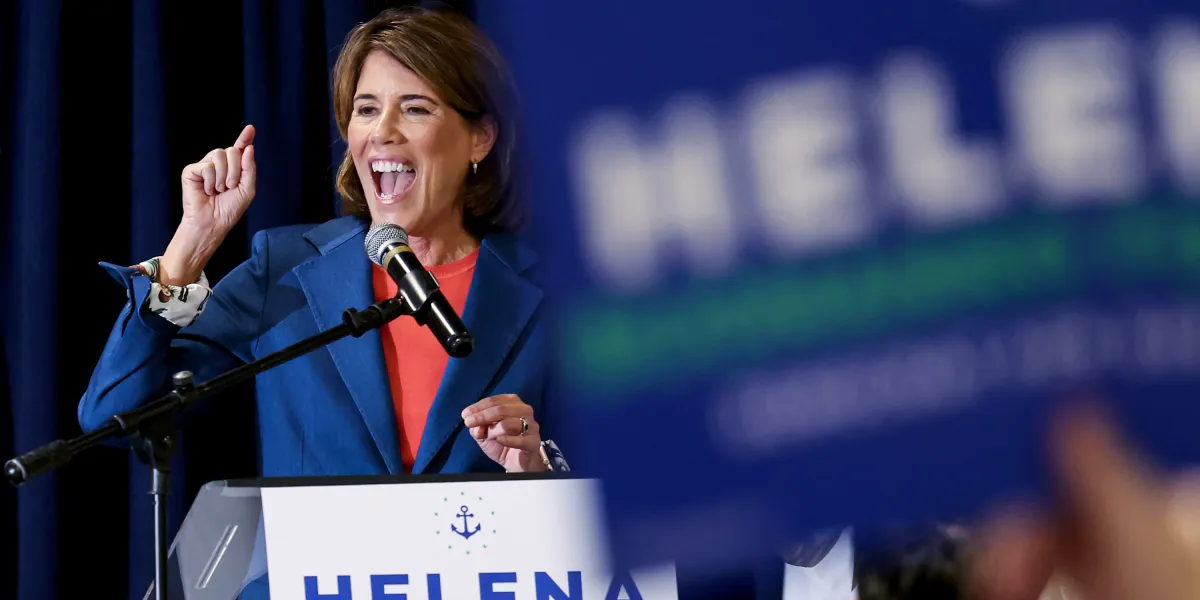
Rhode Island Governor Dan McKee is fighting to survive a Democratic primary challenge from former CVS executive Helena Foulkes, four years after narrowly defeating her in a bitter contest for the party’s nomination.
The vote on Wednesday, September 9, could make McKee the first elected US governor since 2014 to lose renomination and the first Rhode Island governor to be defeated in a primary since 1994.
Foulkes, 62, has raised and spent almost twice as much as the incumbent, according to state campaign finance records, and has maintained a lead in independent polling for much of the year. McKee, 75, has responded with a sustained advertising campaign portraying his challenger as an out-of-touch corporate executive.
The winner of the Democratic contest is expected to be heavily favoured in November in the traditionally Democratic state.
The Washington Bridge becomes a central election issue
McKee’s most persistent political problem has been the Washington Bridge, a major link between Providence and East Providence which carries tens of thousands of vehicles each day.
The governor closed the westbound section in December 2023 after officials identified serious structural defects. The state initially suggested the disruption would last months, but authorities later concluded that the span could not be repaired and would have to be demolished and replaced.
Construction of the new bridge is now under way. Rhode Island officials say all traffic lanes are scheduled to reopen on November 3, 2028, with the project expected to cost about $428 million.
Foulkes has made the delays and rising costs a test of McKee’s leadership, arguing that residents have been asked to tolerate years of congestion while the administration insists the project is progressing.
McKee says closing the bridge was necessary to protect the public and points to recent construction milestones, including the start of work on the bridge’s foundations in June. The replacement is designed to carry five lanes, compared with four on the previous structure, and to have a 100-year service life.
“I think that what I’ve really learned in the last four years, in a deeper way, is how much people feel like state government just works with a powerful few,” Foulkes said in an interview.
“They also hear the leader of the state saying ‘everything’s great’ and they’re saying, ‘I really worry about a good paying job.’”
Adam Myers, a political scientist at Providence College, said infrastructure failures could be particularly damaging to governors because responsibility was easier for voters to assign.
“In the case of a bridge, people know that state government is responsible for that,” he said. “And so there appears to be a very clear place on which to put all the blame.”
McKee targets Foulkes’ corporate record
McKee has sought to shift attention towards Foulkes’ 25 years at CVS Health, where she eventually became president of the pharmacy division, and her subsequent role as chief executive of Hudson’s Bay Company.
He has accused her of helping to fuel the opioid crisis during her time at CVS, an allegation she rejects. CVS agreed in 2022 to pay $5 billion to settle lawsuits brought across the United States over the impact of opioids, without admitting wrongdoing. Foulkes left the company several years earlier.
Foulkes says CVS reduced its opioid distribution by 40 per cent while she led its pharmacy division. She has also warned that McKee’s attacks risk damaging one of Rhode Island’s biggest employers, which is based in Woonsocket.
“The 50 largest companies’ business leaders in this state wrote a letter to you, asking you to stop criticising CVS,” she said during a debate in August. “You are going to drive them out of the state.”
Foulkes has strong Democratic family connections: her grandfather and uncle, Thomas and Chris Dodd, were both US senators for neighbouring Connecticut. She has presented herself as an outsider despite her political links and corporate career.
“It’s a great moment to be an outsider,” she said.
McKee, who previously served as mayor of Cumberland, has emphasised endorsements from organised labour and portrayed himself as the candidate for working-class voters. However, neither the Rhode Island Democratic Party nor the state AFL-CIO has endorsed either candidate.
The campaign has also been shaped by a 2024 investigation by the state attorney general and state police into McKee’s involvement in the awarding of a multimillion-dollar contract. Investigators said he had “personally and directly intervened”, but concluded that he had not broken state bribery or campaign finance laws. Attorney General Peter Neronha has since endorsed Foulkes.
McKee defeated Foulkes in the 2022 Democratic primary with 32.8 per cent of the vote, narrowly ahead of her on 29.9 per cent. This time, she is seeking to turn that close defeat into the biggest challenge yet to his political career.
