


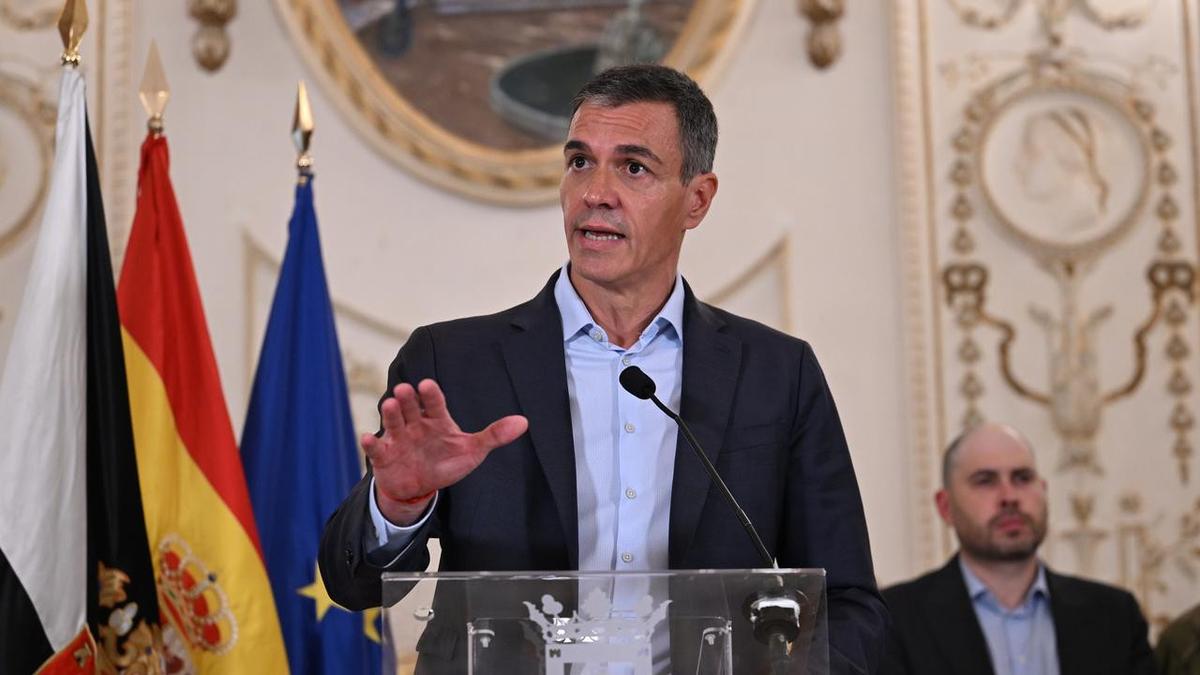
Spanish Prime Minister Pedro Sánchez has accused Russia and Israel of helping spread disinformation that fuelled the Ceuta migrant crisis, while insisting there is no evidence that Moroccan authorities organised last month’s mass crossing.
More than 72,000 people entered the Spanish enclave from Morocco on July 30 and 31 in an unprecedented surge at one of the European Union’s only two land borders with Africa. At least 100 people died during the attempted crossings, according to Ceuta’s local authorities.
Mr Sánchez said research by the European External Action Service, the EU’s diplomatic arm, had identified Russian and Israeli networks operating alongside international far-right groups in the circulation of misleading claims.
False videos and posts on platforms including Instagram and TikTok suggested that people who reached Ceuta by sea could not be returned to Morocco. Spanish officials have said the claims encouraged thousands to attempt the journey.
“When people talk and speculate about the participation of Moroccan authorities, I deny this outright,” Mr Sánchez told Spanish radio station Cadena SER.
He said Moscow and Jerusalem had exploited the crisis to attack Spain’s government over its positions on the war in Ukraine and the conflict in Gaza, although he did not provide further details of the evidence behind the allegation.
Israel’s Foreign Minister Gideon Sa’ar rejected the accusation, saying on social media that Mr Sánchez was “lying shamelessly” and attempting to divert attention from what he described as failures in domestic policy. Russia also denied any connection with the crisis, while the EEAS did not immediately comment.
Mr Sánchez said there had been no intelligence indicating Moroccan involvement and praised the two countries’ co-operation after the influx. Spain’s Interior Ministry said at the time that Moroccan security forces had prevented thousands of further attempts and that both sides had agreed to speed up the return of those who entered illegally.
The Spanish prime minister said about 5,000 migrants remained in Ceuta, including roughly 1,200 children, while around nine in ten of those who entered had since returned to Morocco.
He also acknowledged that Spain’s National Intelligence Centre had provided situation reports before the crossings but had not warned the government of the scale or severity of the impending crisis.
The enclave has since seen regular demonstrations by residents, along with sporadic attacks on a makeshift migrant camp at El Trampolín beach. Police reportedly arrested three Moroccan nationals on Sunday after bottles containing corrosive liquid were thrown at an army patrol; no one was injured.
Spain has begun installing an inflatable barrier and buoys along the breakwater separating Ceuta from Morocco. The measure follows a Supreme Court ruling on July 8 that found migrants swimming into the territory could not automatically be turned back where no physical barrier prevented their entry.
The government has announced an additional €168 million in emergency funding to help revive Ceuta’s economy, on top of more than €180 million allocated to a medium-term recovery plan. It has also proposed a single command structure to co-ordinate the security, migration and humanitarian response.
