


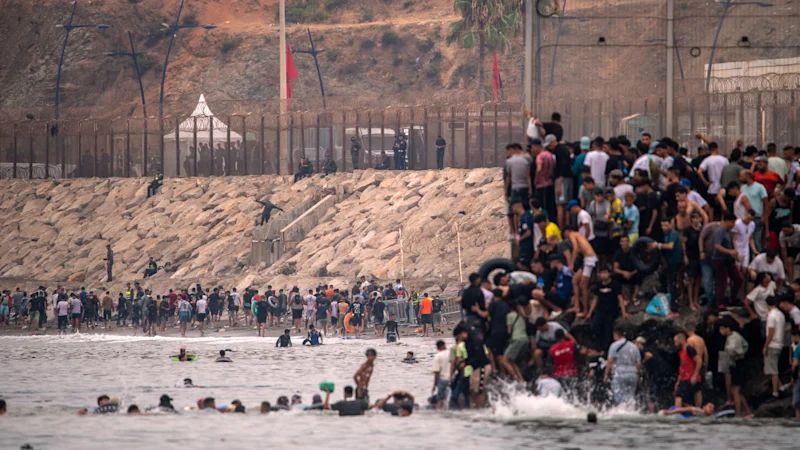
Spain’s prime minister has accused networks linked to Russia and Israel of spreading misinformation that helped trigger the arrival of at least 72,000 migrants from Morocco into the Spanish enclave of Ceuta, prompting a furious denial from Israel’s foreign minister.
Pedro Sánchez said false claims about a Supreme Court ruling had circulated on social media before the mass crossing on July 30. The posts allegedly suggested that anyone who entered Ceuta, including by swimming, could not be returned and would be entitled to travel to mainland Spain.
“There were Russian and Israeli networks that spread these hoaxes and attacked the Spanish government and Europeans on a corrosive issue like irregular migration, which divides and polarises many European societies,” Mr Sánchez told Cadena SER.
He said the claims were also amplified by criminal organisations and a far-right international movement seeking to exploit migration to weaken Spain and divide European countries. However, he stressed that the investigation into the crisis was continuing and that no state actor had yet been definitively identified as being responsible.
Israel’s foreign minister, Gideon Sa’ar, rejected the allegation and accused Mr Sánchez of “lying shamelessly”. In a statement posted on social media, he said the Spanish leader was trying to divert attention from what he called his “shameful failure” to manage domestic affairs.
The Kremlin also denied any involvement. Dmitry Peskov, a spokesman for Russian President Vladimir Putin, reportedly responded “No, he is not” when asked whether Russia had been linked to the crisis.
Ceuta migration crisis remains under investigation
Mr Sánchez dismissed suggestions that Morocco had encouraged the crossing as part of its long-running dispute with Spain over sovereignty of Ceuta. He said neither Spain’s National Intelligence Centre nor other intelligence agencies that regularly work with Madrid had reported evidence of Moroccan involvement.
“There is no information from any intelligence centre that casts doubt on the participation, in one way or another, of the Moroccan authorities,” he said, while praising what he described as Morocco’s immediate and continuing co-operation in returning migrants.
Spain’s interior ministry said at the time that people-smuggling networks were exploiting the Supreme Court judgment to encourage undocumented migrants, most of them young people, to attempt the journey. The government later clarified that the ruling set out the procedure for dealing with people arriving by sea but did not create a right to remain in Spain or prevent returns.
According to Mr Sánchez, about 5,000 migrants remain in Ceuta, including 1,200 minors, while roughly nine in ten of those who entered have since left or been returned to Morocco. The enclave’s reception facilities and public services have faced severe pressure since the influx.
The Spanish government has declared the situation in Ceuta to be one of national security interest until December 31, with the measure intended to co-ordinate state and local resources dealing with border control, humanitarian assistance, accommodation and returns.
Mr Sánchez is due to appear before Spain’s Congress on September 3 to explain the government’s handling of the crisis. Opposition parties have demanded answers over the intelligence warnings received before the crossing, while the prime minister has said that agencies shared situation reports but did not predict the scale of the influx.
