


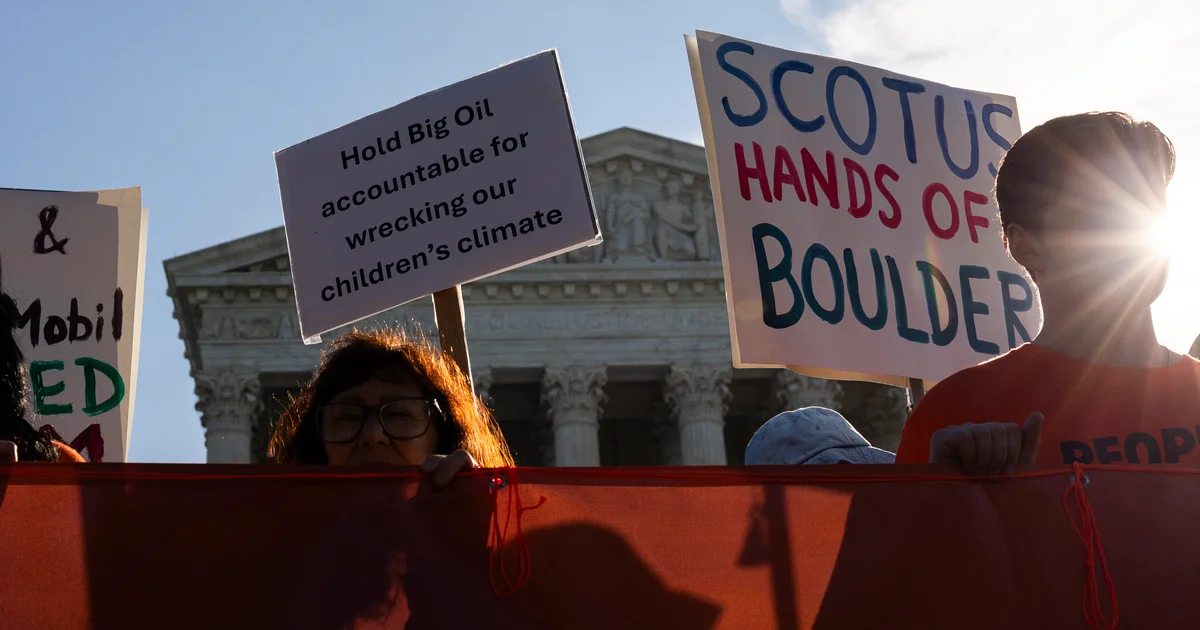
The US Supreme Court has heard arguments over whether a climate change lawsuit brought by Boulder, Colorado, against ExxonMobil and Suncor Energy can proceed in state court.
The city and county claim the companies’ fossil fuel production and allegedly deceptive marketing contributed to global warming and left them facing extreme heat, more frequent and larger wildfires and damage to the ecosystem.
Eight of the nine justices took part in nearly two hours of arguments in the case, Suncor Energy v Commissioners of Boulder County. Justice Samuel Alito recused himself, with the court giving no reason for his decision.
Alito’s 2025 financial disclosure showed individual holdings in ConocoPhillips and Phillips 66. It did not list holdings in ExxonMobil or Suncor Energy, the companies named in Boulder’s lawsuit.
His absence raises the possibility of a 4-4 deadlock. If that happens, the ruling of the Colorado Supreme Court, which allowed the case to proceed, would remain in place.
Arguments over Boulder’s climate change lawsuit
The case is at an early stage. The central question is whether federal law prevents Boulder’s claims, while the justices have also been asked to consider whether the Supreme Court has jurisdiction to review the Colorado court’s decision.
The lawsuit is one of dozens brought by US states and local authorities in state courts against energy companies. Such cases seek damages for alleged past and future harm linked to the accumulation of greenhouse gases in the atmosphere.
Boulder says ExxonMobil and Suncor’s conduct caused or contributed to climate change. It alleges that the companies’ production and marketing of fossil fuels encouraged unchecked use of their products, accelerating the rise in greenhouse gas concentrations.
The companies tried unsuccessfully to move the case to federal court. They then asked a Boulder court to dismiss it, arguing that federal law barred the claims. After that request was rejected, they appealed to the Colorado Supreme Court, which sided with the city and county.
Representing ExxonMobil and Suncor, Kannon Shanmugam told the justices that the Constitution and the Clean Air Act prevent states from pursuing claims over damage caused by greenhouse gas emissions crossing state borders.
Justice Brett Kavanaugh repeatedly referred to earlier Supreme Court rulings dating back to 1972, saying they established that interstate air and water pollution were matters for federal law.
“We don’t have to reinvent the wheel, because we’ve said this multiple times and Congress, presumably when doing the Clean Air Act and doing the Clean Air Act amendments, has relied on this court’s precedents establishing that this kind of pollution is a federal-law matter, unless Congress speaks otherwise,” he said.
The Trump administration is supporting the energy companies. Sarah Harris, the principal deputy solicitor general, told the court that Boulder’s case “egregiously exceeds” the constitutional limits on state authority.
“Interstate air pollution is an inherently federal area, and Congress hasn’t authorized this suit in the Clean Air Act,” she said.
But Justice Ketanji Brown Jackson questioned whether the Supreme Court was being asked to decide the issue too soon. “It feels like we don’t really know enough to be confident that the theories that you are proposing are actually applicable here,” she told Ms Harris.
Boulder says its claims concern alleged deception
Kevin Russell, representing Boulder, urged the justices to dismiss the appeal, arguing that the Supreme Court did not have jurisdiction. If they declined to do so, he said, the Colorado Supreme Court’s ruling should be upheld.
“Since the founding, states have had the power to provide tort remedies for injuries occurring within their borders, even when the conduct causing those injuries occurred elsewhere,” Mr Russell said.
He argued that the case was not an attempt to regulate emissions or solve climate change, but to recover local costs allegedly caused by the companies’ conduct. Boulder’s claims, he said, focused on production and deceptive marketing rather than emissions regulated by the Clean Air Act.
“It is not an effort to reduce emissions,” Mr Russell said. “Under our deception theory, they can continue to produce as much fossil fuels as they like and contribute to as much air pollution and greenhouse gas emissions, as the market will bear when consumers are properly informed about the consequences of that decision.”
Mr Shanmugam described the lawsuit as an unprecedented attempt to use state law to regulate global conduct. He warned that allowing it to continue could lead to similar claims by 90,000 municipalities, enabling juries to impose major damages on selected fossil fuel producers.
Chief Justice John Roberts also questioned how the approach would work if local authorities across the country brought comparable cases. However, he noted that state courts had previously been allowed to hear lawsuits with effects extending beyond their own borders, including mass tort claims and cases concerning internet operations.
Justice Elena Kagan said Boulder’s case appeared comparable to litigation against tobacco companies in the 1990s and pharmaceutical companies over the opioid epidemic, where state claims were allowed to proceed.
“This is chapter three,” she said.
A Supreme Court ruling is expected by summer 2027.
