


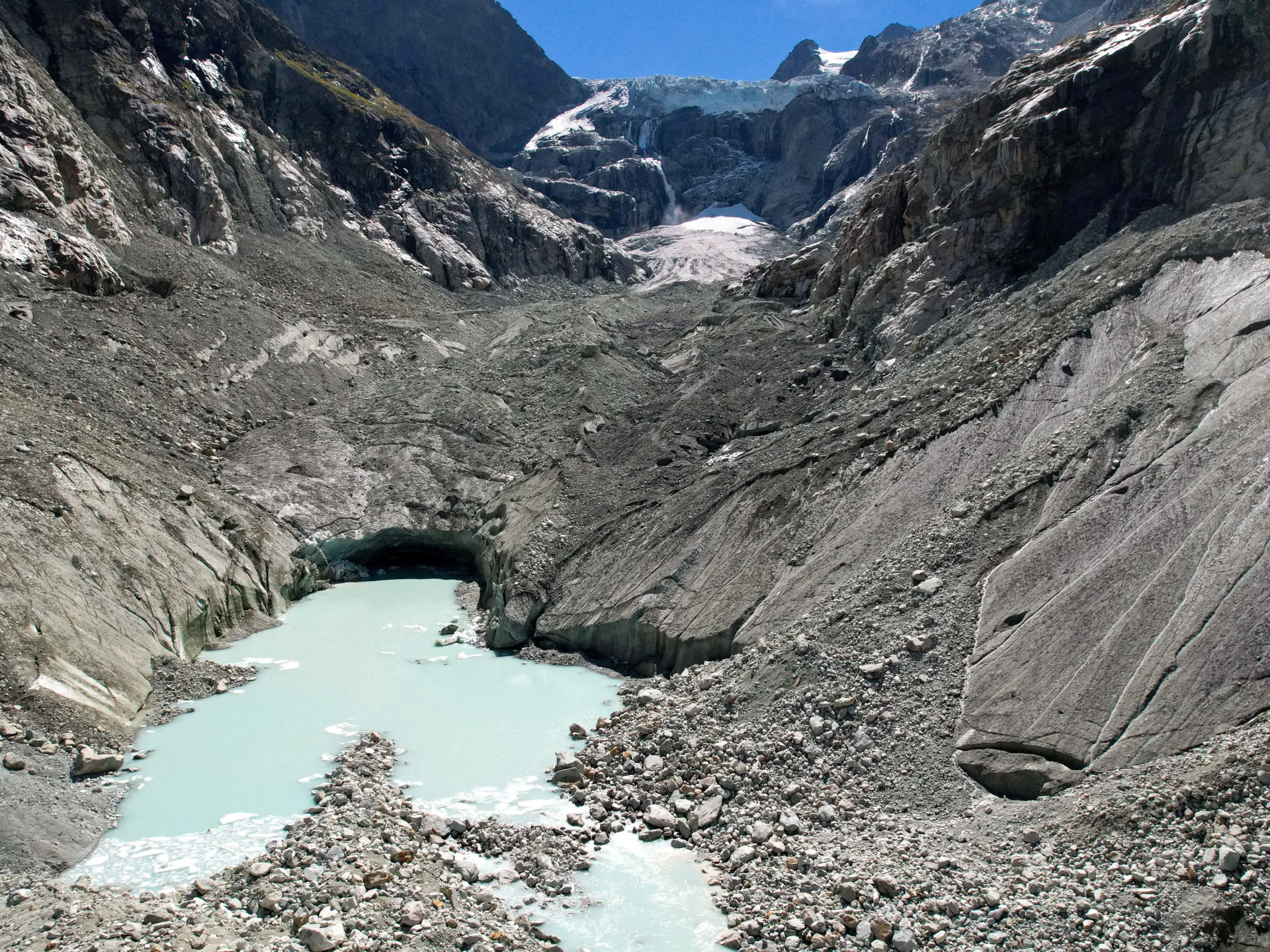
Swiss glaciers lost 5.5% of their ice volume in the year to 30 September 2026, taking the total loss to almost one-fifth since 2021, scientists have reported.
The figures, published by the Swiss Glacier Monitoring Network (GLAMOS) and the Swiss Commission for Cryosphere Observation, follow a summer of record temperatures and a winter with unusually little snow across the Alps.
Swiss glaciers lose metres of ice
Researchers measured 23 glaciers in September to assess the summer melt and remaining snow. The average thickness of individual glaciers fell by between 2.5 and four metres during 2026, while some glacier tongues lost as much as 10 metres.
At the Scex Rouge glacier in the Western Swiss Alps, a measuring pole drilled nearly four metres into the ice in July had shifted three metres out of the glacier by early September.
“Just in August and September of this year, even excluding the heatwaves of June and July, we have lost three metres of ice at an elevation of almost 3,000 metres,” said Matthias Huss, head of GLAMOS.
“This clearly indicates these conditions that we had this summer, they are just inconsistent with the survival of these small glaciers in the Alps,” he said.
Huss attributed the scale of the melting to human-caused climate change, saying Switzerland had experienced its hottest summer on record after a winter that left glaciers with little protective snow.
“Those shrink very quickly and sometimes even completely disappeared,” he said of smaller glaciers. “Also, large glaciers lost an enormous quantity of ice, but they remain impressive.”
The impact on Switzerland’s water supply
The report said Switzerland’s glaciers lost about 2.2 trillion litres of water between July and September alone. That is more than four times the annual drinking-water consumption of all Swiss households, the researchers said.
Glacial water helps fill reservoirs used for hydropower and feeds some of Europe’s largest rivers and streams. Huss said the full effects were not yet being felt because the glaciers were still providing water during periods of need, but warned that this capacity was being lost.
Harry Zekollari, a glaciologist and associate research professor at the Vrije Universiteit Brussel, said glaciers supplied water during hot and dry summers. As the ice became smaller, however, there would be less meltwater available.
“This peak in water supply has now been passed for glaciers in the European Alps, meaning that we expect glaciers to provide less and less water in the coming years,” he said.
Pressure on Alpine tourism
Switzerland’s winter sports and Alpine tourism industries depend on the country’s mountain landscape. About 4% of the workforce is employed in tourism, while Huss said the changing appearance of the mountains was already noticeable.
“They are no longer white but increasingly grey and black,” he said.
Zekollari said glacier loss could also create natural hazards, while the water from melting ice ultimately reached the oceans and affected coastlines around the world.
The scientists said the extent of future losses would depend on how quickly global temperatures were stabilised. If emissions were rapidly halted, about one-third of the ice mass in Swiss glaciers and the European Alps could still be preserved, Zekollari said.
Under a scenario of strong warming, however, the glaciers are projected to lose more than 90% of their volume by 2100. “Every 0.1 degree Celsius warming matters,” he said.
