


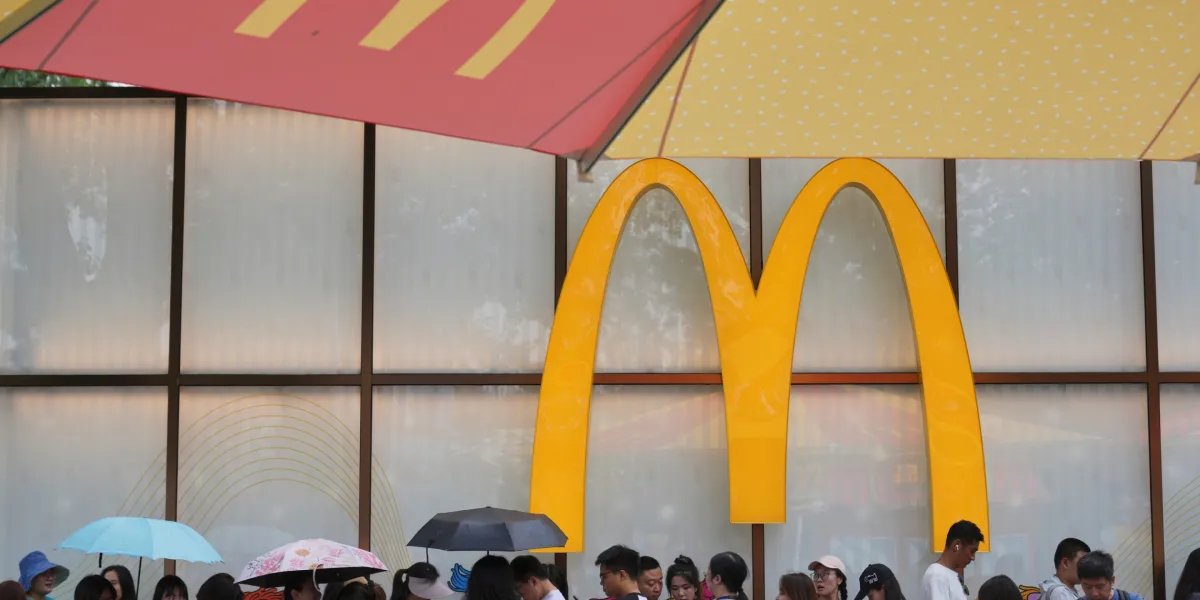
American and Chinese fast-food chains are expanding in each other’s markets, creating an unlikely commercial bridge between two countries divided over tariffs, technology and Taiwan.
US brands are opening restaurants across China, where the potential customer base is four times the size of America’s. At the same time, Chinese companies are looking to the United States for growth as fierce competition, weak consumer spending and a property downturn make expansion at home more difficult.
Yaling Jiang, founder of market research company ApertureChina, described the movement of burgers, fried chicken, coffee and bubble tea between the two countries as “business- and consumer-led gastrodiplomacy”.
American newcomers such as Popeyes and Five Guys are regarded by some Chinese consumers as an indulgence, while Chinese food and drink brands are finding an audience among Americans with increasingly international tastes.
“Consumerism builds a safe, introductory channel for contemporary Chinese culture and can be a great way to elevate China’s soft power,” Ms Jiang said.
The development comes as US president Donald Trump prepares to host Chinese president Xi Jinping for a state dinner on Thursday. The White House has not disclosed the menu, but both leaders have demonstrated an appreciation for relatively inexpensive, familiar food.
In 2013, Mr Xi visited a steamed-bun restaurant in Beijing, queueing for a 21-yuan meal of pork-and-scallion buns, vegetables and stewed pork liver and intestines. Mr Trump’s enthusiasm for fast food is well known, and during his 2024 campaign he worked at a McDonald’s fry station in Pennsylvania.
US chains push deeper into China
China’s appeal to American restaurant companies is reflected in a series of ambitious expansion plans. Church’s Texas Chicken recently opened its first Shanghai branch, where customers queued in the rain. The chain plans at least 600 more restaurants across China.
Wendy’s expects to open 1,000 restaurants in the country over the next decade, while McDonald’s plans 1,000 new Chinese branches this year and aims to reach 10,000 in total by 2028.
Burger King, which entered China in 2005, expects to triple its number of restaurants there to 4,000 by 2035.
“Despite political tensions between the U.S. and China, Chinese actually still go crazy for American brands,” said Shaun Rein, founder and managing director of the China Market Research Group in Shanghai.
KFC was the first major American fast-food chain to enter mainland China, opening in Beijing in 1987. McDonald’s and Pizza Hut followed in 1990.
At the time, KFC was considered a premium destination and somewhere suitable for taking a date, Mr Rein said. He added that McDonald’s and KFC were viewed as a symbol of health and hygiene compared with other parts of the market.
KFC now has about 13,000 restaurants in China, compared with roughly 3,750 in the United States, making the country its largest market by a substantial margin.
There is still room for further growth, particularly outside China’s biggest cities. Much of the population lives in smaller inland centres, where companies including McDonald’s and Starbucks are continuing to open outlets, said Sory Park, a project manager at China-focused consultancy Daxue Consulting.
Foreign chains, however, increasingly rely on Chinese partners to identify sites and share the financial risk. Earlier this year, a Chinese investment firm bought a 60 per cent stake in Starbucks’ Chinese operation after several years of declining traffic to its stores.
American brands may retain their names and best-known products, but their Chinese menus are often adapted to local tastes. KFC serves its traditional fried chicken and chips alongside egg tarts and congee, a savoury rice porridge.
“They need to operate like a Chinese company but deliver American menus that incorporate Chinese values, eating habits, and tastes,” Ms Park said.
Chinese brands test the US market
The flow of fast food is increasingly moving in the opposite direction. Mixue, one of the world’s largest fast-food chains with more than 53,000 outlets, opened its first three US stores in December.
Customers queued in New York to try its soft-serve ice cream, fruit teas and milk tea topped with ingredients such as coconut jelly and taro balls. The company has announced at least two dozen further locations across four states.
At least nine other mainland Chinese chains have entered the US since 2023. Most focus on drinks and snacks, including Heytea, which has 40 US locations, and Luckin Coffee, China’s largest coffee brand after overtaking Starbucks, which has 20 New York stores.
Wallace, founded in 2000, has grown to more than 20,000 restaurants by selling American-style chicken and hamburgers in China. Its second US restaurant opened in California last month, with the company changing its chicken sandwich recipe for American diners.
Many Chinese food and drink groups first expanded into south-east Asia before attempting to establish themselves in the United States. The pressure to seek new markets has increased as a property slump and weak spending have made domestic growth more difficult.
A US government report estimated that the average lifespan of China’s 16 million restaurants and chains was expected to fall to 15 months last year.
By comparison, the American restaurant industry has about one million locations. Aaron Allen, founder of restaurant consultancy Aaron Allen and Associates, said the US accounted for one-third of global restaurant revenue despite representing about 4 per cent of the world’s population.
“The grass is always greener somewhere else in the world,” Mr Allen said.
Price is one area where Chinese operators may seek an advantage. At a Mixue outlet in Hollywood, a medium matcha latte cost $6.83, while a nearby Starbucks charged almost a dollar more. Wallace sells three full-size chicken sandwiches for $10.
“The Chinese can build stuff cheaper and faster. Why would that not apply to food?” Mr Allen said.
He warned, however, that Chinese brands could face a backlash or higher tariffs if they used low-cost imports from China to undercut American competitors. Restaurant companies could also face scrutiny over how they collect and use customers’ data.
Luckin Coffee chief executive and co-founder Jinyi Guo told investors in February that the US was “one of our important long-term opportunities”. The company, she said, was proceeding “with great patience and discipline”.
Not all Chinese brands make their origins prominent. Wallace’s US website and social media accounts do not mention its Chinese ownership or headquarters in Fujian province. The company did not respond to an email seeking comment.
