


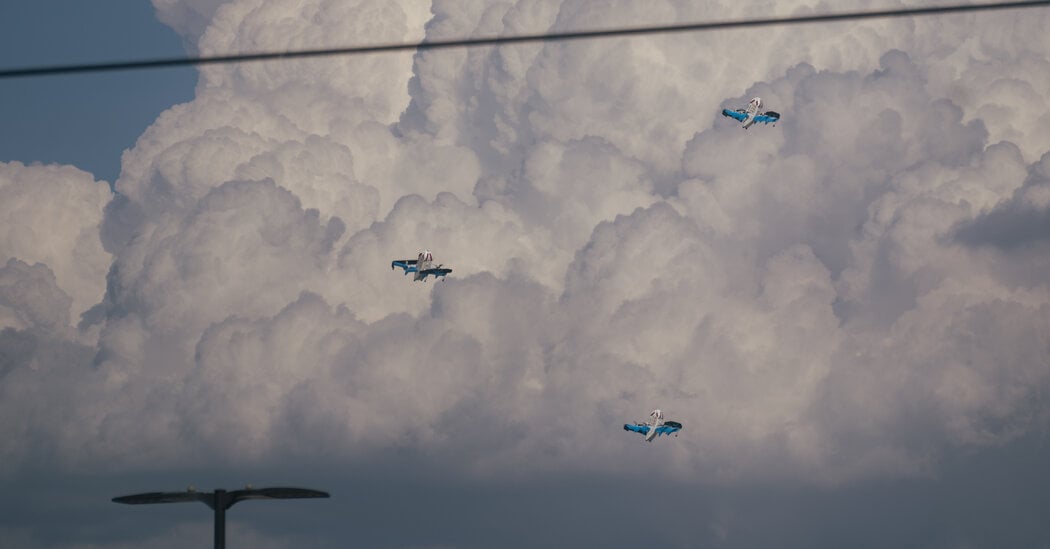
Amazon drone deliveries have triggered a backlash in Richardson, Texas, where residents say frequent flights over their homes have brought persistent noise and raised concerns about privacy and safety.
The Dallas suburb was among the first places to host the company’s Prime Air service after city officials approved its operation in December. Amazon says the programme will expand to 500 towns and cities by the end of the year, promising deliveries of tens of thousands of items in as little as 30 minutes.
But in neighbourhoods close to Amazon’s distribution centre, residents describe a very different experience. Dozens of drones, and sometimes more than 100, can pass overhead each day, with some likening the sound to lawnmowers flying above their gardens.
Eric Anderson and his nine-year-old daughter, Isla, recently watched one of the aircraft arrive while the family was using their back garden pool. The 83lb machine, fitted with six blue arms and multiple propellers, had carried a single package from the distribution centre, less than a mile away.
The drones can carry parcels weighing up to five pounds and travel to addresses within a seven-and-a-half-mile radius of their launch point. During a delivery, they descend to about 13ft, hover above the property and release the package through an open door.
Richardson residents complain about noise
Amazon’s flights are permitted between 7am and 8pm under Richardson’s regulations. The company has said its drones generally travel at an average height of 225ft, while the maximum permitted altitude set by the Federal Aviation Administration is 400ft.
Nikki Anderson, whose extended family watched the aircraft from their home, said the noise had disrupted the quiet of her garden. “We hear them zoom, zoom, zoom, back and forth from morning until past dinnertime,” she said.
She said the sound could be heard inside the house even when the television was on, and appeared to intensify at weekends. Her request for the city to restrict the hours or days of operation was not accepted.
Greg Sowell, a city spokesman, said Richardson had not introduced any additional timing restrictions since the City Council approved the service last year.
“Some people might think, wow, this is really, really cool, and the technology is really cool,” Ms Anderson said. “But people around here, we’re thinking, ‘Ugh, is there anything we can do to stop this?’ We can’t live like this.”
Scott Bratcher, president of a homeowners’ association in a neighbourhood residents have dubbed a drone highway, said the experience in Richardson should serve as a warning to other communities.
“What’s happening in Richardson is about to happen all over the country, and people are finally going to believe us that having all these drones flying around is actually a big, big problem,” he said. “The government and the F.A.A. have failed us.”
The FAA has said it will issue new rules for drone flights. In July, after examining the environmental impact of commercial delivery drones such as Amazon’s, it concluded that they did not create a “significant impact”.
Amazon says response has been positive
Lindsay Hamilton, an Amazon spokeswoman, said customer reaction to Prime Air had been “overwhelmingly positive”. She said fewer than 1 per cent of enquiries about the programme so far this year had concerned noise.
Ms Hamilton compared the sound to a window fan on its lowest setting and said the aircraft were quieter during deliveries than a passing car.
Some residents have welcomed the novelty, posting videos online as parcels are dropped, bounced or slid into gardens and driveways. For others, the convenience has not outweighed the disruption.
Kristi Graham, who complained after drones flew over the garden where her family swims and barbecues, said Amazon changed the route after her intervention. However, she said the new flight path was moved to the front of her house.
Ms Graham is now involved in a neighbourhood group campaigning against the service. Yet her family has also used drone delivery: her daughter ordered deli ham from Walmart after finding a voucher for the service and needing to make a sandwich quickly.
“How could you?” Ms Graham said.
She and other residents, including Ms Anderson, have contacted officials in cities such as El Paso in Texas and Richmond, Virginia, where Amazon’s drones are expected to begin operating. In their messages, they have described the service as “a disaster for the City of Richardson”.
Privacy concerns over drone cameras
The dispute extends beyond noise. Amazon says its aircraft use cameras and sensors to navigate, with images stored on encrypted drives accessible only to authorised staff. The company says the data is used solely to improve safety and customer service.
Stephanie Puri, a video game industry researcher who has helped track the flights, questioned how the information might be used. “Amazon hasn’t always been the most transparent with how they use and reuse data,” she said, raising the possibility of seeing adverts based on what drones observe in her garden.
“If it’s your backyard and you want to sunbathe naked, that’s your property and you do you,” she said. “But, oh, Amazon can see you.”
Ms Puri recorded 52 drones overhead on what she described as a slow day, including three flying between 150ft and 170ft. She said one of her cats growls when the aircraft pass at that height.
At a protest outside Amazon’s distribution centre in June, demonstrators carried signs reading “Too low, too loud, too many”. Ms Puri said several Amazon delivery drivers honked their horns in support, amid concerns that drone deliveries could threaten their jobs.
Brian Rowe, a technology and cybersecurity executive who has raised complaints at City Council meetings, said he had considered using commercial anti-drone equipment. He said the technology, used mainly by the military, would cost tens of thousands of dollars.
“What can we do?” Mr Rowe said.
He is also concerned about the arrival of larger aircraft. A company recently began testing air taxis in the Dallas-Fort Worth area, he said. They may resemble Amazon’s drones, but are considerably bigger.
