


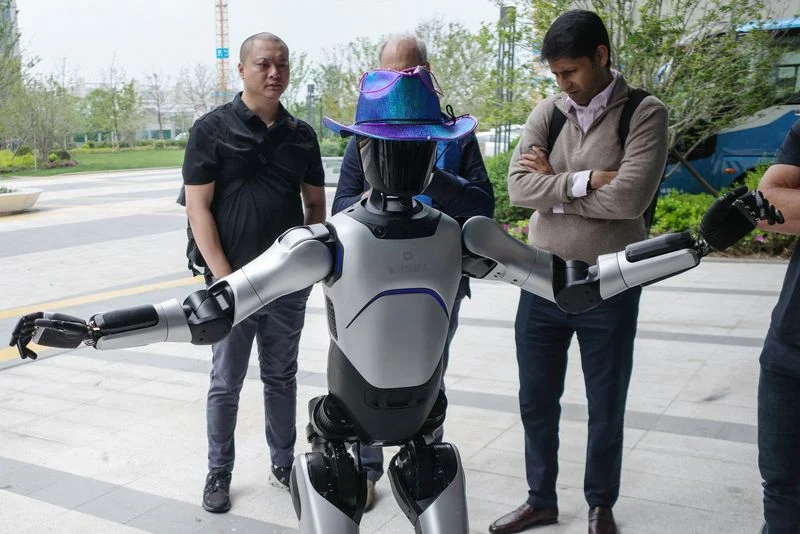
Foreign investors, entrepreneurs and technology executives are travelling to China in growing numbers to inspect its factories, artificial-intelligence firms and robotics companies, as concern mounts that the country may be pulling ahead in advanced manufacturing.
The visits, often costing thousands of dollars, offer access to production lines and research facilities that remain largely out of reach to ordinary tourists. They reflect a widening belief in Western boardrooms that China’s progress in electric vehicles, batteries, AI and humanoid robots demands first-hand scrutiny.
Robert Wu, chief executive of Shanghai-based research firm Baiguan, has organised two tours for more than two dozen investors, entrepreneurs and executives. His five-day programmes cost as much as $15,000 (£11,900), with roughly half of those taking part coming from south-east Asia.
Other organisers are reporting a similar rise in interest. Shanghai-based GloPen, which arranges technology visits, said enquiries had increased by 50 per cent in 2026, mainly from European and Singaporean clients. The company now runs more than 100 single-day corporate tours each month.
The itineraries typically cover Beijing, Shenzhen, Shanghai, Hangzhou and Hefei, cities at the centre of China’s electric-vehicle, battery, artificial-intelligence and robotics industries.
China’s factories become technology destinations
Bertrand Chen, chief executive of the Global Shipping Business Network, joined a three-city tour focused on robotics and emerging technology in April. He said the scale and speed of Chinese innovation were difficult to understand without seeing production in person.
Rui Ma, the Chinese-American founder of Tech Buzz China, has organised 11 similar trips since 2019. She presents them as a form of commercial due diligence, arguing that Chinese companies are increasingly likely to be encountered as competitors, partners, suppliers or potential investments around the world.
Several major American investment firms, including Dimension, Capital Group and Thrive Capital, are known to have sent representatives to China. Technology commentator Lex Fridman has also visited, although many participants prefer not to publicise their trips.
China is encouraging the trend as part of a broader push into industrial tourism. The authorities have designated 142 national demonstration bases, while government-backed research forecasts that the sector could exceed 300 billion yuan, or about $44 billion, by 2029.
At Xiaomi’s electric-vehicle plant in Beijing, visitor numbers have passed 250,000 since tours began. Demand is reportedly so strong that admission places, allocated by lottery, have appeared for resale online at up to 2,000 yuan.
For European executives worried about weak productivity and the pace of progress in AI and robotics, the tours provide an opportunity to examine how Chinese companies deploy technology across entire regions and supply chains.
Alex Shengyun Lu, an AI consultant based in Shanghai, has led seven delegations of as many as 50 corporate visitors since late 2025. He said many arrive seeking practical lessons from both Chinese businesses and the state-backed approach to technology investment.
However, Rui Ma has cautioned against assuming that China has overtaken its international competitors in every field. Non-Chinese technology companies, she said, still hold most global market share, the most advanced intellectual property and the largest profits.
Shenzhen draws foreign founders and engineers
Shenzhen has become a particular focus for overseas visitors. The southern technology hub, once known mainly for low-cost manufacturing, is now promoting itself as a centre for robotics, AI hardware, batteries and rapid prototyping.
Official figures show that Shenzhen received 2.085 million foreign overnight visitors in 2025, an annual increase of 70.1 per cent. The city will also host the APEC Economic Leaders’ Week in November 2026, bringing further international attention to its technology sector.
Joshua Woodard, a US manufacturing consultant based in Shenzhen, said foreign robotics companies continued to rely heavily on Chinese components and hardware despite worsening tensions between Washington and Beijing.
He said overseas founders were using visa-free visits to identify factories capable of producing their next prototypes, while local networks linked entrepreneurs moving between Silicon Valley and Shenzhen with suppliers for batteries, displays and other components.
Jan Smejkal, a Czech entrepreneur who has lived in Shenzhen for 11 years, said he received requests almost daily from foreign start-up founders wanting to see the city’s technology ecosystem for themselves.
