


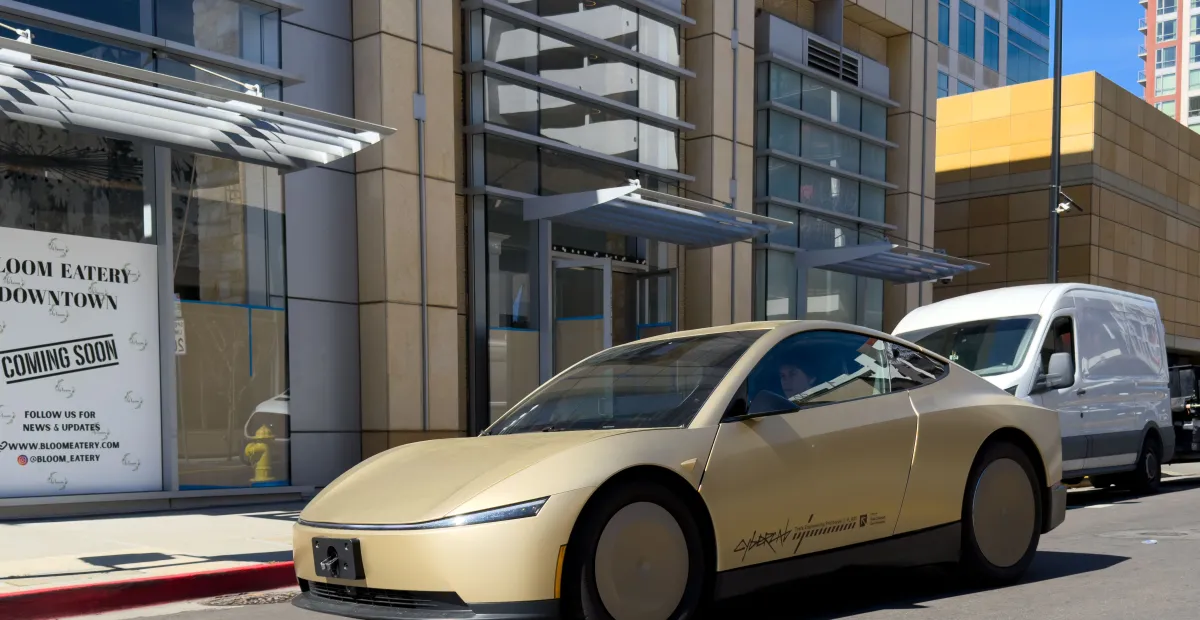
Tesla has launched its Cybercab robotaxi in Austin, Texas, marking a significant step in Elon Musk’s long-promised plan to build a driverless transport network. The two-seat electric vehicle will initially operate within a small-scale service, with no date yet confirmed for customer sales.
The private event was held behind closed doors and was not livestreamed by Tesla. Access was largely given to pro-Tesla influencers, several of whom were required to sign non-disclosure agreements and wait until the event ended before publishing material.
Tesla has been testing the vehicles in Austin and other cities for several months. Records from the Texas Department of Motor Vehicles show that 45 Cybercabs were registered in the state this week, although it is not known how many will immediately be used for paying passengers.
The company has also launched a website setting out the rules for its Robotaxi service. Children under 13 are currently prohibited from travelling in the Cybercab, while videos released by Tesla have demonstrated the car’s interior, crash-testing and accessibility features.
One accessibility video showed a wheelchair user leaving the vehicle and folding his wheelchair for storage himself, rather than demonstrating a fully assisted loading process.
Tesla Cybercab launch increases pressure on autonomous driving plans
The Cybercab is a distinctive two-seater sedan with gullwing-style doors and eight cameras. Unlike conventional cars, it has no steering wheel, pedals or wing mirrors, and Tesla has not fitted it with radar or lidar sensors commonly used by rival autonomous vehicle operators.
Documents submitted to the US Environmental Protection Agency describe a lightweight vehicle powered by a single front-mounted 219-horsepower motor and a 48kWh battery. It has front-wheel drive and a kerb weight of about 3,113lb, making it roughly 700lb lighter than the lightest Model 3 currently available in the US.
Tesla has not said when the Cybercab will be available to buy or how much it will cost. Musk previously suggested that the vehicle could be sold for about $30,000, but the company has yet to confirm either that figure or a production timetable.
An online form now invites businesses to register their interest in purchasing fleets of Cybercabs or developing “mobility hubs and infrastructure” for the service.
The new vehicles join Tesla’s existing robotaxi operation in Texas and Florida, which uses modified Model Y cars. Some journeys are conducted without a human in the vehicle, while others continue to use safety drivers.
Robotaxi Tracker estimates that Tesla now has 256 unsupervised autonomous vehicles operating across six cities. Alphabet’s Waymo, by contrast, operates about 4,000 vehicles in 14 cities, giving it a considerably larger commercial footprint.
Tesla’s approach is being closely watched because the company is relying primarily on cameras and artificial intelligence rather than the broader sensor systems used by competitors. Any expansion will also be subject to local regulations and the ability of the software to manage difficult road layouts, poor markings and changing weather conditions.
Musk has repeatedly predicted that Tesla’s driverless technology was close to widespread deployment. He previously said that half of the US population would have access to Tesla robotaxis by the end of 2025, but the service is currently limited to six cities in Texas and Florida.
Tesla is operating a human-driven ride-hailing service in the San Francisco Bay Area, but has not applied for a California permit to test driverless vehicles, according to the information provided by the company.
The launch also comes amid continuing scrutiny of Tesla’s claims about self-driving technology. The company’s $99-a-month Full Self-Driving package remains a Level 2 driver-assistance system, meaning drivers must keep their hands and attention available at all times.
Tesla faces lawsuits from customers and regulators alleging that it has overstated the capabilities of its systems. The company has also previously acknowledged that hardware in some older vehicles may not be sufficient to support full autonomous driving, despite earlier assurances from Musk that every Tesla produced after 2016 would contain the necessary technology.
Musk said during Tesla’s first-quarter earnings call that unsupervised driving could reach customer vehicles by the end of 2026 “at the earliest”. He warned that complex junctions, unclear road markings and bad weather could delay the rollout.
Investors regard robotaxis as central to Tesla’s future, particularly as its electric vehicle sales face stronger competition, including from Chinese manufacturers. The Cybercab is therefore more than a new model: it is the clearest test yet of whether Musk’s autonomous driving ambitions can become a large-scale commercial business.
