


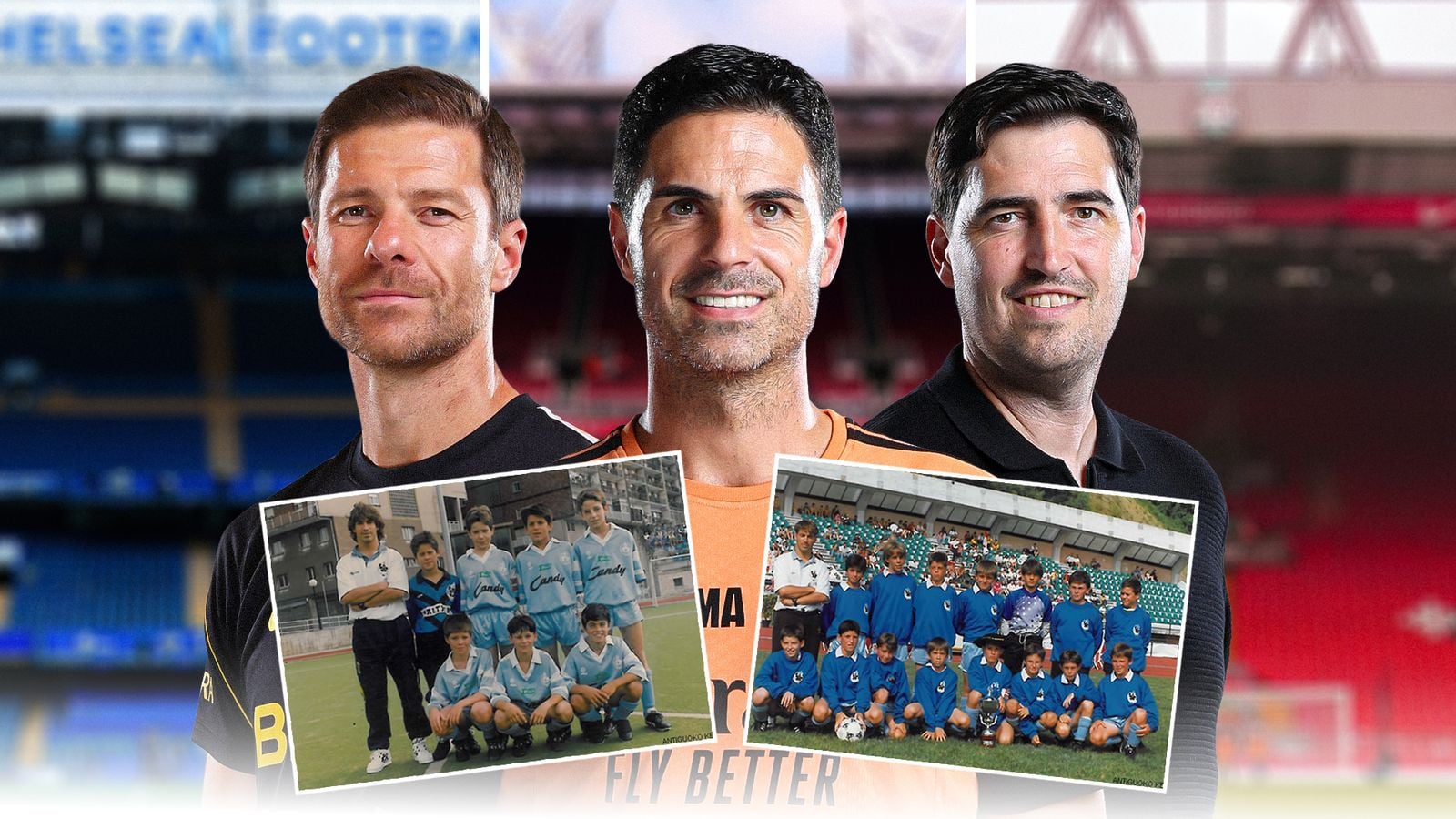
When Arsenal face Chelsea on Sunday, the Premier League meeting will bring together two managers whose footballing education began on the same modest patch of ground in San Sebastián.
Mikel Arteta and Xabi Alonso were team-mates at Antiguoko, the Basque youth club that also helped shape Andoni Iraola. The three men, born within 15 miles of one another and just seven months apart, have since risen to the top of the game as managers.
For those who watched them as children, their journey from a gravel pitch in the Berio district to the dugouts of English football remains difficult to comprehend.
“If I really think about it, it’s absolutely crazy that our three friends are managing these Premier League teams,” said Álvaro Parra, a former Antiguoko player and close friend of Arteta. “Sometimes I turn on the TV and say, ‘Oh, it’s Mikel! Oh, it’s Xabi! What’s happened here?’”
The old pitch has long since disappeared beneath a public park, but Roberto Montiel, Antiguoko’s long-serving coach and vice-president, can still point to where the centre circle once stood.
It was a small, rough surface made of gravel, where wet footballs became heavy and slippery conditions left players covered in mud and scrapes. Yet it was there that a remarkable generation began to develop.
Antiguoko’s teams from the 1981 and 1982 age groups were so dominant that former players still refer to them as the “Basque Dream Team”. They won league after league and regularly overwhelmed established academies, including Real Sociedad and Athletic Club.
“It was like a national team of the best players in the area and it made us an unbeatable team,” said Parra. “We won all the leagues.”
Arteta stood out as a leader
Arteta was regarded as the outstanding talent among the group. Although small, he was technically gifted, quick-thinking and already capable of controlling matches from midfield.
Former team-mate Mikel Yanguas, who played in front of him, recalled that Arteta seemed to anticipate every move. “He was always thinking about his next pass. I just needed to run,” he said.
Montiel remembers one particular moment against Real Sociedad. From a drop ball, Arteta used the outside of his boot to flick the ball away before sending a long pass across the pitch for an unmarked team-mate to score.
His competitive instincts were just as obvious away from football. During a visit to Liverpool when Arteta was playing for Everton, Montiel remembers him sliding along a hallway in celebration after winning a PlayStation match.
“Whatever game you played with him, you would always lose,” said Parra. “If you played PlayStation, you would lose. If you played ping pong, you would lose. He was very, very competitive.”
Arteta left San Sebastián for Barcelona’s La Masia academy at the age of 15. According to Yanguas, his ability to adapt quickly to new surroundings became one of the foundations of his later career in France, Scotland, England and beyond.
Arteta himself has credited Antiguoko with giving him the belief to pursue the game. He has recalled Montiel telling him repeatedly that he would become a professional and one of the country’s best players.
“They really ignited something in me, that belief,” Arteta said. “You need someone like this in life.”
From quiet winger to influential manager
Iraola’s personality was different. While Arteta was the captain who demanded responsibility, Iraola was more reserved, though his talent and competitiveness were unmistakable.
He began as a winger at Antiguoko, where Montiel remembers him beating several opponents before delivering the final pass. When he later joined Athletic Club, manager Ernesto Valverde moved him to full-back — a decision Iraola initially resisted.
It proved transformative. Iraola went on to make 510 appearances for Athletic and became a respected captain before moving into coaching.
His leadership style has remained understated. “He isn’t going to raise his voice above everyone else,” said Iñigo Iraola, his cousin and a coach at Antiguoko. “He’s a quieter, understated kind of leader who has more of an impact through the example he sets his players every day.”
Alonso’s path was less obvious in his early years. He possessed a fine touch and an exceptional range of passing, but initially lacked the physical presence that would later become a feature of his game.
Ignacio Azpilicueta, who played behind him in defence, remembers Alonso developing gradually. “He had a good touch, but physically he wasn’t by any means the biggest or the strongest or the quickest. It took him a while to grow,” he said.
That change came during Alonso’s under-17 season, when his physical development began to match his intelligence and technique. His passing range and ability to strike the ball would later help him win major honours as a player.
“At that age, you could see he was going to be a first division player,” said Parra. “Maybe not that he was going to win the Champions League, but you could see he was going to be a top-level player.”
Antiguoko continues to produce elite footballers. More than 40 graduates have gone on to play in Spain’s top division, while the club’s more recent products include Martin Zubimendi and Iñigo Pérez.
Montiel believes the explanation lies in a combination of careful scouting and a stable coaching structure, but insists the club’s core principles have remained unchanged.
“We’ve never changed the DNA of Antiguoko,” he said. “Competitive instinct, intensity and sporting discipline are non-negotiable.”
Those qualities are evident in Arteta, Alonso and Iraola, both in their playing careers and in the way they now manage. Antiguoko’s general director, Gorka Azpeitia, believes their achievements should be judged not only by trophies and results but also by the people they have become.
At the club’s offices, signed shirts belonging to the three former team-mates occupy a prominent place on the walls. When Arsenal and Chelsea meet in north London, Antiguoko will be watching with a divided loyalty.
“That’s like choosing between Mum and Dad,” Azpeitia said. “A draw would be perfect.”
