


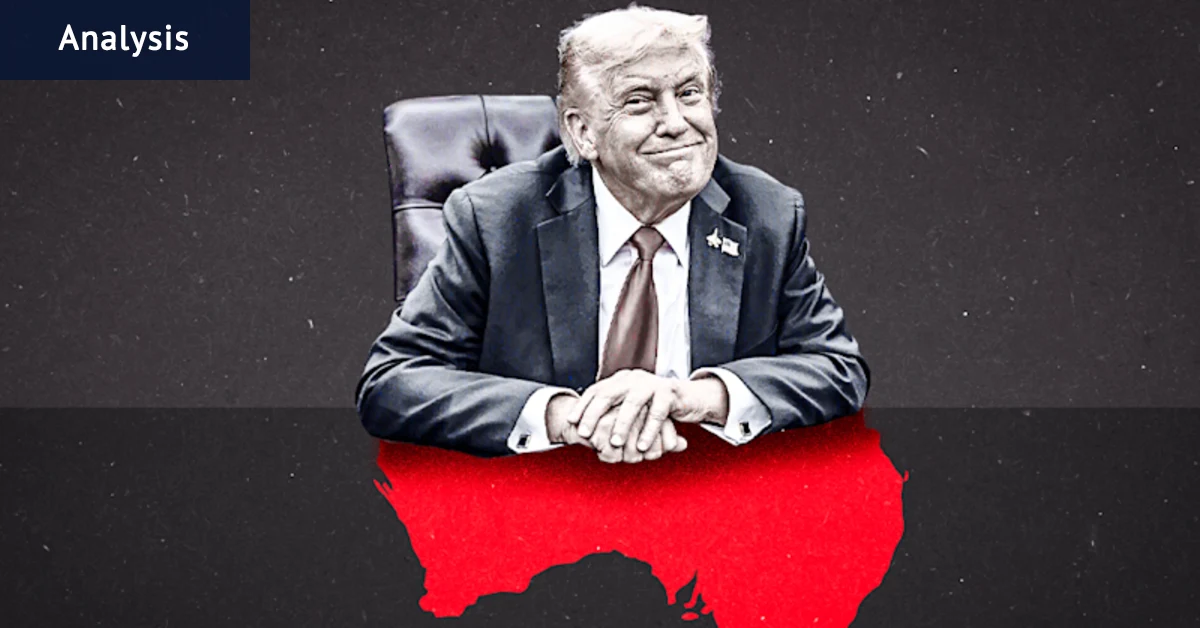
A senior Trump administration official has expressed confidence that Australia would join the United States in a conflict with China, saying Canberra’s past military alliances indicated it would be willing to “join in a good fight”.
Adam Korzeniewski, the US State Department’s AUKUS liaison officer, made the remarks at a security and defence forum in Honolulu in May. His comments offer a rare insight into why Donald Trump strongly supports the agreement between Australia, the US and Britain.
“Australia joined us in the Vietnam War,” Korzeniewski told the audience. “I’m not really that concerned about Australia’s willingness to join in a good fight if one comes up.”
His comments come as AUKUS marks its fifth anniversary and as the three governments continue to advance plans for Australia to acquire nuclear-powered submarines.
Korzeniewski said AUKUS was not simply a single defence deal but “a mentality” that could be applied to other partnerships. He described the agreement as “the spearhead” and “the future model of interoperability between different allies”.
“If we can’t figure this out with Australia and the UK, then what are we doing?” he said.
He also said Mr Trump believed AUKUS was “completely in line with his national security strategy”. The strategy, rewritten in November 2025, calls for a US military capable of deterring aggression along the First Island Chain around China, while requiring allies to spend more on collective defence, provide greater access to military facilities and develop capabilities that strengthen deterrence.
Korzeniewski, who took up his current post in February, is a political appointee whose role is to bridge the US bureaucracy and the Trump administration. He previously served as White House liaison during the dismantling of USAID.
Australia has made no commitment to enter a conflict
The Australian Government has stressed that it has made no promise to take part in a future war. Pat Conroy, the Defence Industry Minister, said in July that any decision to enter a conflict would belong to “a future sovereign elected government”.
“We’ve given no commitment publicly or privately,” Mr Conroy said.
Korzeniewski’s comments are likely to reinforce criticism from Australian opponents of AUKUS, who argue that the pact could give the United States a strategic foothold in the country. Concerns have also been raised over the possible long-term presence of US submarines at HMAS Stirling near Perth.
Australian, American and British officials maintain that their strategic interests are aligned. AUKUS has survived a change of government in each of the three countries since it was announced in September 2021.
Polling by the United States Studies Centre in May found that more Australians supported acquiring nuclear-powered submarines than opposed it, and that more believed AUKUS would make Asia safer than not. However, about 45 per cent said the Government had not adequately explained the need for the agreement, while one in five wanted it cancelled.
Greg Wilcock, Australia’s consul-general in Hawaii, said the best way to address public doubts would be to demonstrate practical results. He rejected the suggestion that AUKUS undermined Australian sovereignty, saying Canberra would retain control over how its territory and sovereign assets were used.
The most significant obstacles may be industrial rather than political. US production of Virginia-class submarines has remained at about 1.1 to 1.2 boats a year, below the 2.33-a-year rate required to meet AUKUS commitments.
Britain’s nuclear submarine programme is also facing serious pressure, with a former Ministry of Defence nuclear policy director describing its condition as “parlous”.
Five years after AUKUS was announced, the three countries have made legal changes to enable the sharing of sensitive technology and Australia is investing heavily in shipyard infrastructure. But the programme is still struggling to deliver the industrial capacity and public confidence needed to match the political rhetoric.
