


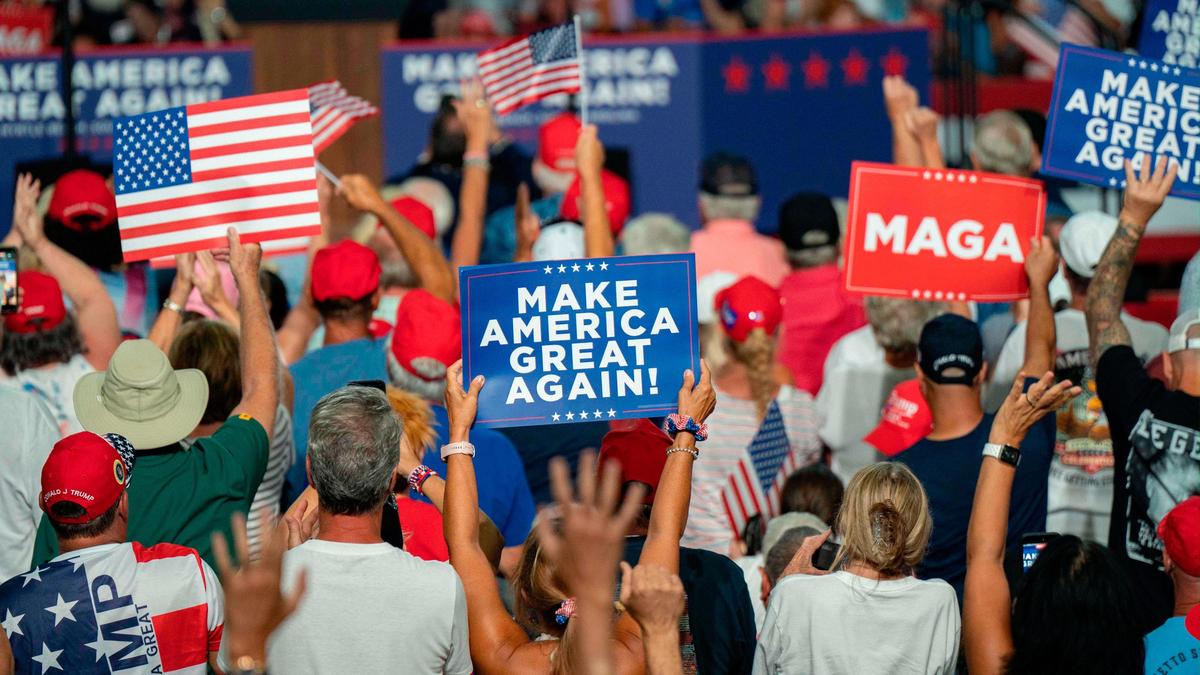
Political hostility fuelled by Donald Trump’s MAGA movement and amplified through social media has raised fresh questions about the standards of public life, after a campaign advertisement in Ohio exploited allegations that a Democratic candidate was abused as a child.
Vivek Ramaswamy, the Republican candidate for governor of Ohio, released an advertisement featuring the mother of his Democratic rival, Amy Acton, and accusing her daughter of being a liar.
Acton and her brother were removed from their mother’s custody when she was 12, after their stepfather, Cledith Arthur, was charged with raping her. He was indicted by a grand jury, fled the state and died in 2004 without facing prosecution.
Acton has described the use of her mother in the advertisement as “despicable” and “exploitative”. Ramaswamy, rather than withdrawing it, claimed ownership of the campaign and said he would spend four million US dollars airing it.
His intervention was endorsed by Vice-President JD Vance, who said Ramaswamy had “the audacity to run a TV commercial which calls it out like it is and calls Amy Acton a liar”. Mr Trump also encouraged him to “ride with it”.
“I don’t care,” Mr Trump told reporters when asked about the advert. “If it were my mother speaking badly about me, you’d be making it the number one story on the news.”
He said the issue was not about Acton’s stepfather, but about her mother calling her daughter a liar. Acton’s history, however, is inseparable from the allegations that led to her and her brother being taken from their mother’s care.
Chris Christie, the former Republican governor of New Jersey, said the episode revealed “the rotten moral core that Donald Trump has created for my party”. He accused Mr Vance and Mr Ramaswamy of showing voters that they wanted to be “just as morally bankrupt as Trump”.
Doug Sosnik, who advised former US president Bill Clinton, said the long-term political consequence could be Republicans having to defend an advertisement that sought electoral advantage from the rape of an underage girl.
Trump faces judgement over political hostility
The controversy comes as Americans prepare to judge Mr Trump’s second term in the midterm elections. Polling cited in the campaign suggests Democrats are increasingly confident of taking control of the House of Representatives and possibly the Senate.
The cost of living remains the central issue, with fuel prices described as having risen to levels last seen during the pandemic. A Reuters/Ipsos poll put Mr Trump’s approval rating at 31 per cent, while 66 per cent disapproved of his performance.
Although Mr Trump insists he is not on the ballot, he has campaigned energetically for MAGA supporters and appeared at rallies in swing states on behalf of key candidates. A poor result for Republicans would nevertheless expose the political cost of his methods.
Critics argue that the Ohio advertisement represents the culmination of a style of politics that began with insults such as “Crooked Hillary” and conspiracy theories questioning Barack Obama’s citizenship. Repeated shocks, they say, have made the public less sensitive to the erosion of standards in campaigning.
The warning extends beyond the United States. Political violence and threats have become a persistent feature of American public life, while the attack on Australian MP Helen Haines has prompted renewed scrutiny of the relationship between online rhetoric and threats against politicians.
One Nation leader Pauline Hanson acknowledged an error after publishing a cartoon mocking independent senator Jacqui Lambie over a health condition. She initially told Senator Lambie to “lighten up”, before saying the cartoon was inappropriate and would be removed.
Ms Hanson had also faced criticism over a cartoon describing former SAS captain and Liberal MP Andrew Hastie as a traitor. Other cartoons depicted former Victorian premier Dan Andrews being run over and independent senator Lidia Thorpe under the wheels of a vehicle.
Australian Federal Police Commissioner Krissy Barrett has said the force monitors a direct relationship between such cartoons and an increase in threats made against politicians.
Ms Hanson rejected any connection between her cartoons and the attack on Helen Haines, saying: “They will not be going anywhere.” She accused her critics of trying to censor her.
Labor cabinet minister Clare O’Neill also deleted a post in which she said she was ready to “smash some Liberals” after having “smashed” a Pilates class. She removed it after an outcry.
The disputes have intensified debate over where political satire ends and material capable of encouraging threats begins. In an increasingly connected environment, online radicalisation can happen rapidly, making the potential effect on disaffected or unstable individuals difficult to predict.
The question now facing politicians in both countries is whether personal attacks and imagery depicting harm will remain an effective electoral tool, or whether voters will regard them as evidence that political debate has abandoned basic standards.
