


Donald Trump has promised a $5,000 “dividend” to every adult American if Republicans retain control of both chambers of Congress in the November midterm elections.
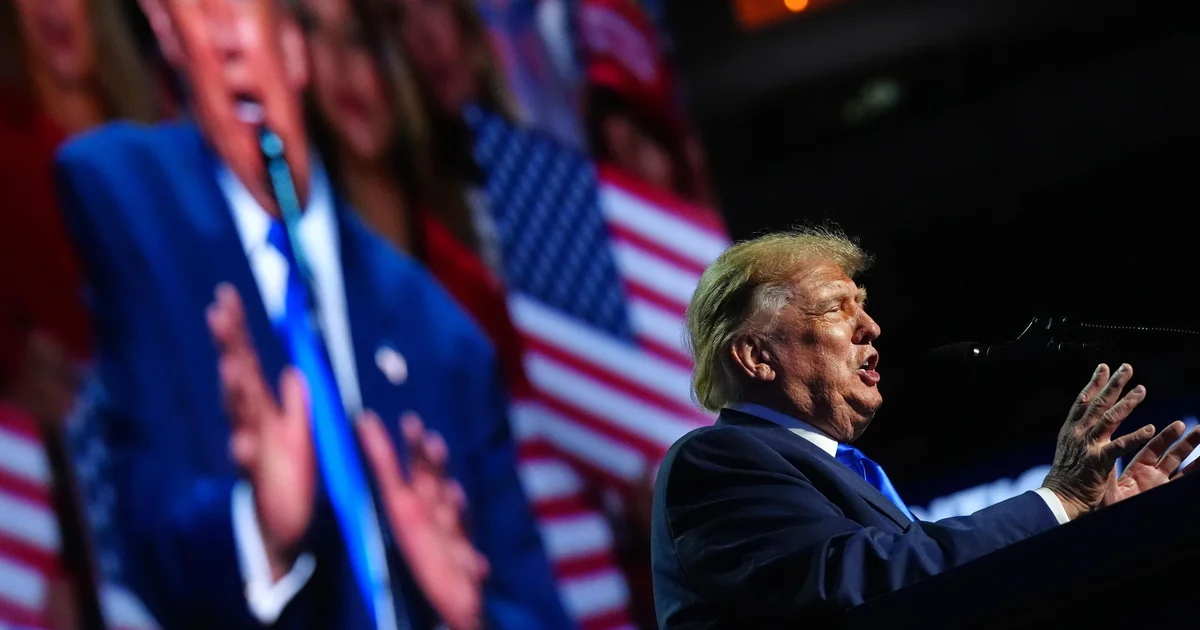
The pledge was made on Wednesday, September 9, during the Republican National Committee’s first midterm convention in Dallas, Texas, where the president urged voters to treat the election as a referendum on his administration.
“If the Republicans win, you win with us and you get $5,000,” Mr Trump told the convention. He said the payment would be known as the “Trump Dividend” and claimed it would be supported by America’s “tremendous strength and success economically”.
He gave no details about when the money would be paid, who would administer it or whether it would arrive as a cheque. Mr Trump did say the funds would have to be spent in the United States.
The promise faces significant political and financial obstacles. About 245 million US citizens aged 18 or over would qualify under the population figures cited by the Census Bureau, putting the potential cost of the scheme at more than $1.2 trillion.
Trump dividend would require congressional approval
A payment on that scale would require action by Congress. Although Republicans currently control the House of Representatives and the Senate, senior party figures have not publicly embraced a proposal that would add substantially to the national debt.
The president’s pledge also depends on Republicans holding both chambers after the November 3 election. Democrats would be unlikely to approve such a plan if they won control of either the House or the Senate.
Marc Goldwein, senior policy director at the Committee for a Responsible Federal Budget, told the Associated Press that Mr Trump had no authority to send the money without congressional approval. He also said the United States was running annual deficits of about $2 trillion and had accumulated debt of roughly $40 trillion.
“We don’t have surpluses to give away,” Mr Goldwein said.
Vice-President JD Vance appeared to qualify the president’s promise shortly afterwards, suggesting that wealthy Americans might not receive the payment. He said the money could be funded from tariff revenue and described the proposal as a dividend for American workers.
However, the sums collected from tariffs fall well short of what would be needed. The Bipartisan Policy Center says the US has collected nearly $500 billion in tariff and excise-tax revenue since the beginning of last year, while more than $100 billion has been refunded following a Supreme Court ruling that struck down many of the administration’s tariffs.
The centre’s analysis also shows that tariff refunds have significantly reduced the revenue available to the government. A $5,000 payment to every adult citizen would therefore require substantial borrowing or another source of funding.
Earlier cash promises have not materialised
The announcement is not the first time Mr Trump has proposed distributing money directly to Americans. During his second term, he backed the idea of “DOGE dividends”, under which a share of savings from Elon Musk’s government-cutting programme would have been returned to the public.
Mr Trump said last year that 20 per cent of the savings could go to citizens, with another 20 per cent used to reduce government debt. The savings ultimately fell far below the levels needed to support such payments and no DOGE cheques were issued.
He also promised a tariff-funded dividend of at least $2,000 for most Americans. That money has not been paid directly to taxpayers. Companies have received refunds after legal challenges to the tariffs, but they are not required to pass the money on to consumers.
The administration has previously overseen broad payments to households during the Covid-19 crisis, while Trump Accounts for children born during his current term have been authorised by Congress. Those measures, however, do not provide a precedent for an unconditional $5,000 payment to every adult citizen.
Republican Senator Bernie Moreno of Ohio said he would prepare legislation for the dividend after the election if the party retained control of Congress. But without a bill, an agreed funding mechanism and support from lawmakers, Mr Trump’s latest promise remains a campaign pledge rather than an approved government programme.
