


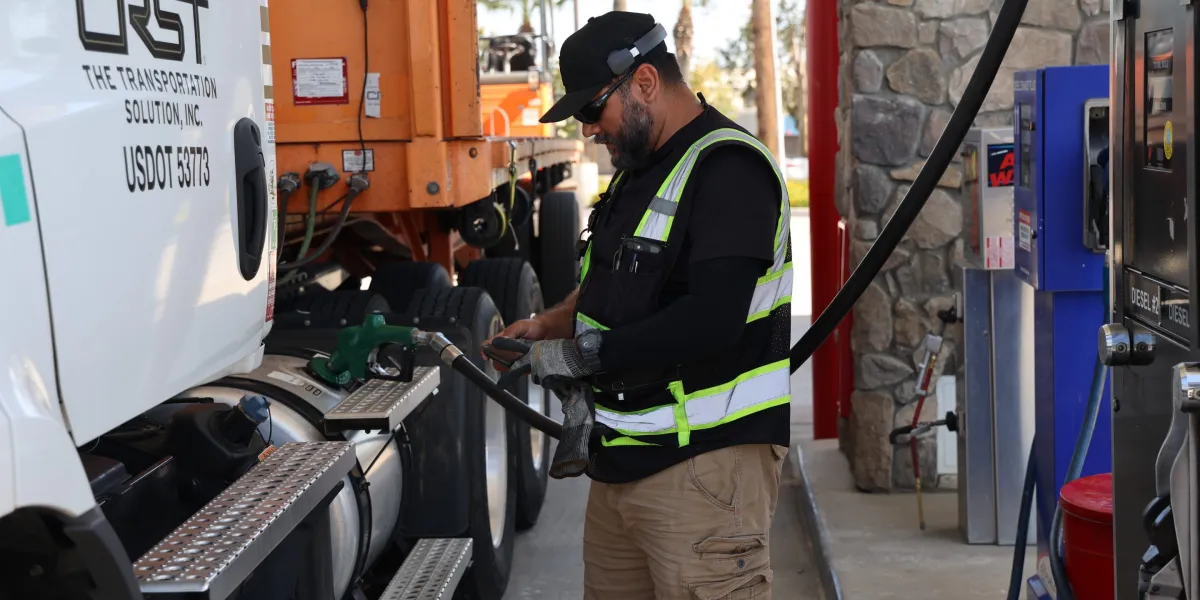
The Trump administration’s red-dyed diesel tax deferral is being criticised by energy analysts and trucking groups as a political gesture rather than a meaningful answer to diesel prices above $6 a gallon during the Iran war.
President Donald Trump signed an executive order deferring taxes on the fuel until the end of the year. Red-dyed diesel is generally used by farmers and truckers, but is exempt from highway fuel taxes and cannot legally be used on public roads.
The fuel’s distinctive dye allows inspectors to identify vehicles suspected of avoiding road-fuel taxes. The measure temporarily removes a 24.4-cent-per-gallon charge, theoretically expanding the supply available to truckers.
But industry representatives say the move is unlikely to deliver significant savings. A joint statement from the Society of Independent Gasoline Marketers of America and the National Association of Truck Stop Owners warned that the tax had been deferred rather than cancelled.
“First, the tax is still owed, so there’s limited upside,” the organisations said in a statement to their members, adding that they did not expect most reputable diesel retailers and fuel marketers to take up the arrangement.
Patrick De Haan, head of petroleum analysis at GasBuddy, said the policy appeared designed to avoid the need for congressional approval while giving the impression that the White House was responding to rising fuel costs.
“This dyed diesel waiver—it doesn’t add supply globally. It doesn’t improve the reasons that have led to high prices,” Mr De Haan said. “It would be more akin to lipstick on a pig.”
The administration’s action comes as Mr Trump’s approval rating has fallen and voters have identified the cost of living as their leading concern, according to a Reuters/Ipsos poll cited in the source material. The president has also proposed suspending the federal petrol tax ahead of the midterm elections, although that would require congressional approval.
The White House said the executive action would “quickly cut diesel costs and put money directly back into the pockets of American truckers”. Spokesperson Taylor Rogers said it would save them more than $100 per fuel refill.
Uncertainty over deferred diesel taxes
David Russell, global head of market strategy at TradeStation Group, said the arrangement could leave truckers and fuel retailers uncertain about who would ultimately be liable for the tax.
“You have an unusual situation where they’re basically saying, ‘We’re going to try to not enforce a tax for a period of time, and we’re going to hope that Congress later blesses that action,’” Mr Russell said.
“And if not, then we might be on the hook, or we might create a situation where gas stations need to pay that tax back to the government later. So it creates a lot of uncertainty.”
Mr Trump has asked the Treasury to explore ways to eliminate the deferred tax, but the department has not provided guidance, according to the source material.
Mr De Haan also questioned how widely the policy could be used. Red-dyed diesel accounts for about 30% of the fuel used by commercial vehicles and is not commonly available at truck stops, although the White House said more than 4,000 US retailers distribute it.
“It’s rarely a truck stop fuel,” Mr De Haan said. “Even if you wanted to find this, it may be kind of like a diamond in the rough to find.”
Geopolitical pressures behind fuel prices
Analysts said a lasting improvement in US fuel prices would depend on wider changes in supply and demand, including the easing of conflicts in Iran and Ukraine.
Mr Russell said a reduction in Middle East tensions could ease bottlenecks. Alongside limited disruption to domestic oil production during the hurricane season so far, that could allow diesel prices to fall through normal market and seasonal movements.
Mr De Haan warned, however, that prices could rise again if Ukraine launched another attack on Russian oil refineries. He said the strongest way for the president to increase global oil supply would be to fulfil his pledge to end the war in Ukraine.
“Aside from solving the underlying geopolitical issues, I don’t know that there’s a great, quick win here,” Mr De Haan said. “The president is scrambling ahead of the midterms to do something, but I just don’t know that this is really a needle mover in my mind.”
