


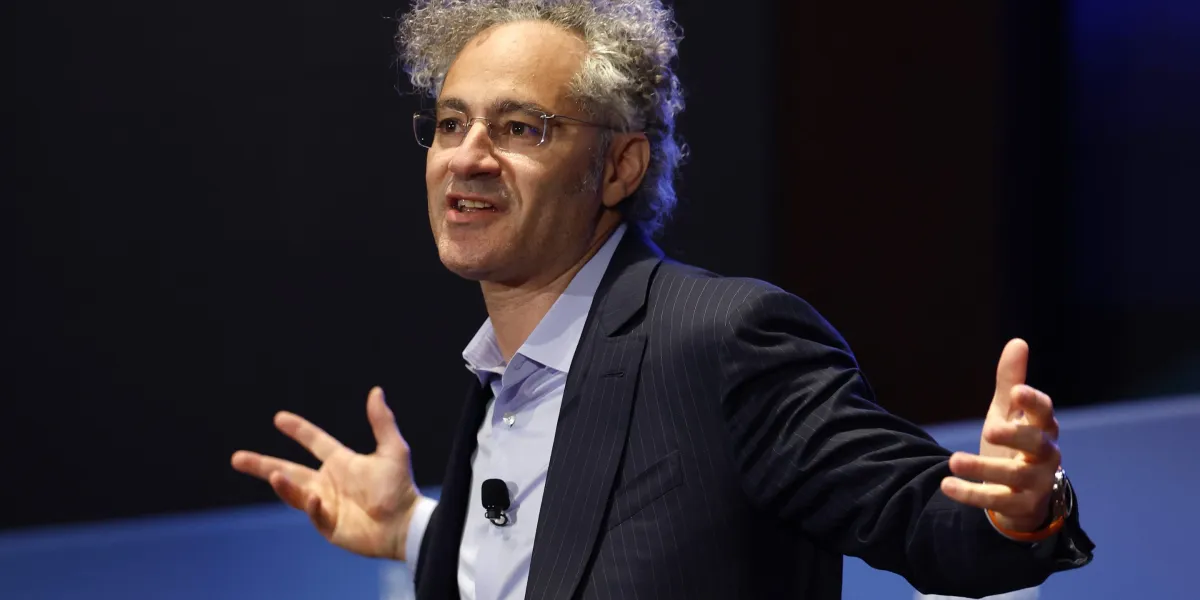
Palantir chief executive Alex Karp has revealed that one of his senior executives told him to stop repeatedly promoting the potential of the company’s Foundry platform, warning that employees found the claims depressing and out of touch.
Karp said Ted Mabrey, who now runs Palantir’s commercial business, told him: “Please stop talking to Palantirians about how big Foundry is going to be. It’s depressing, and everybody knows you’re out of touch.”
He was speaking to Zeta Global chief executive David Steinberg at Zeta Live ’26, the company’s annual marketing conference. Karp said his constant enthusiasm for Foundry had begun to come across as overly aggressive to staff who heard him discuss the platform’s prospects repeatedly.
“I had stopped talking to people for like six months,” Karp said, although he suggested the pause did not last. He said his approach to decision-making often put him at odds with colleagues’ expectations about what could be achieved.
“I have an esthetic idea of what could work and what won’t work,” Karp said. “About once a month, I have some idea that I think is important, and then I know it’s important. Everyone tells me we can never do that.”
Palantir’s Foundry growth
Foundry brings a company’s data together and controls who can access it. The platform is now central to Palantir’s fastest-growing business, with US commercial revenue rising 149 per cent year on year to 764 million dollars in the second quarter.
Palantir subsequently raised its full-year US commercial revenue forecast to more than 3.4 billion dollars, representing growth of at least 134 per cent. After those results, Karp told investors that “for the first time people believe us”.
Zeta is among the businesses building on Foundry. The companies announced in June that Zeta’s Data Cloud would be rebuilt on the platform, in a seven-year partnership that Steinberg said would generate more than 100 million dollars a year in sales within roughly the next year.
Karp said he depended on long-standing colleagues to challenge him, describing those relationships as “very harsh”. “In fact, I often tell them, ‘Can you tell me something I want to hear, please?’” he said.
Investors questioned Palantir’s model
During the discussion, Karp also described the difficulty Palantir faced raising money in its early years. He said investors struggled to understand a company that refused to build software in the way they expected.
“Normal software is built to force you to adopt something that’s parasitic,” he said. Karp argued that investors wanted businesses to make customers dependent on their products, allowing the underlying technology to be turned into a commodity and sold elsewhere.
He said venture capital investors had wanted to hear that clients would be unhappy but unable to leave. “‘Sticky’ is a metaphor for parasitic,” Karp said.
Palantir was also questioned over its work with special operators and its practice of sending engineers to work directly inside client organisations. The company calls the latter model forward-deployed engineering.
Steinberg said Zeta had copied the approach after seeing how efficiently it worked. “We pivoted a huge part of our business to follow you guys on this because it’s so freaking efficient,” he said.
Karp said Palantir now had about 4,500 employees but remained “not everyone’s cup of tea”. He added that some former staff had later sought to return after leaving following “another crazy lecture from Karp”.
Warning over weak AI performance
Karp told the conference that the cost of poor technology execution had changed as businesses increasingly relied on AI applications. In the past, he said, a second-rate software rollout might cost a company time and money without threatening its survival.
Using defence as an example, he said a German government might buy a German missile “even if it’s B minus because it flies and it’s German”. But a missile that could not hit its targets against Russian weapons would no longer be adequate, he argued, with its performance now dependent on an AI application layer.
“Your B-minus missile is a triple-plus with this, and your A-plus missile is useless,” Karp said. “So that’s just binary.”
His advice to chief executives was to identify what made their businesses distinctive, establish visibility from the factory floor through to the cost of goods, and use AI to strengthen that advantage without allowing a rival or another company to learn how it operated.
“If your person down the street gets it right, even if they’re inferior to you, just like the missile, they will outperform you,” Karp said.
