


US companies are being squeezed by tariffs, soaring fuel costs and higher interest rates, forcing businesses to raise prices, cut operations and carry more stock to protect themselves against further disruption.
The pressure is particularly acute for manufacturers, transport firms and retailers, where more expensive raw materials and energy are colliding with rising borrowing costs. Smaller businesses are often most exposed because they depend more heavily on short-term finance.
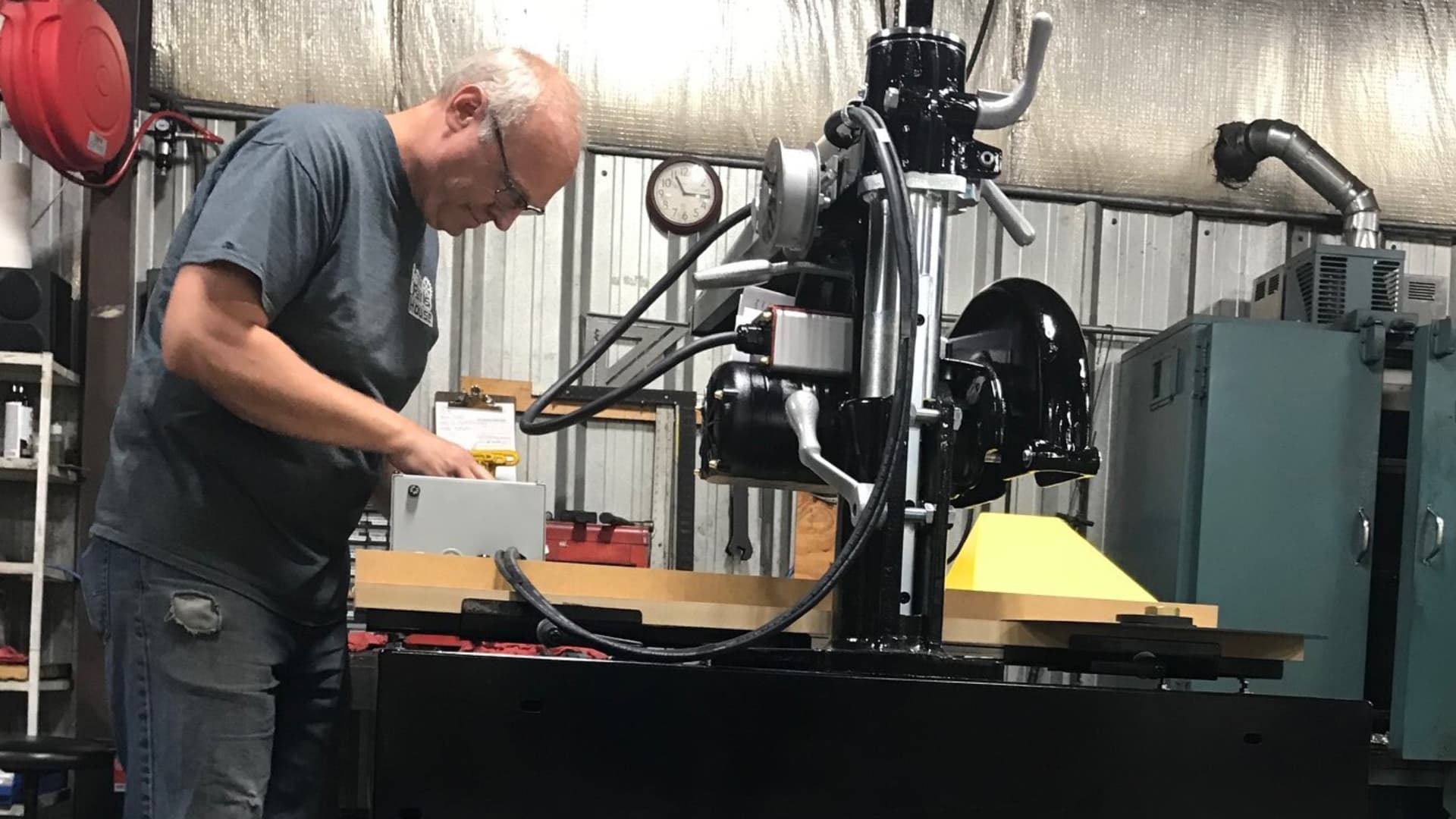
Allen Eden, who runs the 25-person Original Saw Co in Britt, Iowa, has been building up inventory as the price of aluminium, steel and essential components rises. A small bracket used in the company’s saw motors more than doubled in price this summer, from $42 to $87.
“It’s awful,” Mr Eden said. “[I’m] just trying to keep more of the stuff around because I don’t know if we can get it down the road.”
The company sells industrial saws to major retailers including Home Depot as well as to small and medium-sized manufacturers. Mr Eden said price rises for its products now appeared unavoidable.
Gregory Daco, chief economist at EY-Parthenon, said businesses with substantial exposure to both fuel prices and interest rates were “first in the line of fire”. Manufacturing, he added, was especially vulnerable to higher fuel costs.
The Federal Reserve has raised interest rates for the first time in three years and indicated that another increase could follow this year. That has made it more expensive for companies to finance stock and equipment, just as diesel prices have pushed up the cost of transporting goods.
Dubravko Lakos-Bujas, global strategy head at JPMorgan Chase, said smaller companies were likely to feel rate rises more quickly because they generally relied on shorter-term borrowing. Capital-intensive businesses, including manufacturers, equipment suppliers, trucking fleets and commercial property firms, were also particularly exposed.
Supply chain disruption hits US manufacturers
The strain has spread through the domestic automotive supply chain. Lucerne International, a privately owned car-parts manufacturer near Detroit, halted its US manufacturing operations and abandoned plans for a $50 million aluminium forging plant in Michigan.
Mary Buchzeiger, the company’s chief executive, said the latest tariffs had created gaps in global supply chains and pushed up the cost of raw materials and finished components. Lucerne continues to manufacture overseas but has shifted its US operations towards warehousing, distribution and tariff-mitigation services for other companies.
“There’s no doubt that there’s margin pressure for suppliers,” said Paul McCarthy, chief executive of vehicle supplier trade association MEMA. “Some of it, we try to absorb … and then some of it does have to be passed on.”
Profit growth among the 100 largest automotive suppliers fell to 4.2% last year, down from more than 6% in 2021, according to Berylls by AlixPartners. Among the ten largest carmakers, growth declined to 5.2% from nearly 8% in 2022.
Spanish parts maker Grupo Antolin, which supplies Ford, GM, Volkswagen and Stellantis, filed for Chapter 15 bankruptcy protection in the US in July. It cited tariffs, higher raw-material and energy costs, and supply-chain disruption in its restructuring.
Mark Costa, chief executive of Eastman Chemical, said the combination of inflation and interest rates had left companies with little room to absorb higher costs. “Everyone is very quickly raising prices faster than I’ve ever seen in 20 years,” he said.
Home Depot’s chief financial officer, Richard McPhail, said higher energy and raw-material costs would completely offset the benefit of $730 million in tariff refunds. “There’s just so much uncertainty right now,” he said, referring to inflation, interest rates and fuel prices.
The impact is not uniform across corporate America. Large technology and finance companies typically have greater cash reserves and rely more on long-term debt, leaving them better insulated from higher rates than smaller firms.
For many businesses, the decisive issue is whether they can pass higher costs on to customers without damaging demand. Airlines have raised fares while reducing less profitable services as fuel costs climb. Ticket prices were more than 23% higher in August than a year earlier, while Spirit Airlines collapsed this year.
United’s chief financial officer, Mike Leskinen, said customers had remained resilient, but warned that some routes no longer made sense when fuel prices were higher. “So we cut them,” he said.
Corporate profit margins remain close to historic highs, supported by productivity gains, controlled labour costs and investment in artificial intelligence. But EY-Parthenon’s Mr Daco warned that higher rates could slow the economy without directly addressing the pressures created by the Iran war, tariffs and the rising cost of building data centres.
“The economy is resilient, but it’s exposed to growing pockets of risk,” he said. “A shock could materialize faster than we all think.”
