


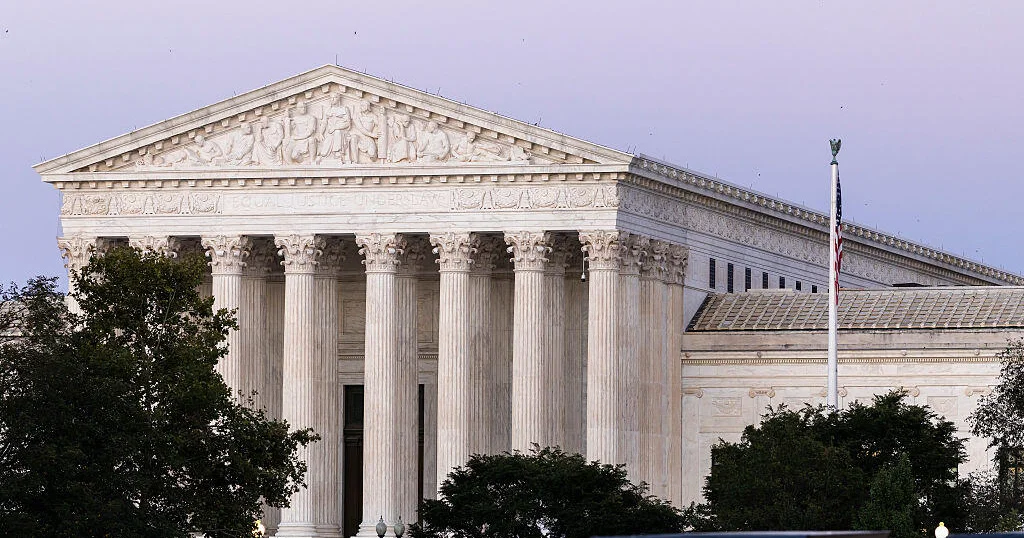
The US Supreme Court has sided with the Trump administration in its attempt to use a federal database to examine state voter rolls for possible non-citizens, temporarily lifting a lower-court order that blocked the system.
In a 6-3 unsigned decision, the justices granted the Justice Department’s request to suspend a ruling by US District Judge Sparkle Sooknanan in Washington DC. Her order had stopped the Department of Homeland Security from using the expanded Systematic Alien Verification for Entitlements (SAVE) database to help states verify voters’ citizenship and immigration status.
The Supreme Court said claims by voting rights organisations that the revised system was unlawful “likely lack merit” and indicated that it was likely to overturn the district court’s decision.
It said the federal government had an obligation under immigration law to respond to requests from state and local election officials seeking to verify voters’ citizenship. The lower court’s order, the justices said, prevented the government from using the programme it considered best suited to that task.
The ruling is unlikely to have a major effect on the forthcoming midterm elections. Federal law prevents states from systematically removing ineligible voters from their registration lists within 90 days of an election, and the November 3 poll is less than 40 days away.
Justices Sonia Sotomayor, Elena Kagan and Ketanji Brown Jackson dissented. Justice Jackson wrote that states could still use the revised database for individual voter-roll checks, and argued that the risk of disenfranchising even a small number of eligible voters outweighed any harm to the government from being prevented from using the system.
“[T]he harm caused by burdening or disenfranchising even a few lawful voters outweighs the nonexistent harm that the Government experiences when it is prevented from taking an action that it likely lacks the authority to take,” she wrote.
The SAVE system forms part of Donald Trump’s wider effort to find evidence of widespread non-citizen voting in federal elections, an occurrence that the source material says has largely been debunked and shown to be very rare.
Voting rights groups challenging the database say it contains inaccurate citizenship information and has led to some American citizens having their registrations wrongly cancelled. The coalition of plaintiffs described the Supreme Court’s decision as “profoundly disappointing”, warning that it could leave millions at risk of being unlawfully targeted.
“However, this case is not over,” the groups said, adding that they would continue seeking to protect voting and privacy rights while defending the district court’s ruling.
The expanded SAVE database
The database was overhauled after an executive order signed by Mr Trump in March last year called for a new proof-of-citizenship requirement for people registering to vote. Federal judges have since blocked the citizenship-related rules.
The changes expanded SAVE, previously used by states to check eligibility for some public benefits and licences. The revised system included records of natural-born citizens, Social Security Administration data including Social Security numbers, and bulk searches by organisations using the database.
The League of Women Voters, the Electronic Privacy Information Center and five individuals sued the Department of Homeland Security, the Social Security Administration and the Justice Department. They argued that combining sensitive records from several agencies was unlawful and that citizens wrongly identified as non-citizens had been removed from voter rolls.
In June, Judge Sooknanan said the administration had “haphazardly combined and repurposed the private information of millions of Americans” and used citizenship data it knew to be unreliable. She ruled that the revised system and related notices were contrary to law, beyond the administration’s statutory authority and introduced without the procedures required by law.
The Department of Homeland Security welcomed the Supreme Court decision as a “victory for election integrity”. Its general counsel, James Percival, said: “It’s remarkable that we had to file an emergency petition in the Supreme Court just so we can use government data to stop noncitizens from voting illegally.”
The administration had argued that SAVE did not disqualify voters, but merely told states whether the federal government could confirm their citizenship. The plaintiffs countered that Congress had not authorised the creation of a master federal database of American citizens and accused the government of creating an error-prone system that endangered privacy and voting rights.
