


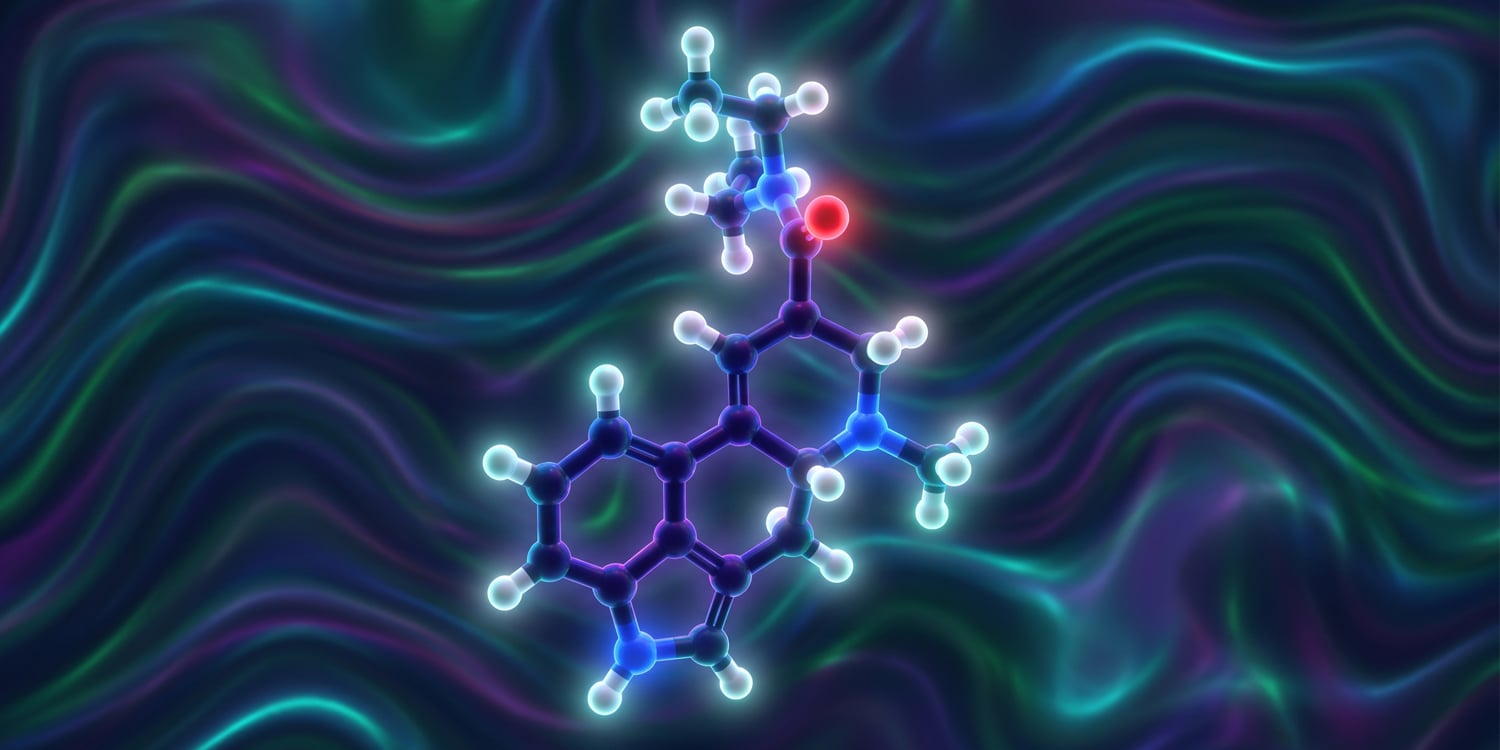
A team of researchers has deconstructed the chemical architecture of LSD to identify which parts drive hallucinations and which might underpin future therapies. By applying function-oriented synthesis, they produced nine simplified analogues and tested them in cells and mice, isolating a minimal two-ring core that appears to trigger the head-twitch response associated with psychedelic effects, while other configurations show antipsychotic potential. The study, published in the Proceedings of the National Academy of Sciences, is led by Andrian G. Basargin with senior author David E. Olson of the Institute for Psychedelics and Neurotherapeutics at the University of California, Davis.
LSD’s effects are mediated largely through the brain’s serotonin system, with the 5-HT2A receptor recognised as the principal driver of hallucinogenic experiences and also linked to neuroplasticity. The drug interacts with a broader set of targets; for example, stimulating 5-HT2B receptors has been associated with risks to heart valves, while activity at 5-HT2C receptors is connected to antipsychotic and anti-addictive properties.
To pursue safer psychedelic-derived medicines, researchers aim to modify LSD so it no longer activates 5-HT2B or induces hallucinations, while preserving beneficial receptor interactions. In the lab, the team first assessed how each simplified molecule bound to and activated various human serotonin receptors before testing them in mice to track the head-twitch response and in open-field tests following amphetamine administration.
The researchers’ experiments revealed that the complete four-ring LSD skeleton is necessary for maximal activation of the 5-HT2A receptor, and every pared-down analogue showed weaker receptor engagement than the original molecule. They also pinpointed the two-ring combination corresponding to the original LSD’s “A” and “D” rings as the bare minimum required to elicit the characteristic head-twitch response in mice. “If you delete certain structural elements of LSD, you can still produce psychedelic effects,” Olson explained. “This is analogous to determining that you can remove the roof of a car, windshield, doors, etc. and it can still drive.”
When the D ring was removed, the resulting three-ring compound, named UCD0094, exhibited markedly reduced activation of both the hallucinogenic 5-HT2A receptor and the heart-risk 5-HT2B receptor, while retaining strong activation of the 5-HT2C receptor, a target associated with antipsychotic properties. The authors suggest UCD0094 could be a strong candidate for developing drugs that promote brain plasticity without causing hallucinations.
A two-ring compound, UCD0076, showed almost no activity at the hallucinogenic 5-HT2A receptor but strong activation of 5-HT2C. In mice, UCD0076 did not induce head-twitches and, at high doses, pretreatment prevented head twitches when subsequently given a known hallucinogen. In open-field tests, it also reduced amphetamine-induced hyperactivity in a dose-dependent manner, suggesting that selective 5-HT2C targeting can dampen psychosis-like behaviours.
However, not all in vitro findings translated perfectly to live animals. For instance, UCD0179 was a potent activator of 5-HT2A in cell cultures but failed to trigger head-twitch responses in mice. “We were surprised that UCD0179 did not produce hallucinogenic effects in vivo given its in vitro profile,” Olson said. “This really speaks to the importance of a drug reaching its target in sufficiently high concentrations.”
The researchers caution that many compounds were tested as racemic mixtures, meaning the molecules contained two mirror-image forms that can interact differently with brain receptors. Because mice are not humans and the head-twitch response is only a proxy for human experiences, results may differ in people. They also note that LSD interacts with a range of targets beyond 5-HT receptors, including dopamine and adrenergic systems, and further work will examine these interactions to assess safety and potential side effects.
Olson stated that the long-term goal is to use these insights to develop better medicines for treating neuropsychiatric and neurodegenerative conditions. “Our long-term goals are to use this information to develop better medicines for treating neuropsychiatric and neurodegenerative conditions,” he concluded.
The study, titled Deconstruction of lysergic acid diethylamide, was led by Basargin with a team of collaborators and published in PNAS. The research is associated with the Olson Lab at the University of California, Davis, and marks a concerted step in exploring how to separate the therapeutic potential of psychedelics from their hallucinogenic effects.
