


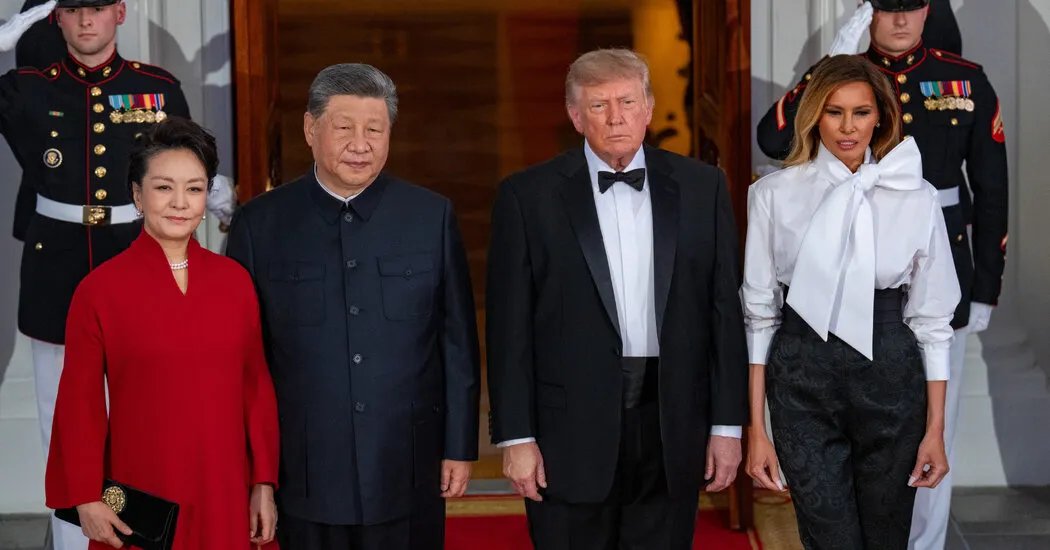
Chinese business leaders were absent from the White House state dinner for Donald Trump and Xi Jinping, highlighting the sharp deterioration in commercial ties between the United States and China.
The omission was particularly striking because Xi’s 2015 state visit to the US included a delegation of prominent Chinese executives, among them Alibaba founder Jack Ma and Tencent’s Pony Ma. At the time, disputes over human rights, cyberattacks and trade coexisted with a shared interest in expanding business between the two countries.
“It’s a rather depressing marker of how bad the relationship has gotten,” said Emily Kilcrease, a senior fellow and director at the Center for a New American Security who specialises in the US-China economic relationship.
She said commercial agreements had been expected to feature in the summit, adding: “But it seems like we can’t even get to agreement on some of that.”
Chinese officials had expected until shortly before the summit that they might bring a business delegation to Washington, according to two people familiar with the discussions. No executives were ultimately invited to the dinner.
Reports had identified Wang Chuanfu, founder of electric carmaker BYD, and Robin Zeng, chief executive of battery manufacturer CATL, as possible attendees. Their presence could have showcased China’s strength in battery technology and renewable energy.
Several senior Chinese executives did travel to Washington and held meetings away from the official gathering. Jeremy Chan, a senior China analyst at Eurasia Group and former American diplomat, said some had been waiting to see whether they would be included.
“The whole thing is crazy. It would be comical if it weren’t so tragic,” he said.
Their appearance at the White House would also have carried political risks. In June, the US Department of Defense added Alibaba and BYD to an expanded list of companies it identified as Chinese military companies.
“It would actually be seen by some in Washington as provocative to bring these companies along,” said Ilaria Mazzocco, deputy director at the Center for Strategic and International Studies, where she focuses on Chinese business and economics.
US companies remain visible at Trump-Xi summit
The contrast with the American business presence was pronounced. Apple’s Tim Cook, Tesla’s Elon Musk, Nvidia’s Jensen Huang, Meta’s Mark Zuckerberg, Amazon’s Jeff Bezos, OpenAI’s Sam Altman, Microsoft’s Satya Nadella and General Motors’ Mary Barra attended the state dinner.
When Trump visited Beijing in May, Cook, Musk and other leading American executives stood behind senior US officials at the Great Hall of the People. Trump told Xi he had brought “the greatest businessmen, the biggest, and I guess the best, in the world”.
Xi said earlier on Thursday that China welcomed American companies wanting to invest and do business there. In an apparent reference to US restrictions on Chinese firms, he added: “We hope Chinese companies are treated fairly here in the United States.”
The two countries have imposed successive tariffs and restrictions since Trump’s first term. Washington has limited Chinese access to advanced American technology and restricted US investment in parts of China’s high-tech sector, while Beijing has imposed controls on exports of rare-earth metals and magnets used by American manufacturers.
Chinese companies have also moved from being potential partners and customers for American firms to becoming major competitors. The rivalry is particularly intense in artificial intelligence, robotics, electric vehicles and batteries.
American carmakers have lost ground to Chinese electric vehicle manufacturers, while Apple faces competition from Huawei and Nike from increasingly popular Chinese brands. Despite that pressure, China remains important to US businesses: a 2026 survey by the US-China Business Council found that 80 per cent of American companies considered the Chinese market either “very important” or “important”.
For Chinese companies, however, tariffs, political scrutiny, investment restrictions and national security rules have made entering or expanding in the US considerably more difficult, particularly in strategic industries.
Joerg Wuttke, a partner at Washington consultancy DGA-Albright Stonebridge Group, said the prominent role given to American executives showed how uneven the relationship had become.
“Is there anybody from China interested in doing business in America?” he said. “No, because it’s not possible. So why should they waste their time?”
