


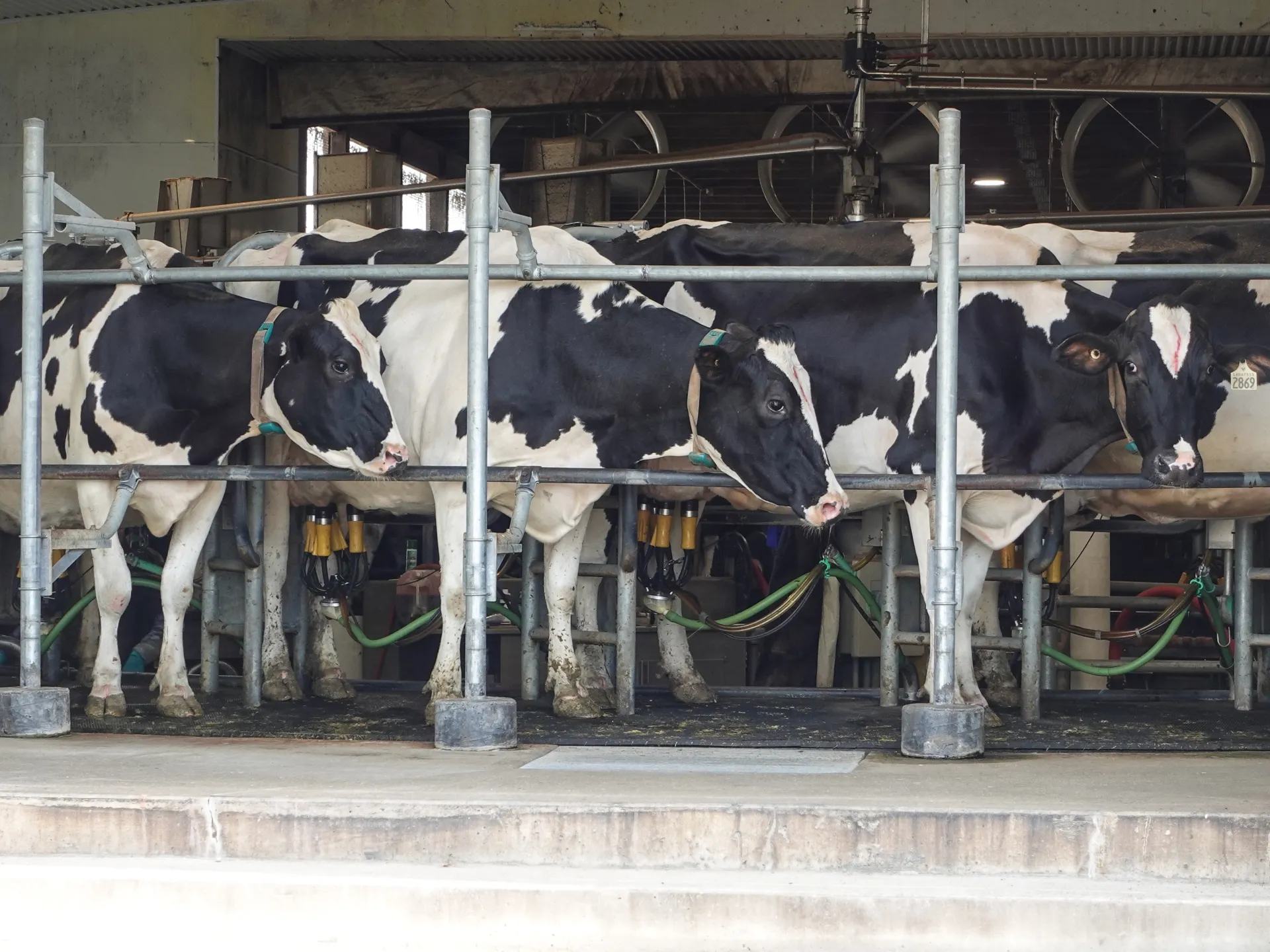
US tariffs on Canadian dairy products have brought cross-border sales close to a standstill, leaving farmers facing the prospect of surplus milk, falling processor demand and uncertainty over the future of their herds.
At Casey Pruim’s farm in Abbotsford, British Columbia, 28,000 litres of raw milk leave the property every second day. Most is consumed in Canada, while some had previously been used to make products sold in the United States.
Those sales have largely stopped since Donald Trump’s 50% tariff on 20 billion Canadian dollars’ worth of goods, including dairy products, came into force on August 22.
Pruim, who chairs the British Columbia Dairy Association, said farmers did not decide individually which products were exported. His 330 cows are milked three times a day and the milk enters a provincial marketing system, which allocates supplies to processors according to demand.
If a processor loses orders in the US, it may require less milk. The consequences are then spread across the provincial pool of producers.
“If the processor who’s exporting some of his product to the United States can no longer sell into that market because he’s now priced out of the market with a 50 percent tariff, that’s how it would impact the dairy farm,” Pruim said.
He warned that a sustained squeeze on processor demand could leave farmers with no option but to dispose of milk. In the worst-case scenario, herds would have to be reduced.
“Cows aren’t like a tap; you can’t just turn them on or off,” he said.
Dylan Kruger, director of public affairs at BC Dairy, said it was too soon to determine the full effect of the measures or whether milk no longer destined for the US could be sold elsewhere.
“There is still considerable uncertainty around the impact of the US tariffs,” he said.
Canadian dairy farmers caught in trade dispute
Dairy products are particularly exposed to trade disruption because milk is perishable and collected on a tightly managed schedule. Farmers cannot quickly alter production when processors lose access to a major market.
David Wiens, president of the Dairy Farmers of Canada, described the tariffs as “completely unwarranted” and said they would affect the supply chain on both sides of the border.
Dairy trade between Canada and the US has largely operated under the Canada-United States-Mexico Agreement, known in Canada as CUSMA. Canadian dairy, poultry and egg production is managed through a system of quotas and import controls designed to provide farmers with more stable prices and maintain domestic supplies.
Washington has criticised the arrangement, arguing that it restricts US dairy exports. Trump has accused Canada of “ripping off the United States of America for years” and imposing “ridiculously high tariffs” that made it impossible for American farmers to prosper.
Canadian producers reject that claim, arguing that the existing agreement already gives US imports substantial tariff-free access which is not being fully used.
Figures from the Dairy Processors Association of Canada show that Canada’s dairy trade deficit with the US has widened since CUSMA came into force in July 2020. Canadian dairy exports to the US rose from 241.3 million Canadian dollars in 2020 to 308.7 million dollars in 2025.
Over the same period, imports of dairy and dairy products from the US more than doubled, from 647.4 million Canadian dollars to 1.355 billion dollars. The latter figure represented 13.8% of the total value of US dairy exports, according to the association.
Bryan Yu, chief economist at Central 1 credit union, said Canadian producers would struggle to replace a major market quickly.
“There is going to be pain in the near term for a lot of our producers,” Yu said.
“You really can’t quickly adjust to a 50 percent tariff, because it’s uncharted waters for a lot of industries … and ultimately it shuts [Canadian producers] out, because a lot of them don’t have the margins that they can play with,” he added.
Some additional supply could be absorbed by Canadian consumers, while exporters look for new markets or higher-value products. But Yu said neither option could be implemented immediately, particularly for chilled goods that require buyers, transport arrangements and regulatory approvals.
Canada has responded with tariffs of its own. Measures introduced on September 8 cover 20 billion Canadian dollars’ worth of US products, including a 50% tariff on milk, cream and whey products and a 25% tariff on many cheeses.
Prime Minister Mark Carney has presented the retaliation as both a response to Washington and part of an effort to make Canada’s economy more resilient. After the latest trade negotiations collapsed, he said Ottawa would match the US measures “dollar for dollar” to protect workers, farmers, families and businesses.
However, Oxford Economics said the retaliatory tariffs could raise costs for producers and consumers and weaken economic growth, despite helping some industries.
For now, Canadian officials are advising affected companies to check their CUSMA compliance, explore available relief and contact trade commissioners about potential new markets.
Yu said Canada and the US might reach a tariff agreement in the coming months, but warned that the interim period could bring “higher prices, weaker economic activity and deeper mistrust”.
For Pruim, the uncertainty is itself damaging after the collapse of repeated trade talks.
“I think, like [for] any Canadian, it’s disappointing to have these trade talks collapse again and just the uncertainty around it,” he said.
