


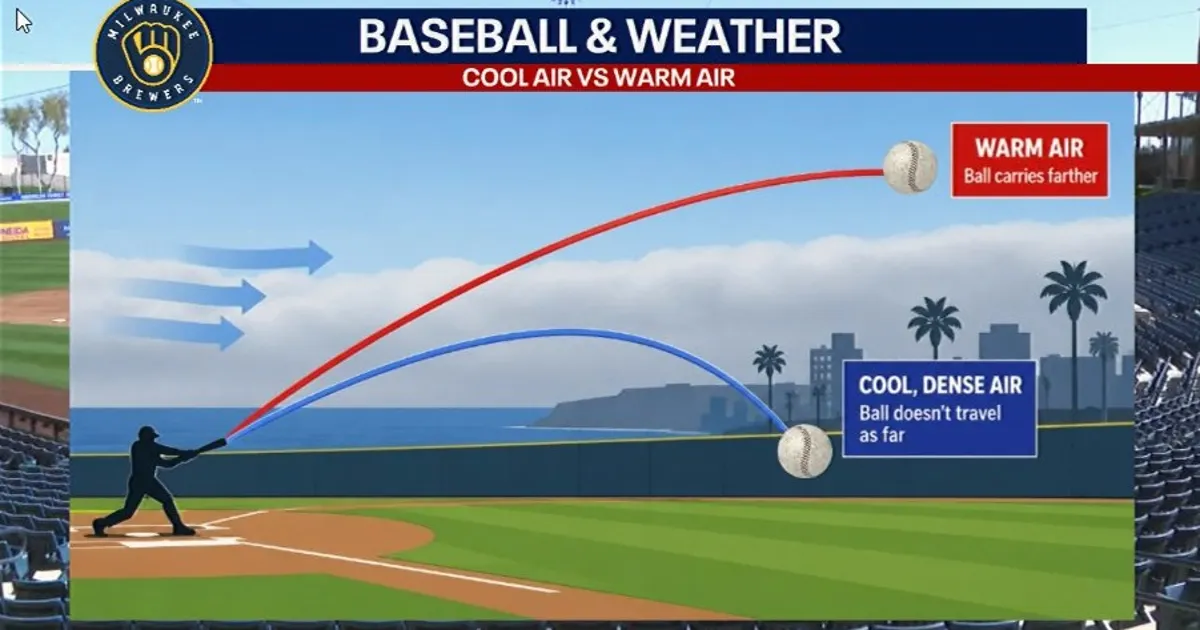
Warmer-than-usual temperatures in Milwaukee could give the Milwaukee Brewers a marginal boost in the World Series, with less dense air allowing well-struck baseballs to travel slightly farther at American Family Field.
Forecast highs are expected to reach the low 70s Fahrenheit (around 21-23C) on Friday October 23 and Saturday October 24, 2026, well above the usual late-October average in the mid to upper 50s. Clear skies and generally light winds are also expected before temperatures ease during the evening games.
How Milwaukee weather could affect the World Series
The effect is rooted in basic physics. Warmer air creates less aerodynamic drag, meaning a ball hit with sufficient force may carry a little further than it would in colder, denser conditions.
Research published by the American Meteorological Society found that a 1C rise in game-day temperature was associated with an increase of about 1.96% in home runs at stadiums without domes. The effect was smaller during night games, when temperatures are generally lower.
That does not mean the weather will decide the series. The strength and technique of the hitter, the pitcher, the baseball, equipment and the dimensions of the ballpark all remain more significant factors. Wind direction, however, can also influence whether a deep fly ball reaches the stands.
At American Family Field, home plate is oriented towards the north-west and centre field towards the south-east. Forecast south-easterly winds on Friday, followed by a stronger southerly breeze on Saturday, could therefore provide some assistance to balls hit towards centre field, depending on their precise speed and direction.
Milwaukee has also experienced one of the sharpest increases in baseball-season temperatures among Major League Baseball cities. Climate Central’s analysis found that the city’s average temperature during the season rose by 3.6F between 1970 and 2024, placing it joint fourth nationally alongside Cleveland, Detroit and St Louis.
Across the 26 MLB cities that have warmed since 1970, the average increase was 2.8F. Climate Central said warmer conditions have already contributed to a measurable, though small, increase in home runs across the sport.
American Family Field roof and playing conditions
The Brewers’ retractable roof offers the club considerable control over the conditions. The fan-shaped structure can be opened or closed in less than ten minutes, and the decision is made by the team with temperature and the forecast among the factors considered.
When the roof is closed, the weather outside has less direct influence on the ball’s flight, although the air inside the stadium still matters. American Family Field uses 14 gas-fired heaters to warm the seating bowl during cold-weather games, while the playing field can remain cooler as outside air enters around parts of the roof and outfield structure.
The first pitch for the World Series games will come after the daytime peak, but the forecast suggests temperatures should remain close to or above the normal high for late October. A cold front expected late Sunday October 25 into Monday could then bring temperatures down into the 50s early the following week.
The likely impact of the warmer conditions is therefore modest rather than decisive. But in a series where a few feet can separate a home run from a warning-track out, Milwaukee’s unseasonably mild weather may offer the Brewers one small advantage.
