


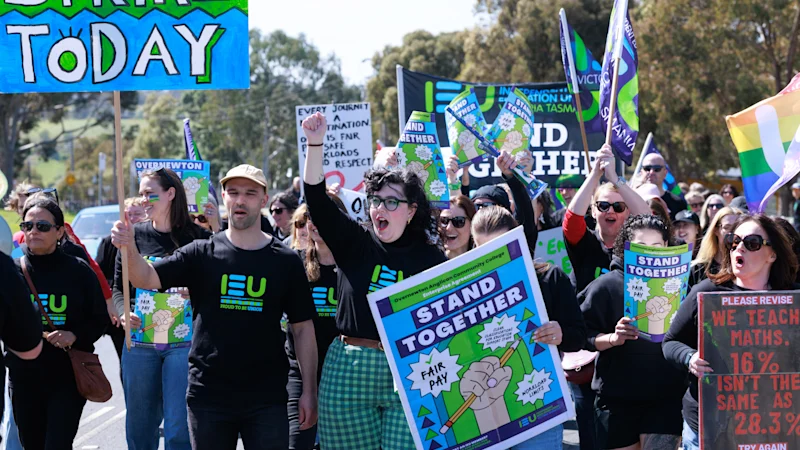
Private school teacher pay in Melbourne is coming under pressure after the state’s government school teachers secured increases of up to 32.4 per cent over four years, while staff at an independent school walked out in a dispute over wages.
Teachers at Overnewton Anglican Community College in Keilor took industrial action after rejecting a proposed 16 per cent rise over three years. The Independent Education Union said the deal would leave staff behind their public school counterparts despite current salaries being slightly higher.
The union said teachers at the college currently earn about $120,000, compared with roughly $118,000 for equivalent government school teachers. Under the proposed agreement, it argued, that position would be reversed.
The Victorian government’s new public school agreement was backed by 93.1 per cent of participating workers in a ballot. It will deliver rises of at least 13 per cent by October next year, with total increases of between 28.3 and 32.4 per cent over four years.
The top salary for experienced public school teachers will rise from $129,544 to $166,150.
Private schools face growing wage pressure
An analysis of remuneration figures from more than 40 private schools found that the average total package for all staff was $119,976 in 2024-25. The figures include teaching and non-teaching employees, making direct comparisons between schools and teacher salaries difficult.
Xavier College recorded the largest increase in total remuneration during the period, rising from $112,000 to $145,000. Principal Lee MacMaster said the school needed to remain competitive to attract and retain high-quality teachers.
“We know the quality of teaching has the greatest impact on a student’s learning experience. Our competitive employment conditions and strong professional culture enable us to attract and retain highly skilled educators,” he said.
At Melbourne Grammar School, average remuneration across 214 teaching staff and 378 non-teaching staff was $116,000. Experienced teachers joining the school can receive up to $143,823.
Headmaster Philip Grutzner said rising public school salaries would create additional pressure for private schools. Melbourne Grammar teachers had received annual increases of between 3 and 3.25 per cent over the previous three years.
“The school’s budget for 2027 has not yet been finalised; however our priority remains to attract, support, and retain exceptional staff, and remuneration is part of this,” Grutzner said.
Haileybury’s average remuneration across its workforce was $124,000. Scott Doran, the school’s vice-principal of community engagement, said competitive pay and conditions were essential in a tight market for teachers.
“There is strong competition for brilliant teachers, and we want to be a school where the very best people can build their careers, so it is imperative that our pay and conditions are competitive,” he said.
Industrial action is unusual in independent schools, where individual institutions negotiate their own agreements. Teachers at Lauriston Girls’ School in Armadale also went on strike earlier this year, while protected action at Strathcona Baptist Girls Grammar School was cancelled after staff accepted a new offer.
David Brear, Victorian and Tasmanian general secretary of the Independent Education Union, said members would not accept arrangements that left them worse off than government school teachers. He also said some independent schools were failing to match improvements to workload conditions secured in government and Catholic schools.
Independent Schools Victoria chief executive Rachel Holthouse said private schools were dealing with higher operating costs, reduced government funding and pressure on families’ ability to absorb fee increases.
“Ultimately, independent schools are committed to ensuring their staff are fairly rewarded through a balance of salary and conditions, their schools remain sustainable, and the communities they serve continue to have access to the quality education they expect,” she said.
The Victorian Catholic Education Authority has also been negotiating pay and conditions, and said it would match public school increases of up to 32.4 per cent over four years.
Chief executive Elizabeth Labone said Catholic schools would have to fund the rises through their own budgets, unlike state schools, while trying to limit the impact on families. About 90 per cent of Catholic schools charge less than $5,000 in annual fees, she said.
