


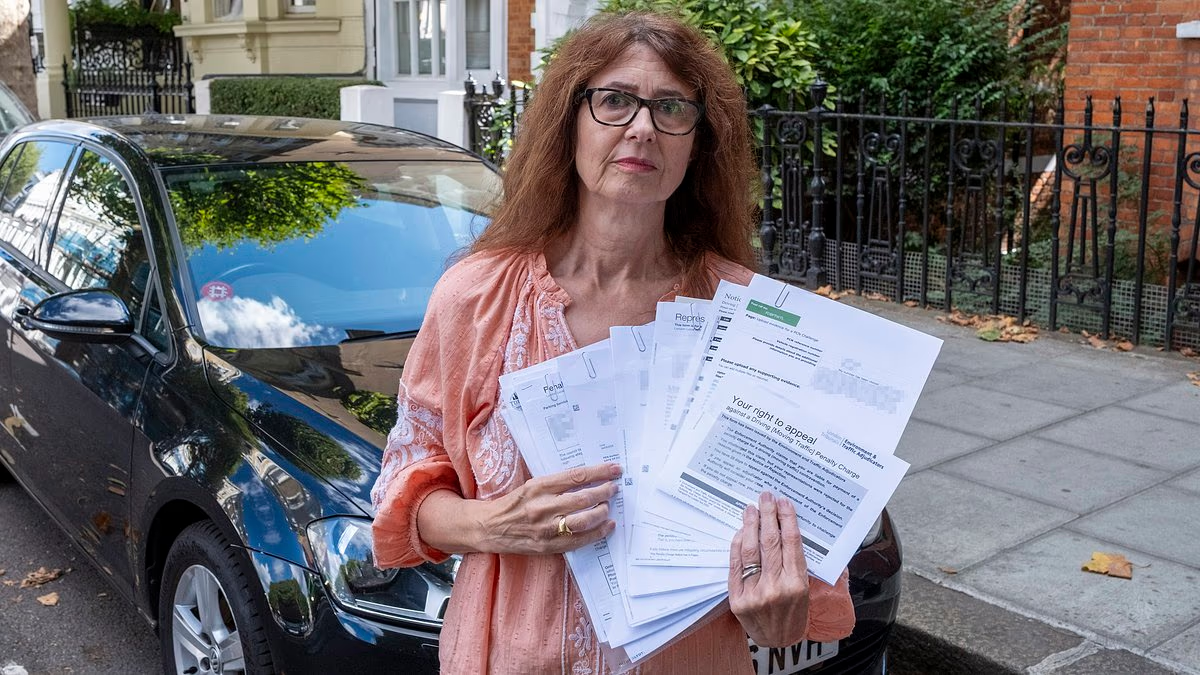
Sandra Yarwood was abroad when a second Volkswagen Golf bearing her registration began triggering traffic penalties across London.
By the time she returned from a two-week holiday in Canada, 32 penalty charge notices totalling about £2,800 had arrived at her home in Earl’s Court. The alleged offences included driving in bus lanes, parking illegally and entering restricted traffic areas.
The black Golf parked outside her home had not moved. Instead, criminals had copied its registration number and fixed it to a similar vehicle in south London.
What followed was a lengthy effort to persuade seven separate authorities that she was not responsible for the offences. Although most of the notices were eventually withdrawn, two remained outstanding weeks later, leading to a planned appearance before legal tribunals in February 2027 after she missed a deadline set by Lewisham Council.
“I can’t count the hours I’ve spent fighting the tech and the bureaucracy,” Ms Yarwood said. “They make it as hard as possible to contest traffic fines. Most of the time you can’t speak to anyone at all. The default position is that you must have done it.”
She reported the suspected cloning to the police and the Driver and Vehicle Licensing Agency, believing that the incident reference number would settle the matter. Instead, the authorities sought further evidence linking her car to the offences.
Each penalty notice required a separate challenge, often through a different online portal. Ms Yarwood said she was asked to provide photographs of her Golf from every angle, as well as evidence showing where it had been when the offences were committed.
The photographs exposed several differences between the genuine vehicle and the one captured by enforcement cameras. Her car had an English Heritage sticker on the windscreen, a scratch along its side caused by a low bollard near her doctor’s surgery and a sunroof. The vehicle shown in the penalty evidence had none of those features.
Greenwich Council, Transport for London, Southwark Council, Central Parking Management and Merton Council accepted the evidence and cancelled their notices.
But Ms Yarwood said she repeatedly encountered problems when attempting to upload the same material to the Lewisham and Lambeth systems.
“I tried every day for a week to upload the photos, but each time was met with a blank screen,” she said. “I tried one more time and bingo, Lewisham was up and running. But not Lambeth.”
After struggling with an online chatbot and being told that Lambeth’s system was unavailable, she sent photographs of her car by registered post. She said it was only after speaking to a member of staff that progress was made.
Lambeth Council later confirmed that its two outstanding penalty notices had been cancelled. A spokesman apologised for the difficulty Ms Yarwood had experienced and said the authority would work with motorists who believed a penalty had been issued incorrectly.
However, he said cases involving alleged number-plate cloning required “a high level of evidence”, including clear images of all four sides of the vehicle. The council also acknowledged a technical problem that had temporarily prevented motorists from submitting challenges online.
Lewisham Council also confirmed that its notices had been cancelled and said it was reviewing how suspected cloned-registration cases were identified and dealt with.
The case reflects a wider problem for motorists whose registration numbers are copied. The DVLA advises anyone receiving fines for offences they did not commit to report the matter to the police, notify the agency and send evidence to the organisation that issued the charge. Police reports can result in a marker being placed on the relevant vehicle record and on automatic number-plate recognition systems.
London’s traffic adjudication service has previously noted that motorists can receive multiple penalty notices as a result of cloning. It has also warned that camera evidence can be inconclusive, particularly in bus-lane and moving-traffic cases, leaving vehicle owners dependent on police or Action Fraud reference numbers and their own photographs.
Transport for London says images from its enforcement cameras can be compared with photographs of the genuine vehicle when cloning is alleged. Differences in the make, model, colour or visible features may help establish that the registration number was being used on another car.
For Ms Yarwood, the experience has highlighted the pressure placed on people to repeatedly prove their innocence through systems that are not always easy to use.
“I’m in my sixties and know how to use a computer,” she said. “If I were less tech savvy, then God help me.”
