


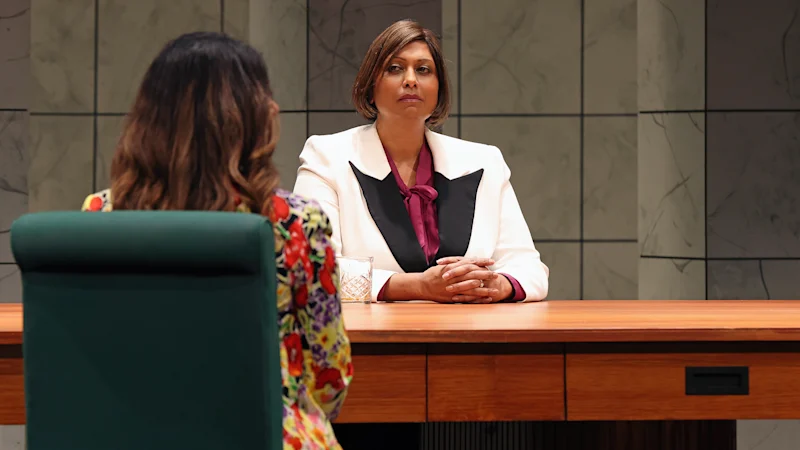
Emily Steel’s political satire Housework has arrived at Sydney Opera House with a sharp, lively look at the compromises, rivalries and impossible expectations facing women inside Australia’s corridors of power.
Directed by Shannon Rush for Sydney Theatre Company, the production runs at the Drama Theatre until October 17. It originally premiered in Adelaide in February 2024 before transferring to Sydney. ([sydneytheatre.com.au](https://www.sydneytheatre.com.au/news-articles/2026/housework-digital-program/?utm_source=openai))
Set in Canberra’s Parliament House, the play follows first-term MP Ruth Mandour, her exhausted chief of staff Anna and junior staffer Kelly as they navigate a critical week in government.
Ruth, played by Susie Youssef, is determined to make an impact with healthcare reform. Anna, played by Emily Taheny, is trying to keep both her political career and her home life from collapsing, while Franca Lafosse’s Kelly is an inexperienced employee desperate to win approval.
Kelly’s decision to spend a night with the science minister, however, sets off a chain of ambition, betrayal and political manoeuvring. What begins as a personal indiscretion quickly becomes a threat to careers, legislation and loyalties.
The plot grows increasingly tangled in its second half, with compromises multiplying as each character attempts to protect their position. Yet Steel avoids presenting her politicians and staffers as simple villains or heroes. Everyone is damaged by the system, and everyone contributes to its dysfunction.
That ambiguity is central to the play. Its criticism is directed not only at male privilege and the treatment of women in public life, but also at the absence of solidarity between women competing for influence.
Ruth questions whether Anna is sufficiently committed if she refuses to sacrifice her family for politics. Anna, in turn, accuses Ruth of using Kelly as a scapegoat to secure the science minister’s support for her health reforms.
The production’s humour comes chiefly from quick exchanges and precise comic timing rather than broad slapstick. Taheny is particularly effective as Anna, delivering the play’s most incisive lines while giving the character an emotional weariness beneath her professional control.
Lafosse brings warmth and energy to Kelly, making the character’s naivety more sympathetic as her faith in political power begins to disappear. Youssef’s Ruth is part idealistic reformer and part self-regarding performer, with the balance leaning towards the latter on opening night.
Indira Naidoo doubles as the prime minister and a cleaner, while Johnny Nasser gives the science minister a more rounded portrayal than the surrounding political chaos might suggest. Laurence Boxhall completes the principal cast.
Rush keeps the action moving, although some early scenes are played at such a relentless pace that the production has little room to build momentum. Ailsa Paterson’s set captures the impersonal marble grandeur of Parliament House before shifting to the chamber and a serviced apartment, with stark lighting by Nigel Levings reinforcing the institutional chill.
Andrew Howard’s driving percussion adds the feel of a campaign march, suggesting that every conversation is another skirmish in a wider contest for power.
Housework is more playful than devastating, and its political observations are not always especially new. But its energetic performances and refusal to offer easy moral answers make it an entertaining backstage tour of ambition, loyalty and compromise in Canberra.
