


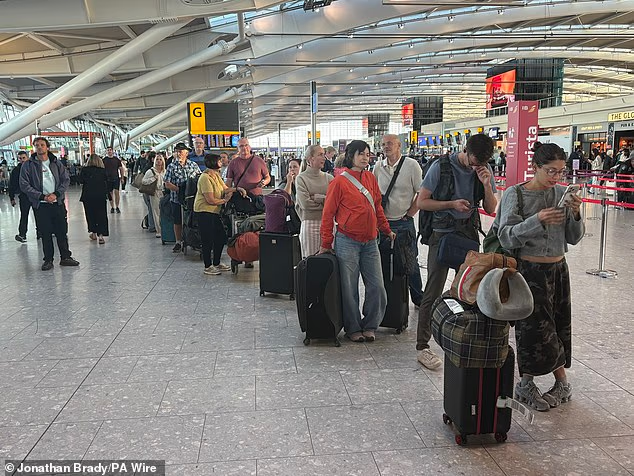
Thousands of passengers faced a second day of disruption on Wednesday, 9 September, after a technical failure in the UK’s air traffic control system caused more than 1,000 flights to be cancelled or delayed.
National Air Traffic Services (NATS), which provides air traffic control services to 15 airports, said it had fixed an issue in its flight processing system on Tuesday. But the resulting backlog continued to affect Heathrow, Gatwick, Manchester, Birmingham and airports across Europe.
Heathrow alone had cancelled about 250 flights by early Wednesday morning, while British Airways said the disruption was continuing as aircraft and crew remained out of position across its network.
NATS chief executive Martin Rolfe has been summoned to brief Transport Secretary Heidi Alexander. He said a “very, very thorough and full investigation” would be carried out and that a cyber attack had been ruled out.
Mr Rolfe said the failure appeared to be different from previous incidents and that NATS had not seen the same problem occur more than once in its 50-year history.
Airlines have nevertheless demanded answers. Ryanair chief operating officer Neal McMahon called for Mr Rolfe to resign, accusing NATS of repeated mismanagement and saying passengers had suffered avoidable delays of up to eight hours.
Passengers stranded on aircraft and airport floors
Former Formula One driver and broadcaster Martin Brundle said he had spent nine hours sitting on a British Airways aircraft at Heathrow which had not moved from a remote parking bay.
He said there had been no food, no steps or buses to allow passengers off, and that the toilets had become unusable. A mother with a baby and a passenger with a medical condition were among those desperate to leave the plane, he said.
“Pathetic and dangerous lack of corporate contingency and responsibility,” Mr Brundle wrote on social media.
US actress Rebel Wilson also posted footage of queues at Heathrow, while hundreds of passengers slept on yoga mats in Terminal 4.
Paige and Omar Iannarino, from Texas, said they had been trapped on the runway for more than six hours after travelling from Albania and were unable to find a hotel room for the night.
“After more than six hours trapped on the runway, exhausted and completely helpless, this has been an absolute nightmare,” they said.
At Gatwick, passengers faced lengthy queues at immigration after flights were cancelled and electronic passport gates appeared to fail. Marcus Wareham said he had waited eight hours for his flight before it was cancelled, followed by another four hours before he could leave the airport.
Other travellers slept on the terminal floor as queues continued into Wednesday morning. Gatwick said flights had resumed, but warned that it would take time for operations to return to normal.
In Rhodes, holidaymakers trying to return to Britain spent the night outside the airport. Traveller James Finch said about 120 people, including babies, elderly passengers and people with disabilities, were eventually allowed into a conference room at around 5.30am.
“We are all just sitting in the conference room with no information,” he said. The group had been rebooked on a flight scheduled for Thursday morning.
Julia Kobrin and her daughter Daniela were stranded in Milan after their British Airways flight was held on the tarmac for six hours before being cancelled. After failing to get help from the airline until the early hours, they found a hotel room and secured alternative flights via Menorca, adding about 700 miles to their journey.
Sarah Holt, who was travelling from Lisbon to Heathrow, said her British Airways flight had been repeatedly delayed before being cancelled at 7pm. She was told to pay for her own hotel and claim the cost back, and was not due to fly home until Thursday.
She said she had lost two days of paid work and described seeing queues for lost luggage and passengers unable to leave the airport.
Another passenger, Mark Houghton, said his flight from Barcelona to Gatwick was delayed by five hours before the aircraft was held on the runway for a further 90 minutes. He eventually arrived home at 3.30am.
Louise Jarvis said eight travellers had spent 16 hours at Gatwick after two replacement flights were cancelled, losing two days of a holiday they had paid for. The group booked a flight from Bristol in an attempt to salvage the trip.
Passengers may not receive compensation
Travel experts warned that passengers affected by the NATS failure may not be entitled to compensation because air traffic control disruption is generally treated as an extraordinary circumstance outside an airline’s control.
However, passengers may still be entitled to food, refreshments and overnight accommodation, depending on the length of the delay. Those forced to pay for hotels, meals or alternative arrangements should keep receipts and submit them to the airline.
Travel insurance could also cover some losses, although policies differ and disruption cover is not included as standard. Passengers have been advised to check their policy documents before making a claim.
ABTA said the rights of affected customers would depend on whether they had booked flights separately or as part of a package. Its director of public affairs, Luke Petherbridge, said the industry and the public would want to know what had gone wrong and how the system would be made more resilient.
British Airways advised customers to check the status of their booking before travelling to the airport. The airline said connecting passengers at risk of missing an onward flight on the same ticket would be rebooked automatically.
Heathrow said flights were operating on Wednesday but warned of knock-on disruption as aircraft and crews were repositioned. It urged passengers to travel only if they had a confirmed flight and said extra staff had been deployed across the terminals.
Mr Rolfe apologised to passengers, saying it was “disappointing and upsetting” when failures occurred despite NATS’s investment in technology and contingency planning.
But with airlines still clearing the backlog and passengers facing further cancellations, the effects of Tuesday’s failure were expected to continue through Wednesday and beyond.
