


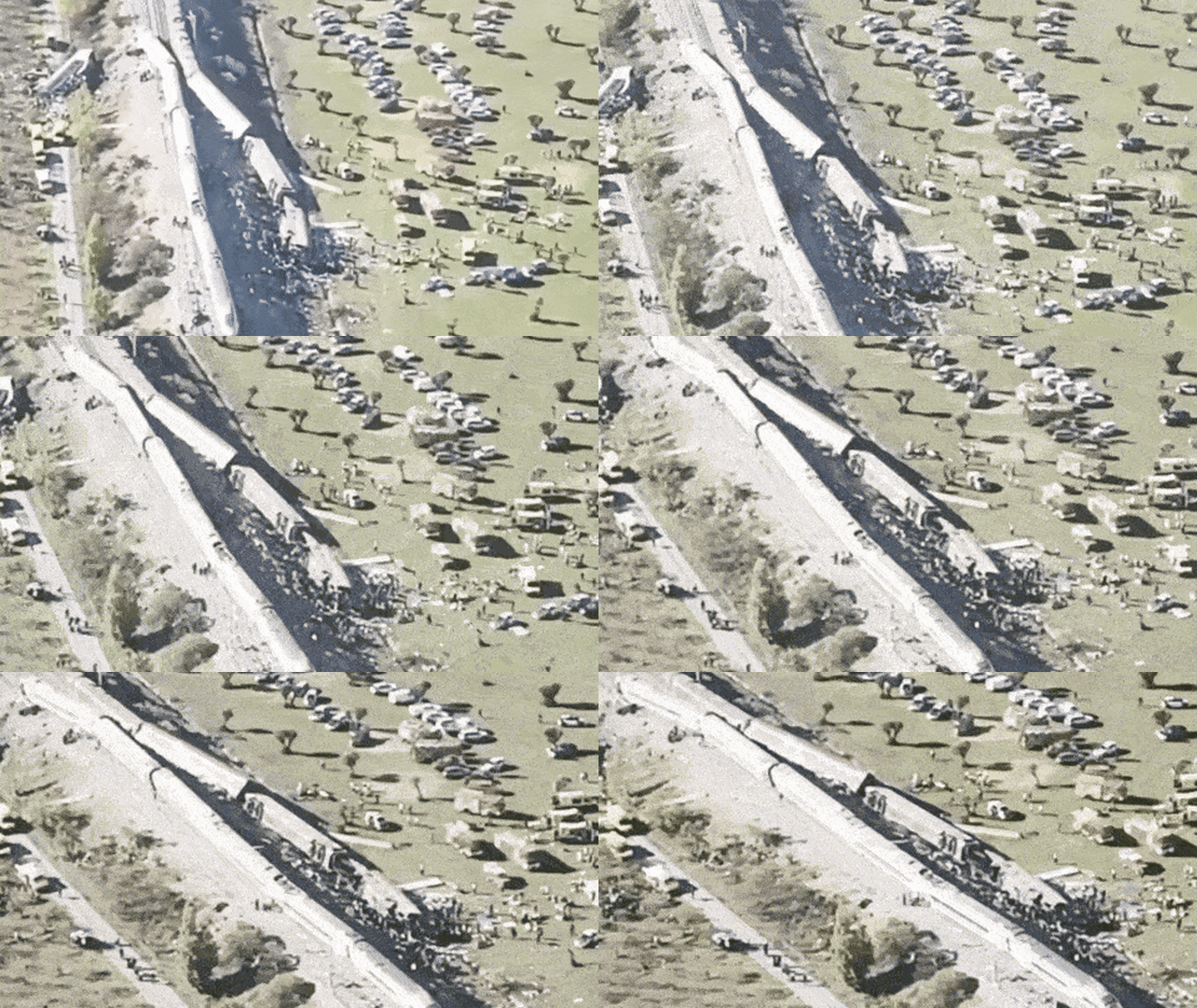
At least 64 people have been killed and more than 100 injured after two high-speed trains collided in central Spain, with 50 of the injured reported to be in a serious condition.
The crash happened on Wednesday morning in the province of Toledo, south of Madrid, when a state-owned Renfe AVE service and a private Iryo train travelling towards Seville collided on the same route.
The regional government of Castilla-La Mancha confirmed the updated death toll, after earlier reports put the number of fatalities at 10 and then 30. Emergency services continued working among the wreckage, where passengers were reported to have been trapped in the damaged carriages.
One passenger on the Iryo train, identified as Eduarda, said people had been screaming because they could not escape. Another passenger described the scene as “apocalyptic” as medics removed bodies from the crushed trains.
Early reports indicated that the Renfe service was carrying 397 passengers, while 147 people were aboard the Iryo train. Rail services were suspended between Madrid, Ciudad Real and Andalusia.
Investigation into Spain high-speed train crash
Spain’s transport minister, Óscar Puente, said the accident followed the failure of a security system covering a 63-kilometre section of track. The system stopped working at about 8.30am because of a computer malfunction, causing trains on the route to stop.
Mr Puente said a central command centre then instructed the Renfe train to resume its journey without speed restrictions, despite a stop signal still being active. The train collided with the stationary Iryo service at about 8.53am.
He said the train should not have been allowed to move, and that it should at least have been restricted to a reduced speed. Investigators were still examining how fast it had been travelling, but Mr Puente said it may have been moving at up to 200km/h.
“I am not attributing responsibility to anyone, I am just stating the facts,” he said.
A passenger on the Renfe train, Jesús Jerónimo, told the newspaper El Pais that he felt “a really brutal acceleration” before being thrown into the seat in front of him. Another passenger said the rear carriages of the Iryo train had been reduced to “a twisted mass of metal”.
The crash occurred nine months after another accident involving trains operated by the same companies on the same line. In January, 45 people died in southern Spain when one train left the track and hit an oncoming service.
Spain’s prime minister, Pedro Sanchez, said he was “shocked” by the accident and offered his support to victims and their families.
“Emergency services are working on the ground to assist those affected and ensure their safety, in coordination with all the involved administrations,” he wrote.
Messages of sympathy were also sent by Italy’s prime minister, Giorgia Meloni, French president Emmanuel Macron and European Commission president Ursula von der Leyen.
