


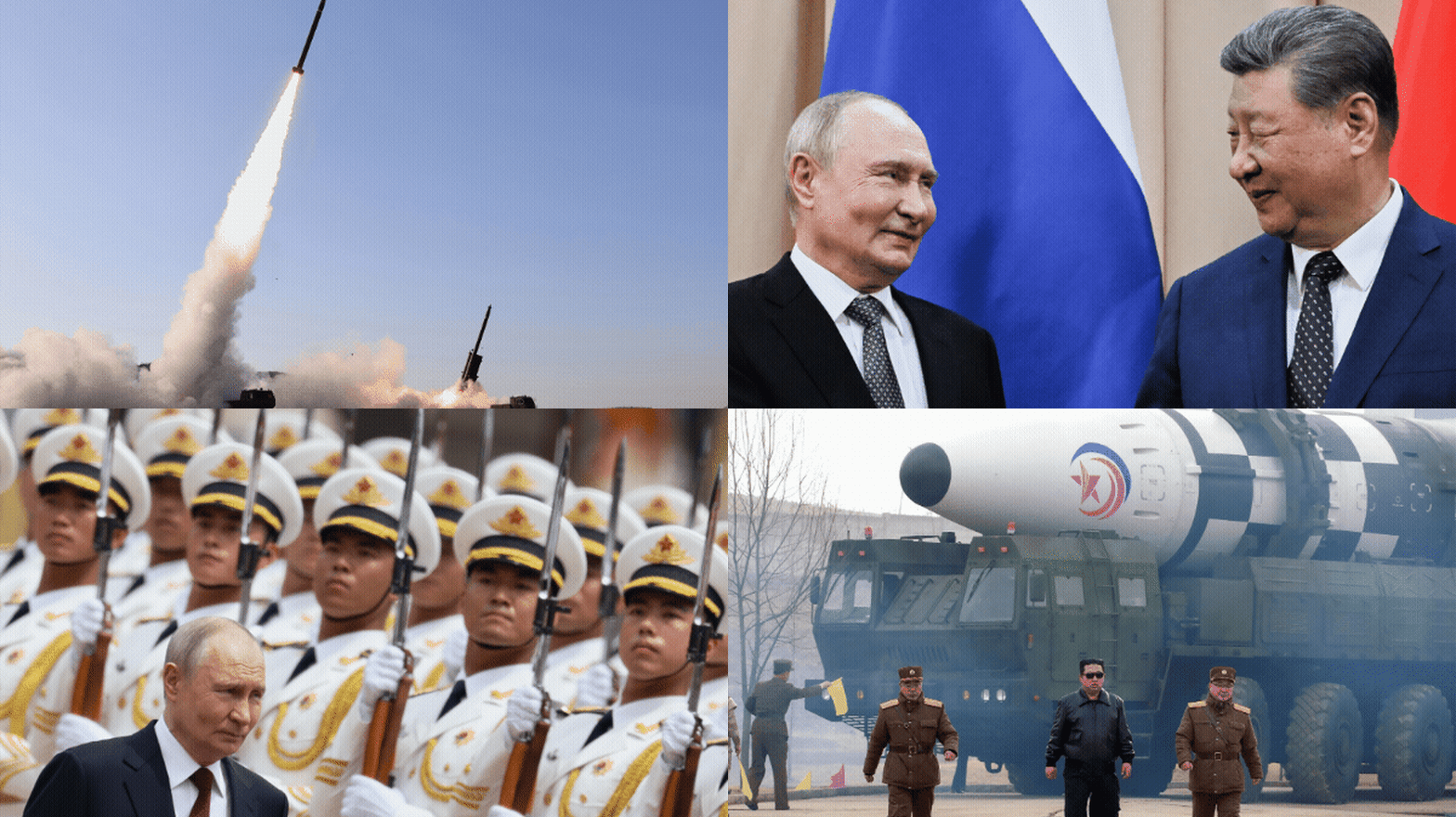
Australia faces growing security risks from the deepening military co-operation between China, Russia and North Korea, experts and political figures have warned as the three countries work together in the war in Ukraine.
David Petraeus, the former director of the CIA and a former senior US Army general, said China was rapidly developing weapons and had the industrial capacity to manufacture them in large numbers for Russia.
Speaking at a security conference in Kyiv, General Petraeus said China was studying the war closely while supplying components for Russia’s military-industrial complex, including drones and robotic systems.
“We should be very concerned that China is learning assiduously from what Russia and Ukraine are doing,” he said.
He said China’s ability not only to innovate but also to scale production was particularly significant, arguing that Western countries needed to develop a new approach to warfare and urgently reform their military institutions.
Petraeus estimated that Russia would produce 10 million drones this year, while Ukraine was seeking to increase its own output from eight million to 10 million.
China, Russia and North Korea alliance raises Asia concerns
North Korea’s support for Moscow has added another dimension to the developing partnership. Pyongyang has supplied an estimated 10,000 troops, large quantities of artillery ammunition and more than 100 missiles to Russia.
Eric Schmidt, the former Google chairman and an investor in drone technology, said he had seen the consequences of the relationship during a previous visit to Kyiv.
“The North Koreans are giving the Russians the KN-25, which is a major ballistic missile – it’s an enormous size and does enormous damage,” he said.
“I was here when it was shot at Kyiv. I know it to be true. That’s very, very worrisome. So the connection between China and North Korea and Russia is a great concern.”
One of Schmidt’s companies, Perennial Autonomy, develops Merops interceptor drones used by Ukrainian units and sold at low cost.
The former Swedish prime minister Carl Bildt said concern should focus not only on what Russia was receiving from North Korea, but also on what Moscow might provide in return.
He cited speculation that North Korea wanted to build a nuclear submarine and could seek Russian assistance with its propulsion systems.
Dame Emily Thornberry, chair of the UK parliament’s foreign affairs committee, said the conflict in Ukraine could not be viewed as distant from Australia or the wider Indo-Pacific.
“It may seem like Ukraine’s a long way away from Australia, but the North Koreans don’t think so, right? They’re sending troops in to fight for the Russians,” she said.
Thornberry said China’s closeness to Russia would have wider geopolitical consequences, arguing that Moscow was becoming a “vassal state of China”.
“So you can’t close your eyes and look the other way and think that’s a long way away because everything is connected with everything else these days,” she said.
There is no consensus among Western countries on how best to respond. Sanctions intended to restrict Russia’s access to vital supplies have not stopped China and North Korea from supporting Moscow.
Professor Carlo Masala of the Bundeswehr University Munich said imposing sanctions on China could trigger retaliation and damage Western economies.
“The minute we do it, they will retaliate, which will harm our economies,” he said, adding that Russia was therefore likely to continue receiving the supplies required to assemble its weapons.
Masala said Europe needed to expand defence production to support Ukraine and prevent a Russian victory. “The only thing is to basically outproduce China, to create the industrial base for a much stronger support for Ukraine,” he said.
Polish foreign minister Radosław Sikorski said the war was benefiting China by strengthening its influence over Russia and allowing it to take a greater share of the Russian market.
“If I were a Russian nationalist I would be horrified that Russia will become a very, very junior partner to China,” he said.
