


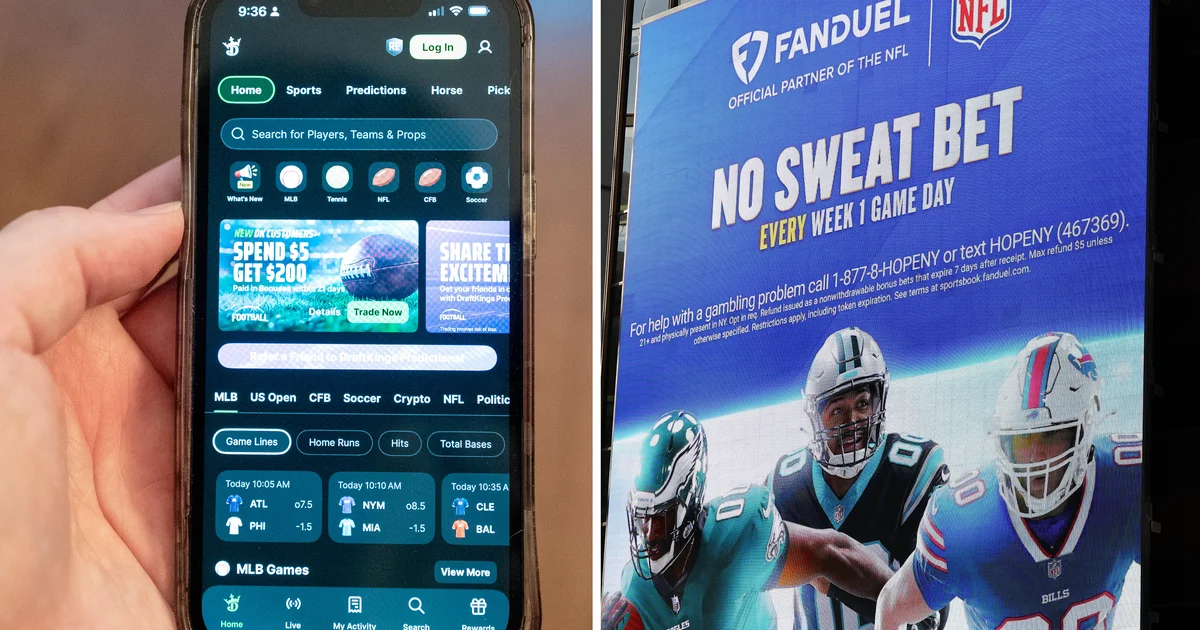
Sports betting apps FanDuel and DraftKings are facing 15 lawsuits alleging that their platforms were designed to encourage addictive gambling, as concerns grow over the financial impact of online betting in the United States.
The cases were filed by Florida lawyer Jennifer Hoekstra, whose firm was involved in an earlier legal victory against Meta. She argues that betting apps use features similar to social media platforms to keep users engaged and encourage them to return.
“I represent individuals who have essentially lost their houses and their spouses and their kids over this,” Ms Hoekstra said. “It’s the same type of workflow, the same type of notifications. It’s almost as if it’s the same type of addiction.”
The amount wagered on sports in the US reached 167 billion dollars last year, according to the American Gaming Association. A UCLA study found that bankruptcies and credit card delinquencies rose by about 25% in states where online sports betting was legalised.
A survey by the National Council on Problem Gambling found that 8% of American adults – almost 20 million people – reported experiencing at least one indicator of problematic gambling behaviour “many times” during the previous year.
FanDuel and DraftKings are contesting the claims. FanDuel, which has about 18 million customers, said any suggestion that it failed to monitor or curb problem gambling was “completely false”.
The company said it had invested 158 million dollars in responsible gaming initiatives and removed 5,700 people from its platform because of their gambling behaviour last year. It also said that 58,000 accounts had been manually reviewed by its responsible gaming team.
Betting firms accused of keeping customers engaged
An investigation into the companies found that they worked to keep bettors engaged even when losses were mounting, according to a former FanDuel employee.
“It’s less about cutting them off than slowing them down,” the former employee said. “It’s never forever.”
The former employee said some colleagues had ignored signs that customers were betting excessively. “We know what we should do, but … we don’t want to slow them down from placing a bet,” he recalled them saying.
Both firms offer high-spending customers incentives including access to luxury suites, signed sports equipment and special sporting experiences.
Esteban Ruiz-Haynes, a pest control salesman from Virginia, said he had become a VIP customer with a FanDuel manager who contacted him about events and even sent him birthday messages. He estimated that he bet between 80,000 and 120,000 dollars a year, roughly equivalent to his annual income.
Mr Ruiz-Haynes said he had sometimes wagered a weekly pay cheque on a single match. If he lost, he said, he would be “eating ramen noodles for the rest of the week”.
Louis Ruggiero, a recovering gambling addict, said he lost 100,000 dollars on FanDuel over three months before being offered VIP status. He said two other gambling companies had made similar offers.
“The incentives got bigger. The outreach got more personal. The losses got deeper,” Mr Ruggiero said. “This is not ‘VIP treatment.’ This is predatory retention disguised as hospitality.”
Claims over data and notifications
The former FanDuel employee said the company collected detailed information about customers’ betting habits, including whether their activity was increasing, within a normal range or beginning to fade.
He said customers who stopped betting were often sent push notifications intended to bring them back to the app. Ms Hoekstra alleges that such alerts and bonus offers can create a constant invitation to gamble during moments of boredom, stress or financial anxiety.
“It’s the dopamine hit,” she said.
Her lawsuits draw on a similar legal argument to a California case involving Meta and YouTube, in which lawyers argued that the design of social media platforms was addictive and contributed to harm. A jury found the companies negligent and ordered damages of 4.2 million dollars against Meta and 1.8 million dollars against YouTube.
Ms Hoekstra is seeking to apply that argument to online gambling, alleging that the design of betting platforms can contribute to addictive behaviour. The claims have not been established in court.
DraftKings said it could not comment on pending litigation but said it took responsible engagement seriously. The company said all employees received annual training and that it employed more than 50 full-time staff focused on responsible engagement.
It also said customers could set limits on deposits, wagers, time and losses, and use tools including its My Budget Builder and My Stat Sheet.
Joe Maloney, president of the Sports Betting Alliance, an industry-funded advocacy group, said cases such as Mr Ruggiero’s were outliers and that most people gambled responsibly.
“It is for entertainment. It is not for wealth creation,” he said.
Mr Maloney said betting firms provided tools allowing customers to set deposit, wager and loss limits, including for those who believed they were chasing losses or spending too much time or money on the apps.
Mr Ruggiero said he had repeatedly tried to stop gambling, including after the birth of his son. “I’m in the hospital holding my newborn son, who is three hours old, and I got $10,000 on the Knicks-Pelicans game,” he said. “I couldn’t stop.”
