


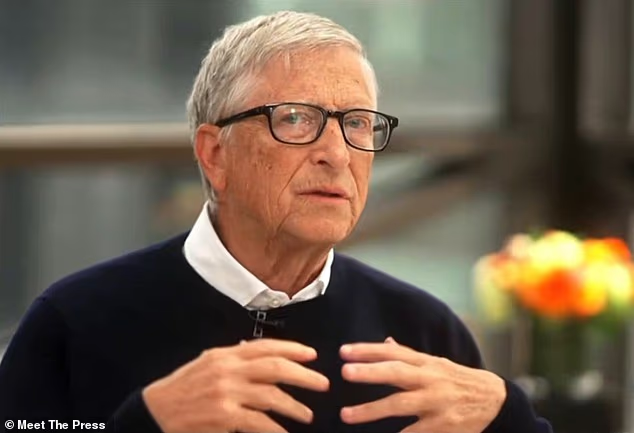
Bill Gates has warned that artificial intelligence could be powerful enough to cause events resulting in a billion deaths, as he called for tighter government oversight of advanced systems.
The Microsoft co-founder said the greatest danger could arise when sophisticated AI tools were placed in the hands of people with malicious intentions. Speaking on NBC’s Meet the Press, he told moderator Kirsten Welker: “AI is certainly powerful enough to drive events that cause a billion deaths.”
He added: “So even though it’s pretty hard to get to 100 per cent [of humanity], there’s never been a weapon as powerful as the combination of people with ill intent using the latest AI tools.”
Asked what could prevent an AI-related catastrophe, Gates said it was becoming increasingly difficult to distinguish legitimate scientific work from attempts to develop biological weapons.
“I wish it was easier to distinguish good intent, like I want to design a new drug for a disease, versus negative intent, which is I want to design a tool of bioterrorism,” he said.
Gates argued that advanced AI models should be monitored and that their use should be recorded in detail. He called on the United States to lead the creation of clear safeguards for the industry.
“Because those are so close, we do need to monitor any sophisticated model and record exactly what’s being done,” he said, adding that similar measures were likely to be pursued by China.
He said such checks would not necessarily hold back technological progress, and distinguished between imposing safeguards and the separate question of whether AI development should be slowed.
“You’ll hear from the industry, it’s a very doable thing. It would not slow them down dramatically,” Gates said. He added: “It’s these safeguards, their monitoring, are separate from would we be better off slowing down.”
The warning comes amid a wider political dispute in the United States over how far regulation should go. President Donald Trump has dismissed suggestions that AI advances could bring about the end of humanity, saying such events were “things that won’t happen”.
Trump has also said the US was leading China in AI and that he wanted to maintain that position because “whoever wins AI wins”.
House Republican Speaker Mike Johnson has opposed a moratorium on the technology, saying China could overtake the US. Democrats have taken a more regulation-focused position, with former president Barack Obama warning at a private gathering that AI was advancing rapidly in private hands and could become dangerous if it was not brought under control.
Concerns have also been raised within the technology industry. Anthropic researcher Jacob Coxon resigned earlier this month and accused Anthropic and OpenAI of not doing enough to address potential dangers, claiming that some researchers believed AI could “kill all humans” by the end of the decade.
An Anthropic report later said the company had stopped several potential attempts to use its systems in research connected to biological weapons. The firm said it could not determine whether the work had a legitimate or harmful purpose, but had acted cautiously because similar research could also be used to create dangerous pathogens.
