


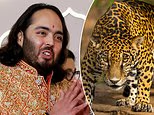
A young cheetah has undergone a complex operation to repair a severely fractured hind leg at Vantara, the vast wildlife rescue centre established by billionaire Mukesh Ambani’s son in western India.
The animal, named Dorcas, was placed under anaesthetic while a team of veterinary specialists spent three hours rebuilding the damaged limb with two titanium plates.
The procedure took place at the centre in Jamnagar, Gujarat, which describes itself as one of the world’s largest wildlife rescue and rehabilitation facilities. Reliance Foundation, which runs Vantara, says it cares for more than 150,000 animals from over 2,000 species, supported by a workforce of more than 3,500 people.
Dorcas was brought to India from a sanctuary in South Africa in 2024. The facility had reportedly been left struggling financially after the Covid pandemic, prompting her transfer to Vantara.
Her treatment carries particular significance in a country where cheetahs were declared extinct in 1952. India’s last recorded cheetahs were shot in 1947, although the species has since been reintroduced through a separate government-backed programme at Kuno National Park.
Professor Gerard Steenkamp, who led the operation with an eight-member medical team, reflected on the cheetah’s place in Indian history during the surgery.
“A maharaja shot the last three cheetahs in 1947,” he said. “Though the rifle he used would almost certainly have been made in England.”
The operation is one example of the specialist care available at Vantara, whose facilities include dedicated treatment centres for big cats, elephants, birds and reptiles. The organisation says its work includes emergency surgery, rehabilitation, conservation breeding and research.
The centre’s patients have arrived from a wide range of circumstances. Some were confiscated from private collections or rescued from illegal wildlife markets, while others came from failed zoos, circuses, logging operations and areas affected by natural disasters.
Elephants are among the most prominent residents. Vantara says some were saved from Indian and European circuses or from logging camps where they had been forced to carry heavy loads for long periods. Other animals were bred for captive shooting or recovered from the illegal trade in ivory and traditional medicines.
The scale and purpose of the project have nevertheless attracted scrutiny. Critics have questioned the volume and origins of animals transferred to the site, as well as whether a privately run complex of such size should be regarded as a sanctuary or a zoo.
Those allegations were examined by a Special Investigation Team appointed by India’s Supreme Court in 2025. The inquiry involved the Central Zoo Authority, the Wildlife Crime Control Bureau, customs officials, India’s CITES authorities, the Central Bureau of Investigation and other agencies.
In an order issued in September 2025, the Supreme Court said the investigation had found no breach of Indian wildlife, customs, foreign-trade, financial or anti-trafficking laws. The court accepted the team’s conclusion that the animals had been acquired through the required approvals and permits and closed the complaints before it.
The investigation recorded that Vantara’s two principal organisations had acquired 40,633 animals in total, including 29,274 imported through the Greens Zoological Rescue and Rehabilitation Centre and 6,034 brought in through the Radhe Krishna Temple Elephant Welfare Trust. The figure differs from Vantara’s broader public claim of caring for more than 150,000 animals, which includes the wider sanctuary operation and its multiple species.
The Supreme Court also said the centre’s veterinary and animal husbandry standards complied with the relevant regulations. Vantara has separately promoted its use of robotic-assisted surgery, telemedicine, intensive-care units designed for different species and genomic research.
Among the big cats at the facility is Pancham, a ten-year-old Bengal tiger involved in a series of fatal encounters with villagers collecting firewood. Dr Boon Allwin, a senior veterinarian responsible for big cats, said the animal had suffered dental problems and had been seeking easier prey.
“These tigers don’t actually like the taste of human flesh,” Dr Allwin said. “We don’t blame him for what he did.”
Pancham remains under care at the centre, where staff say he is being treated and monitored rather than regarded simply as a dangerous animal.
For Dorcas, the immediate priority is recovery from the leg surgery. The aim is to restore enough strength and movement for her to live comfortably, whether or not she can eventually return to a more natural environment.
Her operation highlights both the ambition and the controversy surrounding Vantara: an animal-care project backed by one of India’s wealthiest families, equipped to undertake procedures rarely attempted on wild species, and now responsible for an animal population whose exact size and long-term purpose continue to attract international attention.
