


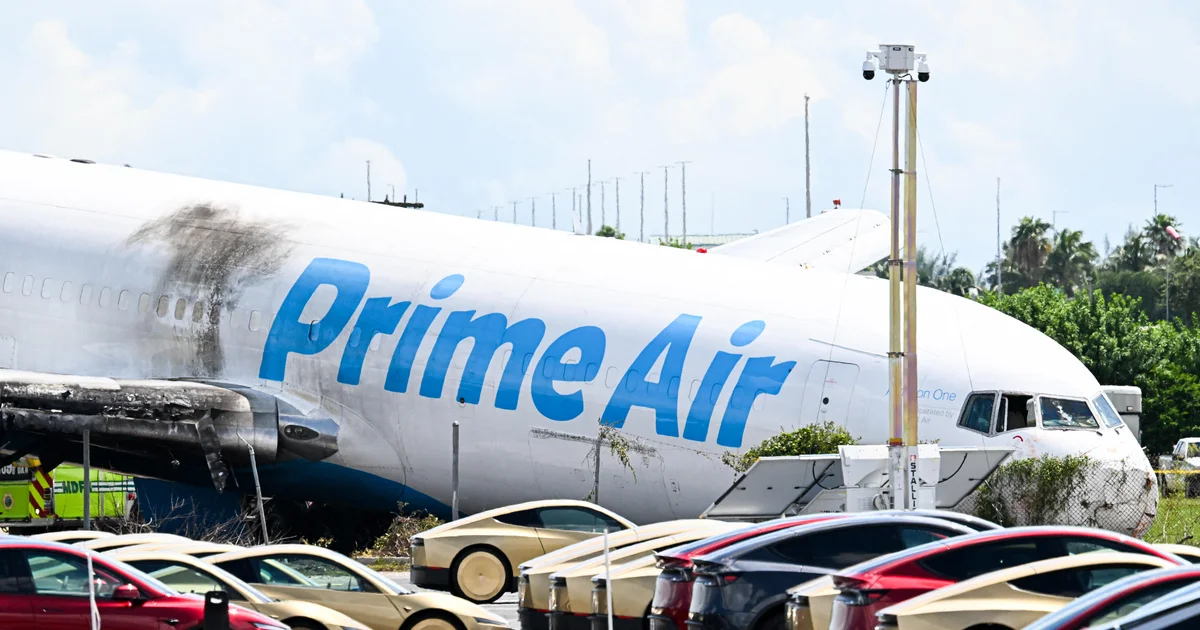
Investigators have recovered the flight data and cockpit voice recorders from an Amazon cargo plane that overran a runway at Miami International Airport, struck two vehicles and caught fire, killing five people.
The National Transportation Safety Board said on Monday that all those who died were travelling in the vehicles hit by the Boeing 767-300. At least five other people were injured.
The crash happened at about 2pm local time on Sunday, 6 September, as 21 Air Flight 7598 landed at Miami after departing from Luis Muñoz Marín International Airport in San Juan, Puerto Rico, according to the Federal Aviation Administration.
Five people killed in vehicles struck by aircraft
NTSB chairwoman Jennifer Homendy said the aircraft overran runway 30, struck airport navigation equipment and hit a white Ford Econoline van belonging to Professional Ocean Service Corporation, an airline cleaning contractor. Seven people were inside the van.
The aircraft then broke through a perimeter fence and collided with a Toyota Corolla Cross travelling along Northwest 67th Avenue, outside the airport. It continued for roughly 1,300ft beyond the paved runway before coming to a halt near an area where Tesla robotaxis were stationed.
“I would describe it in one word: devastating, utter devastation,” Ms Homendy told reporters, describing extensive damage to the vehicles, aircraft components, fencing and airport equipment.
The NTSB said the van was inside the airport boundary, while the Toyota was on the public road. The identities of those killed and injured had not been released.
Black smoke rose from the aircraft as emergency crews tackled the fire. Miami-Dade Fire Rescue sent more than 60 units to the scene, while a ground stop temporarily halted flights at the airport and all four runways were closed before operations gradually resumed.
NTSB to examine aircraft, runway and Amazon-21 Air contract
The recovered recorders are being sent to NTSB headquarters in Washington for downloading and analysis. Investigators have obtained some speed information from other sources but want to compare it with the aircraft’s flight data before releasing any conclusions.
About 32 NTSB investigators are working at the crash site. Access to the aircraft remains limited while recovery operations continue and fuel is removed.
The investigation will examine the crew’s performance, the aircraft’s systems and engines, air traffic control, weather, airport conditions and the structure of the aircraft. Investigators will also review the plane’s maintenance and ownership history; it was manufactured in 1994.
One issue under consideration is whether an Engineered Materials Arresting System, or EMAS, could have reduced the severity of the overrun. The crushable material is installed at the end of some runways to help stop aircraft safely, but is not required at every airport.
The NTSB will also examine the contractual arrangements between Amazon and 21 Air, which operated the flight on Amazon’s behalf.
“This is an Amazon operation for transporting cargo, but it’s actually contracted to 21 Air,” Ms Homendy said. “We’re going to want to see what that relationship is, who does what, what safety provisions might be in any sort of contracts or any sort of policies.”
Investigators had not yet conducted interviews on Monday, although the agency’s transportation disaster assistance team was arranging them. Specialist groups are due to begin detailed work on Tuesday.
Ms Homendy said the NTSB would not determine a probable cause while investigators were still at the airport. The team is expected to remain at the scene for at least a week to document the wreckage and preserve evidence.
The agency plans to provide a further briefing on Tuesday. The FAA is conducting its own investigation into the runway overrun, while the NTSB is leading the overall inquiry.
