


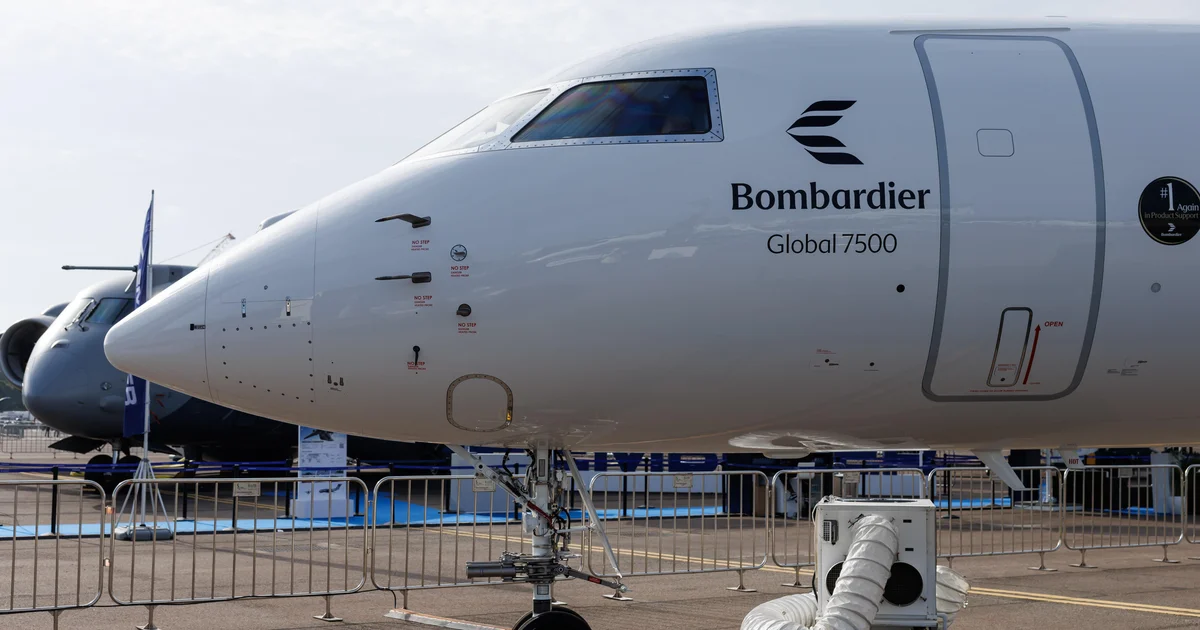
Donald Trump has threatened to ban Bombardier jet sales in the United States unless the Canadian aircraft manufacturer builds its planes on American soil, escalating an already bitter trade dispute with Ottawa.
“NO MORE SELLING BOMBARDIER IN THE UNITED STATES! Their products aren’t good enough!” Mr Trump wrote on Truth Social on Monday, hours before Canadian tariffs on about $20 billion (£15.2 billion) of US goods came into force.
He added that if Bombardier wanted access to the American market, it must “build here” and stop treating the US like a “piggybank”. It remains unclear what legal mechanism the White House could use to prevent the company selling to American customers.
Bombardier shares fell by about 3 per cent on Tuesday as investors assessed the threat. Analysts warned that a ban could harm US suppliers and customers as well as the Montreal-based manufacturer.
Bombardier’s US footprint
Although Bombardier is headquartered in Canada, the company has a substantial American presence. It employs workers across 20 US states and operates facilities in Arizona, California, Connecticut, Delaware, Florida, Illinois, Kansas, New Jersey, Texas and Washington DC.
The company says its American supply chain includes 2,800 businesses in 47 states and supports tens of thousands of jobs. It spends more than $2.5 billion a year with US suppliers and has its US headquarters in Wichita, Kansas.
Bombardier also manufactures major components in the United States. Its aircraft wings are made in Red Oak, Texas, while flight-control systems are produced near Los Angeles. The company operates service centres in Dallas, Hartford, Miami, Tucson and Wichita.
Its Challenger business jets use American-made Honeywell engines manufactured in Phoenix, Arizona. More than half of the components used in Bombardier aircraft are sourced from US manufacturers, according to analysts at investment bank Stifel.
“Bombardier values its great partnership with American companies and its US employees,” the company said in a statement. “Our plan is to continue to invest in our people, our customers and the communities in which we operate across the country.”
The manufacturer said in January that it was expanding its American operations, including plans for a new facility in Fort Wayne, Indiana.
Senator Jerry Moran, a Republican from Kansas, said he had contacted the Trump administration to highlight Bombardier’s contribution to the state. Senator Roger Marshall, also a Republican, said he would fight to protect more than 1,200 Kansas jobs linked to the company.
The International Association of Machinists and Aerospace Workers, which represents employees in the aviation sector, opposed any attempt to block Bombardier aircraft from the US market.
“Anything that undermines the stability and continued growth of these jobs is counterproductive to protecting workers and strengthening the aerospace industry in both the United States and Canada,” the union said.
Uncertainty over a possible US ban
Stifel analysts said it was uncertain whether Mr Trump could legally bar Bombardier from selling aircraft in the United States. Buyers could potentially take delivery of planes outside the country and register them under a foreign jurisdiction, they said.
Nevertheless, the analysts warned that continued political pressure could affect the company even without a formal prohibition, potentially slowing new orders until Washington and Ottawa reach a broader trade agreement.
The private-jet market remains unusually tight, with customers facing waits of several years for some aircraft. A ban on Bombardier planes would therefore risk disrupting US buyers as well as the company’s American workforce and suppliers.
Bombardier is one of the world’s largest business-jet manufacturers, specialising in medium and large aircraft. Its customers include wealthy private individuals, businesses, governments and military organisations, including the US Department of Defence and the Federal Aviation Administration.
Its aircraft are also used for intelligence, surveillance and reconnaissance missions because of their ability to fly quickly at high altitude. The company’s American operations have expanded alongside a surge in demand for private aviation since the Covid-19 pandemic.
