


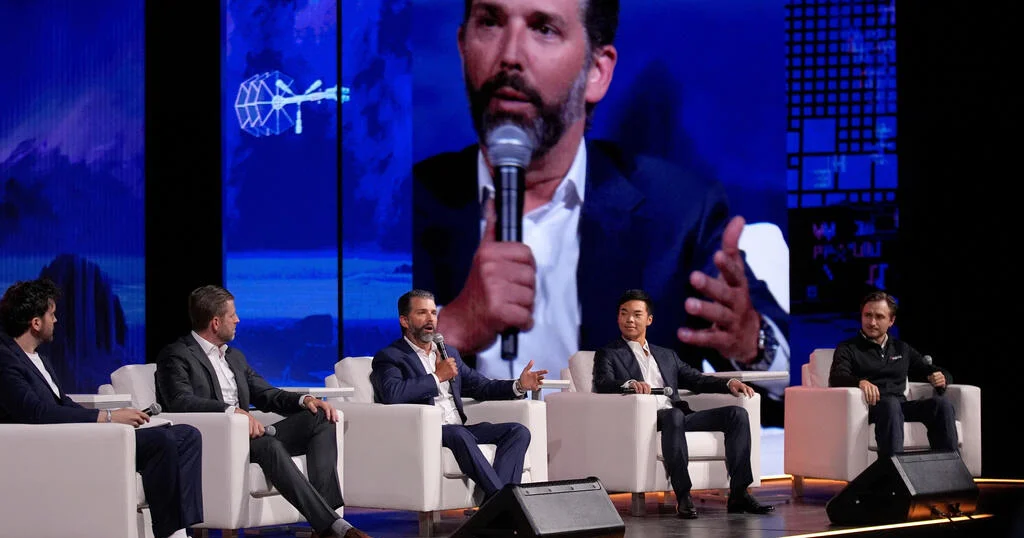
Donald Trump Jr’s venture capital firm has rejected allegations of insider political influence made by senior House Democrat Jamie Raskin, setting the stage for a potentially wider congressional investigation if Democrats regain control of the chamber after November’s midterm elections.
In a letter sent to Mr Raskin’s office, Alexander J Merton, a lawyer for 1789 Capital, accused the Maryland congressman of making public claims before establishing the facts and seeking confidential company records to support them afterwards.
“1789 Capital welcomes legitimate congressional oversight, but it has no intention of being held hostage to political gamesmanship,” Mr Merton wrote, describing Mr Raskin’s approach as “spaghetti-against-the-wall”.
The firm did not provide the documents requested by Mr Raskin, including a list of its investments, due diligence files and communications with members of the Trump administration, including messages sent through encrypted applications.
Mr Raskin, the senior Democrat on the House Judiciary Committee, opened the inquiry after questioning the timing of investments made by 1789 Capital and subsequent government decisions involving several companies in its portfolio.
Donald Trump Jr became a partner at the firm shortly after his father won the 2024 presidential election. Mr Raskin has pointed to reports that 1789 Capital’s assets under management rose from about $150 million to more than $3 billion, while its main fund recorded returns of roughly 200 per cent by June 30, 2026.
The investigation centres on investments in prediction market Polymarket, e-cigarette maker Juul, defence technology company Anduril Industries and rare-earth magnet manufacturer Vulcan Elements.
Mr Raskin has alleged that 1789 Capital acquired stakes in companies shortly before they received federal funding, major contracts or favourable regulatory decisions. He has questioned whether the firm benefited from advance information or political access linked to Mr Trump’s return to the White House.
1789 Capital’s lawyer disputed that characterisation and said the congressman had “repeatedly conflated separate entities, mischaracterised transactions” and, in some cases, appeared to contradict the sources cited in his letter.
On Vulcan Elements, the firm said the company had already received federal business dating back to 2024, before 1789 Capital took part in a financing round. It described itself as “one of many institutional investors” in the company.
Vulcan later secured a $620 million loan from the Department of Defence and a $50 million grant from the Commerce Department, with the government receiving warrants and an equity interest under the arrangements. Mr Raskin has cited the deals as a central example of what he regards as suspiciously timed government support.
His letter also raised questions about Anduril, which received major defence contracts, Juul, after US regulators authorised the marketing of five of its products, and Polymarket, whose prospects in the American market improved after federal investigations and regulatory restrictions were lifted.
The House Democrats’ request was made as a congressional demand for information rather than a subpoena. Private companies and members of the administration are not required to comply with such requests, and Democrats do not currently have the power to compel evidence without majority support in the House.
Mr Raskin set September 9, 2026, as the deadline for the requested material and instructed the firm to preserve relevant communications. If Democrats win control of the House in November, the dispute could form part of a broader programme of investigations into the business dealings of the Trump family and companies linked to the administration.
The response came as Republicans prepared to hold their first midterm convention in Texas. Donald Trump Jr was due to attend the event in Dallas, where his father was scheduled to deliver the keynote address.
