


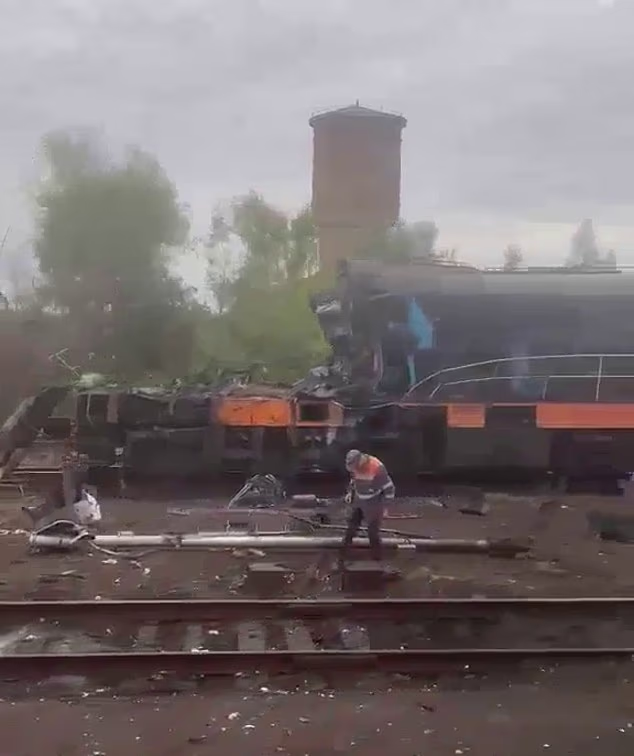
A Russian drone attack near Ukraine’s border with Poland may have been aimed at a train carrying Boris Johnson and senior foreign officials, security experts have warned.
The former prime minister was travelling from Kyiv on a charter service when passengers received a drone alert as the train approached the Yahodyn crossing. A last-minute change to the timetable allowed it to reach Poland earlier than planned.
Just over an hour later, another train travelling along the same route was evacuated. A nearby stationary locomotive was then hit and burst into flames, while a petrol station was also reportedly struck. No one was injured.
The drone hit approximately a mile inside Ukrainian territory, in an incident described by Ukrainian railway officials as unprecedented so close to the European Union border.
Peter Dickinson, editor of Ukraine Alert at the Atlantic Council think-tank, said the attack could have been “a Mafia-style message straight from the Kremlin”. He said Moscow would have been “very well aware that plenty of senior foreign officials would be traveling along that train route”.
Mr Dickinson described the incident as a “deliberate and calculated attack” and said it formed part of “a broader intimidation campaign currently being waged by the Kremlin as Putin seeks to bully Europe into abandoning Ukraine”.
Mr Johnson, a prominent supporter of Ukraine, said: “Nothing will deter me from using Ukrainian railways or going back to Ukraine.”
Passengers on the charter trains included the UK national security adviser Jonathan Powell, former CIA chief David Petraeus and former Swedish prime minister Carl Bildt. Mr Bildt said passengers on his train had been instructed to prepare for evacuation before being allowed to continue.
Robin Wagener, a Green Party member of the Bundestag who was travelling on the same train as Mr Johnson, said the attacks were “blind terror against Ukrainian civilians and a dangerous escalation”.
He added: “We must finally put a clear stop to this terror.”
The train carrying the European delegation was approaching the Yahodyn crossing shortly after 7am local time when some passengers received the evacuation warning. It crossed into Poland at 7.46am after being dispatched ahead of schedule.
At 9.15am, the next train on the route was evacuated. A shunting locomotive was struck shortly before 9.30am and caught fire, while reports said an explosion at a nearby petrol station sent flames towards parked lorries.
Oleksandr Pertsovskyi, head of Ukrainian railways, said it was the first time Russian forces had launched a “massive attack towards our western frontier”.
“Whether or not it’s a coincidence that this happened at the same time as a train carrying high-profile foreign figures was passing through this specific crossing, that we cannot say,” he said. “But it certainly poses many questions.”
Mr Johnson and the other dignitaries had been in Kyiv for a major security conference before travelling back along what was described as the only safe route out of Ukraine. The group included Gunter Sautter, a senior foreign and security policy adviser to German chancellor Friedrich Merz, as well as security advisers from France and Italy.
Maksym Kuzakhmetov, a Russian journalist and historian living in exile, said he had “no difficulty whatsoever believing this was a deliberate, planned attack”.
“The Kremlin has little hesitation in ordering the physical elimination of anyone Putin comes to regard as a personal enemy,” he said, adding that Western politicians who openly supported Ukraine were “anathema” to the Russian president.
Ukrainian foreign minister Andrii Sybiha said: “Putin’s terror was knocking directly on the doors of the EU and Nato.”
“Putin needs to understand that his barbarism will be met with decisive action. This is the only way to stop him,” he added.
The Conservatives described the incident as a “stark escalation” and called for increased defence spending. Stuart Anderson, appointed shadow minister for war preparedness, said Russian aggression was “a real and growing threat to European security and, ultimately, our own national security”.
Defence Secretary Wes Streeting said: “Reckless, dangerous attacks on civilian infrastructure so close to Poland underline the wider security threat Russia poses.”
