


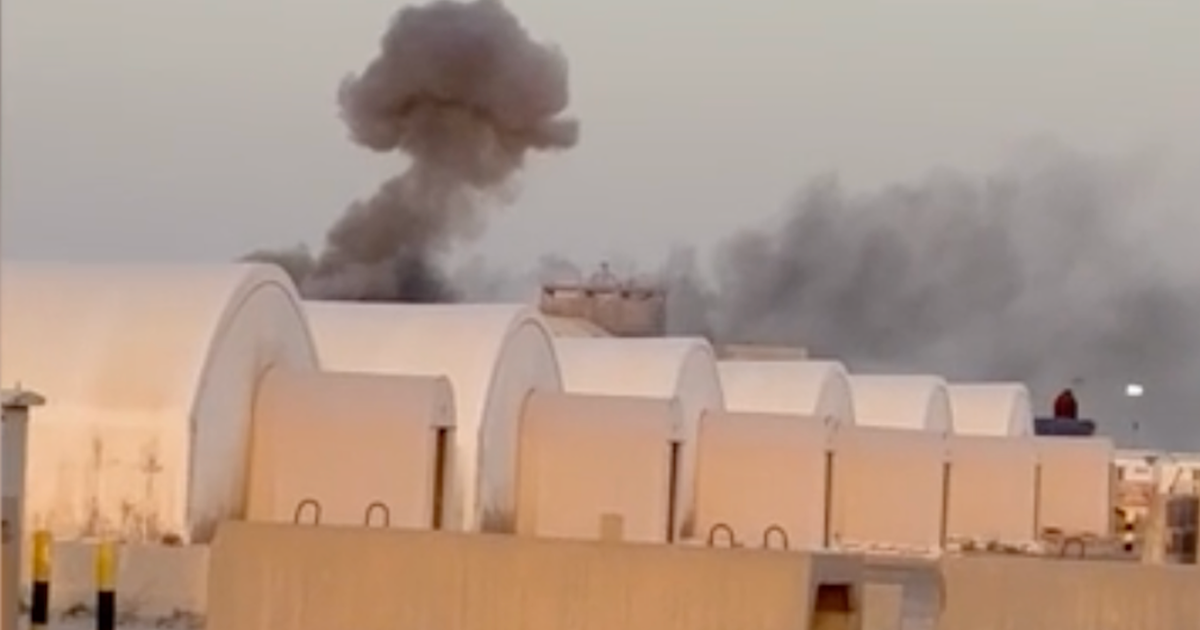
New footage shows Iranian missiles and drones striking Camp Buehring, a major US military base in Kuwait, during the opening months of the war with Iran. The recordings capture explosions, impacts and damage to buildings and military equipment at the installation.
The videos were filmed by a person stationed at the base. Their metadata was examined and the scenes were compared with photographs showing damage at Camp Buehring.
The attacks placed American forces under sustained pressure, with troops repeatedly forced into bunkers. Three US service members also said Iranian F-5 fighter jets were used during the assaults, a claim previously reported in April.
“They ran so close to us I could see their helmets,” one eyewitness said. “They came in, they hit us, and then took off.”
Camp Buehring troops moved into the desert
Most of the roughly 7,000 troops at Camp Buehring, also known as CBKU, had been moved elsewhere before the war as part of the Pentagon’s “get off the X” plan. The term refers to relocating personnel away from positions vulnerable to attack.
More than 100 soldiers nevertheless remained at the isolated base. Those who stayed became concerned that the installation did not have enough capacity to cope with a mass-casualty incident if the attacks continued.
A senior Army logistics official, working from another post in Kuwait, confirmed there were concerns over supplies of .50-calibre ammunition and other specialised munitions, including Patriot missile batteries.
“They hit us bad,” an unnamed source said. “It was horrible. There were a lot of brave guys who stayed to fight there — and people at home don’t know what happened. We had to abandon the base.”
The remaining service members eventually loaded vehicles with the equipment they could carry and drove at night into the Kuwaiti desert. Their remote positions became forward operating bases, where they stayed for an extended period.
No one was killed by enemy fire at Camp Buehring or the forward operating bases. However, two soldiers were injured by lightning during desert sandstorms in late April, according to US officials familiar with the matter.
One suffered burns after a direct strike, while the other sustained a ruptured eardrum. Army leaders had been attempting to move the troops before the incident but were unable to do so quickly enough.
The soldiers left the forward bases in May for Camp Arifjan, before later being relocated to positions inside and outside the Middle East.
“CBKU got demolished,” the source said. “They need to do an investigation. How come no one came to reinforce us?”
Camp Buehring, around 25 miles from the Iraqi border, has served for more than two decades as a staging ground for US forces deploying across the Middle East. The US Central Command declined to comment on the attacks.
Defence Secretary Pete Hegseth said in March that more than 90 per cent of Americans stationed at bases had been moved “off the X” as the US built up offensive combat power and introduced defensive measures.
A Defence Department inspector general’s report found that equipment losses during the war were worth up to 3.7 billion dollars, including nearly 60 aircraft. The Congressional Research Service later reported that 81 fixed-wing, rotary-wing and drone aircraft had been lost or damaged by Iran, citing news reports and Defence Department statements.
The inspector general’s report said US Central Command had recorded Iranian strikes on American bases in Kuwait, Bahrain, Qatar, the United Arab Emirates, Saudi Arabia, Iraq, Oman and Jordan.
