


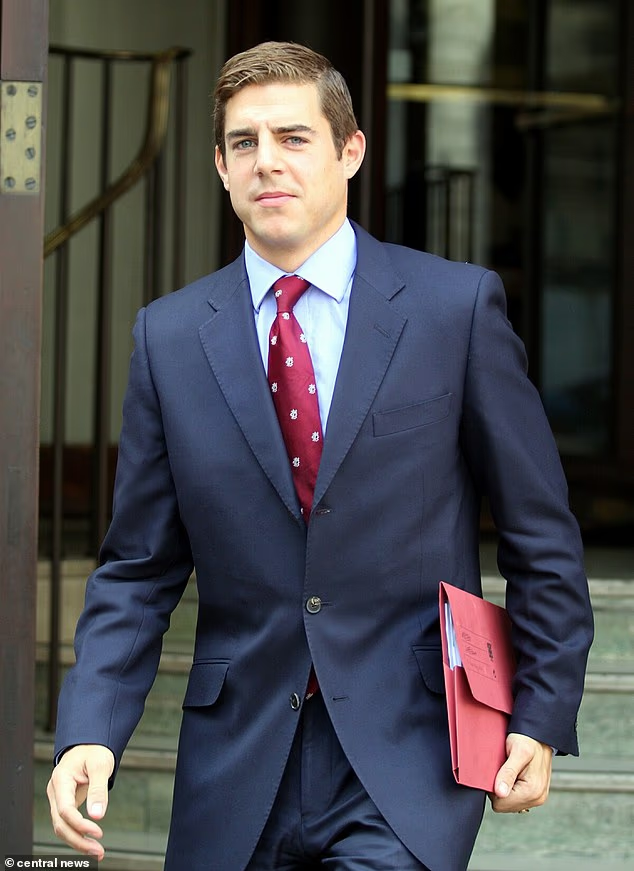
Nicholas Brandram, the former Army captain arrested over the unsolved “Putney Pusher” attack, took his own life on Tuesday after months of pressure, his family said, prompting a referral of the Metropolitan Police investigation to the police watchdog.
Brandram, 44, had been released under investigation earlier this month after detectives reopened their inquiries into the 2017 incident, in which a jogger pushed a woman into the path of a double-decker bus on Putney Bridge.
His sisters, Sophie Voelcker and Alexia Hicks, said he had been suspended from his role as a senior relationship manager at HSBC Private Bank and was living with the “shame, anxiety, humiliation and extraordinary pressure” of the case.
They said the family had “put faith in the justice system” but felt let down. They also claimed Brandram had been awaiting a DNA test which they believed would have cleared him.
Hours after the family issued their statement, the Independent Office for Police Conduct said it had received a mandatory referral from the Met.
The force has insisted that the investigation remains ongoing. Chief Superintendent Dan Knowles said officers were continuing to pursue outstanding lines of inquiry and forensic examinations following Brandram’s release.
“Investigations of this nature, particularly those involving complex evidential and forensic work, can take a number of months to complete as officers gather and assess all available evidence,” he said.
Family says investigation placed Brandram under unbearable strain
Brandram’s sisters said he had told them shortly before his death that “this investigation was murdering him”. They said he had maintained to the end that he was not the man shown in the CCTV footage.
Friends said he had initially been confident that detectives would realise they had arrested the wrong person. One recalled Brandram describing his arrest at his £1.4 million home in Chiswick in June.
“When the police told him at the station that it was on suspicion of being the Putney Pusher, he said: ‘I punched the air with relief because I knew it wasn’t me. I was so relieved.’ He said he knew he was in the clear and so had nothing to worry about,” the friend said.
But his confidence reportedly deteriorated as the inquiry continued and his professional life was affected. He had also separated from his second wife and was concerned about the effect of the allegations on his relationship with his three-year-old son.
A friend who saw him about a week before his death said Brandram had told them: “Everyone knows that I’ve been accused, but I didn’t do it.”
Brandram pointed to differences between himself and the jogger in the footage, including a withered calf dating from his Army service and distinctive blue eyes. His family also said there was “no credible evidence” that he was the man captured on camera.
The Putney Bridge attack
The incident took place during the morning rush hour on May 5 2017. The unnamed 33-year-old woman was crossing Putney Bridge towards Fulham when a man wearing a light grey T-shirt and dark blue shorts approached her.
Footage showed him pushing her into the road, where she fell in front of a bus. The driver’s reaction meant the vehicle’s front wheels missed her head by inches. She suffered minor injuries.
The jogger continued across the bridge and, about 15 minutes later, ran back past the woman while she was still being helped. Police released the CCTV footage three months later, prompting widespread speculation about his identity.
Two men were arrested in 2017, but neither faced further action. The case was closed in June 2018 before being reopened this year after police received new information.
Brandram was also arrested on suspicion of possessing Class A and Class B drugs. He was later released under investigation, a status which carries no conditions or fixed date for a return to a police station.
Brandram’s Army and banking career
Brandram’s former Army colleagues described him as a well-liked and polished figure who had served in Afghanistan, Bosnia and Iraq. He passed out from Sandhurst in 2005 and later received the Queen Elizabeth II Diamond Jubilee Medal.
Friends said he had been deeply affected by the deaths of two fellow soldiers, including his close Sandhurst friend Ralph Johnson, who was killed in Afghanistan in 2006, and Colour Sergeant Alan Cameron, who died after being wounded by an improvised explosive device in 2010.
He left the Army after the Scots Guards’ 2010 Afghanistan tour and moved into financial services, working for Killik & Co and Bank Leumi before joining HSBC Private Bank.
Colleagues remembered him as charming, competitive and well presented. He was a father and had described himself in a recent professional interview as a “co-parenting single father”.
His family said the consequences of the investigation would remain with them “for the rest of their lives”.
Confidential support is available from the Samaritans on 116 123.
