


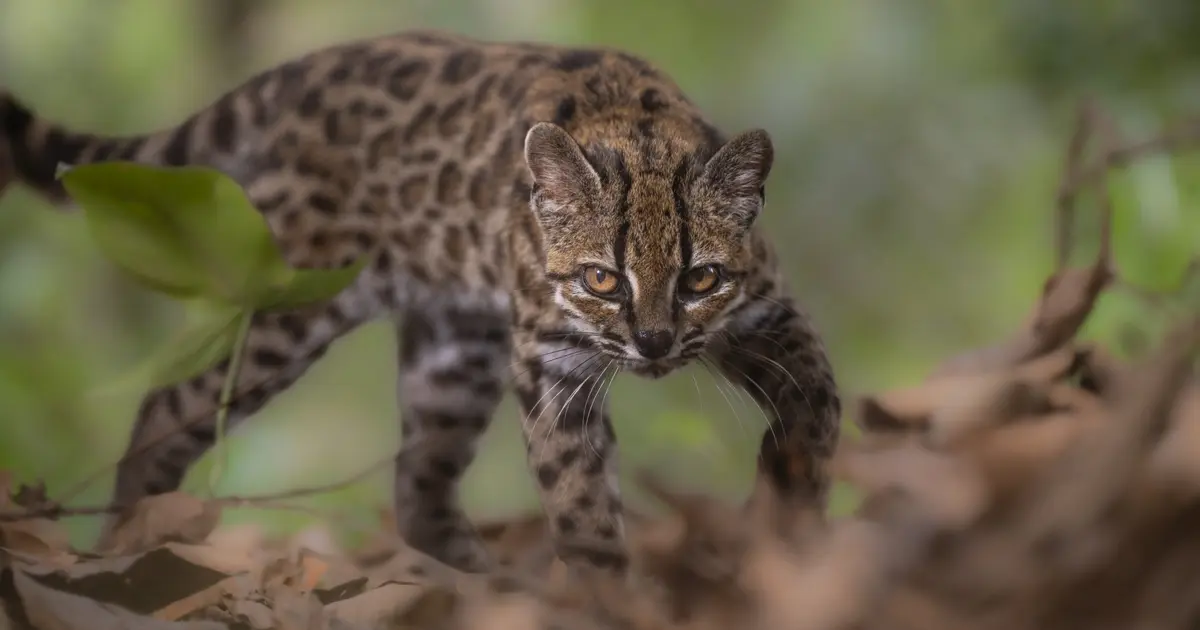
Scientists have identified a previously unknown wild cat species in Bolivia’s cloud forests, the first living feline to be formally described in more than a century.
Named Leopardus tilcayo, the small spotted cat was found in the Yungas, a mountainous region of humid forest on the eastern slopes of the Andes. Local communities have long referred to the animal as a tilcayo.
The discovery was made by an international research team led by Eduardo Eizirik of Brazil’s Pontifical Catholic University of Rio Grande do Sul, with National Geographic Explorer Paola Nogales-Ascarrunz and University of Antwerp evolutionary biologist Jonas Lescroart among the scientists involved.
The cat measures about 46cm from head to body and weighs roughly 1.4kg. Its light-brown coat is marked with irregular dark rosettes, while camera-trap images suggest it is mainly active at night.
Researchers were alerted to the animal after a male was found as a cub near a forest in Bolivia’s Nor Yungas region in 2016. It was initially mistaken for a domestic cat and later taken to the Senda Verde wildlife sanctuary, where the now 10-year-old animal remains in protective captivity.
That individual has become the official specimen representing the new species, known in scientific terms as the holotype. It is currently the only known Leopardus tilcayo living in captivity.
Genetic analysis revealed five tiger cat species
The team compared complete genetic data from 38 tiger cats across South America, including eight preserved museum specimens. The analysis showed that animals once treated as a single tiger cat species actually comprise five genetically distinct species.
The lineage leading to Leopardus tilcayo separated from other tiger cats about 1.4 million years ago. The findings were published in the journal Current Biology.
Tiger cats are known as cryptic species because their physical appearance can be so similar that genetic testing is needed to distinguish them. In addition to the new Bolivian species, the researchers identified a new subspecies in Peru’s Yungas, named Leopardus tigrinus antisuyo.
Scientists have so far gathered only limited information about the tilcayo’s behaviour, population and distribution. Remains found in scat suggest that small rodents form part of its diet, but much more fieldwork is needed to understand how the animal lives.
The discovery also carries implications for conservation. The Yungas forests face pressure from deforestation, agriculture, mining and human-caused fires, while habitat fragmentation threatens many species found in the region.
Tiger cats are currently assessed by the International Union for Conservation of Nature as two vulnerable species. The researchers have submitted their findings for a fresh review of the five separate lineages, with Leopardus tilcayo potentially facing a more serious classification when assessed on its own.
Experts say the finding highlights how much biodiversity remains undocumented, even among well-known groups such as wild cats. It also suggests that some species could be at risk of disappearing before scientists have formally recognised them.
