


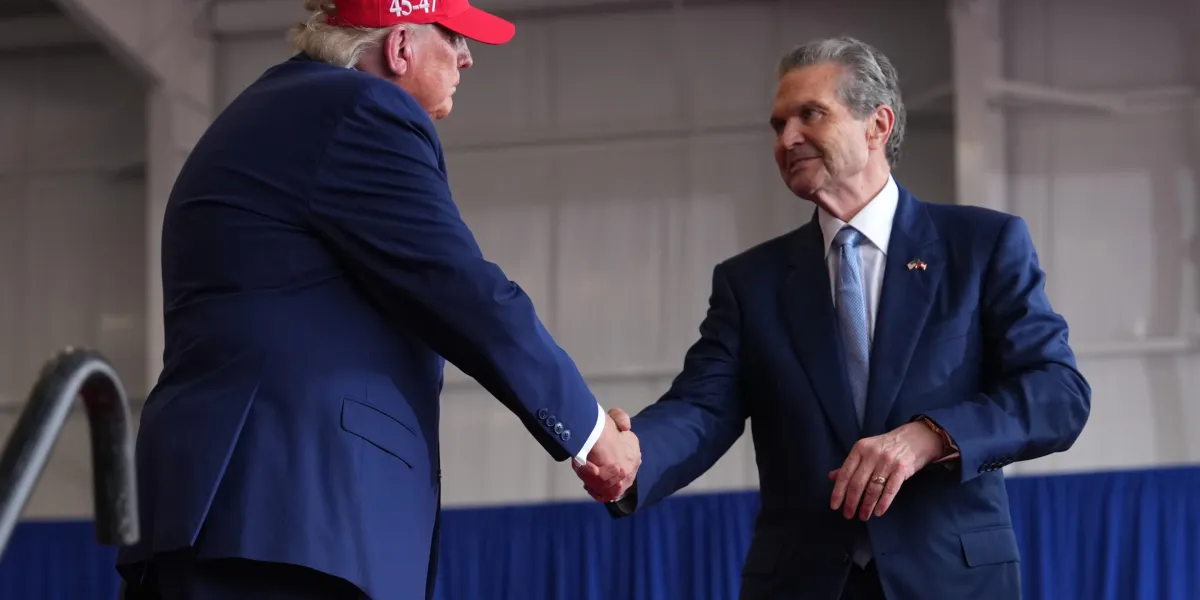
Rick Jackson, the Republican candidate for governor of Georgia, is presenting himself as a softer, more personal alternative to Donald Trump while spending almost $200 million of his own money on the campaign.
The 72-year-old healthcare entrepreneur has drawn on his childhood in poverty and foster care to appeal to working-class voters, while also aligning himself with the president on issues including immigration and business.
His Democratic opponent, former Atlanta mayor Keisha Lance Bottoms, has accused him of trying to buy the election and become a Trump “stooge”. The contest on November 3 is shaping up as a test of whether a more restrained version of conservative billionaire politics can succeed in a key swing state.
Rick Jackson’s foster-care story
Jackson has made his early life central to his campaign. During the only general-election debate, he said his father left when he was nine months old and that his mother, a waitress with a serious alcohol problem, had only a sixth-grade education.
He said he had seven stepfathers before the age of 12, lived in public housing, attended 13 schools and spent time in five foster homes.
Jackson left college at 21 to start a business that eventually became Jackson Healthcare, a major provider of contract nurses and other workers to hospitals and health systems. Public-sector contracts have also contributed to the company’s success and Jackson’s fortune.
His campaign has turned the journey into the slogan “From foster care to billionaire”. At a rally in north Georgia, he described himself as having “severe abandonment issues” before telling supporters: “I will never abandon you.”
He has also highlighted the millions he has spent supporting young people who leave Georgia’s foster-care system at 18. In one advert, he becomes visibly emotional while telling several beneficiaries: “I am so proud of you.”
Jackson describes his wealth in religious terms, saying it is “God’s money” and that his responsibility is to have “kingdom impact”. He has said his personal spending is intended to help Georgia’s 11 million residents avoid hardship.
A changing relationship with Donald Trump
Jackson entered the Republican primary as a relatively unknown figure outside political and business circles, despite his links to healthcare policy, taxation and state contracts. He defeated Lieutenant Governor Burt Jones in a run-off after Jones had secured Trump’s endorsement in August 2025.
During the primary, Jackson promised to be “like Trump, but with Southern tone” and said he would bring Georgia the same kind of business approach he associated with the president.
He also adopted a hardline position on immigration, pledging to make Georgia a national leader in deportations. One advert said people who entered the country illegally and committed violent crimes would be “deported or departed”.
The advert was later dropped. In a subsequent campaign film, Jackson’s grandchildren question his harsh image before encouraging him to appear more relaxed, with a pickup truck, a dog and different clothes.
Jackson has since moderated his public presentation, as voters express frustration over inflation and the war in Iran. Although he appeared with Trump in July and said he hoped to become “this guy’s favorite governor”, he did not mention the president in a speech at a rally in Dalton on October 16 until Trump called him on stage.
Jackson was due to join Trump at a rally in Perry on Saturday, which would be their second appearance together during the final stretch of the campaign.
Tax cuts and healthcare promises
On policy, Jackson has retained conventional Republican pledges to reduce taxes and regulation and cut what he calls waste. He has promised to halve Georgia’s state income tax within four years and said he would not seek a second term if he failed.
He also wants a balanced budget, full audits of state spending, higher teacher salaries and greater investment in vocational education.
Jackson says he can widen healthcare access without expanding Medicaid under the Affordable Care Act, instead relying on partnerships with private insurers. Such a plan would require federal approval and financial support.
Bottoms has sought to undermine Jackson’s claims to represent ordinary Georgians. During the debate, he said his plumber drove a Mercedes and suggested that people in Atlanta had felt unsafe “at the gas store” during her time as mayor.
When an audience member asked about the minimum wage and the cost of basic necessities, Jackson replied: “Hopefully, you’re not the one that is getting the $7.50 an hour.” The minimum wage is $7.25, while Bottoms has proposed doubling it. Jackson has not backed an increase, saying instead: “My focus is creating jobs. I’ve been creating jobs my entire life.”
Some voters remain receptive to his account of hardship and wealth. Debbie Satterfield, a 72-year-old supporter wearing a Trump shirt and a Jackson sticker, said his rise from poverty reminded her of her own life and that voters could “see his soul”.
