


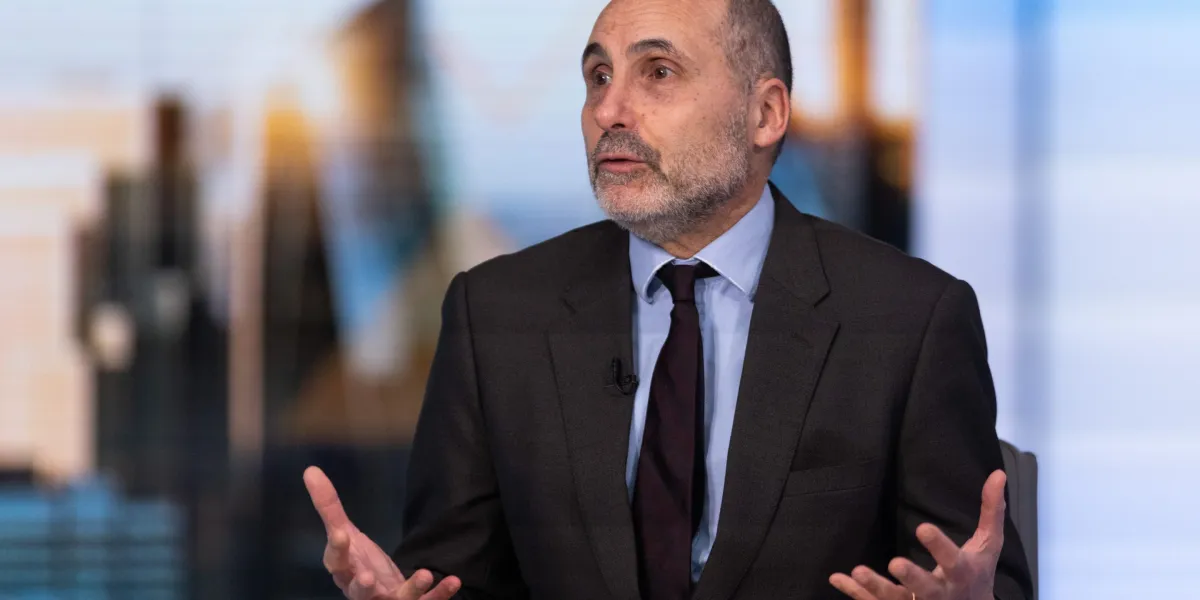
Goldman Sachs strategist Peter Oppenheimer has sharpened his warning that an AI earnings bubble may be forming, arguing that technology companies and governments are competing for a limited pool of capital as spending on data centres, energy and defence increases.
In a report titled “Competition for Capital”, Oppenheimer stopped short of saying that such a bubble definitely exists. But he linked the risk to rising borrowing costs, surging technology investment and record corporate bond issuance, while taking a more cautious view of the near-term outlook for equities.
The report develops a concern first raised by Oppenheimer in August, when he said there appeared to be no valuation bubble in technology stocks but that an “earnings bubble” could be building.
At the time, he pointed to sharp market reactions to company results. Microsoft shares rose 17 per cent in a single day after strong earnings, while Meta fell almost 10 per cent despite beating forecasts. The equal-weighted S&P 500 also outperformed the cap-weighted index by its widest margin since 2009.
Oppenheimer interpreted those moves as evidence that investors were becoming less certain about how concentrated the market’s earnings growth had become. His latest report sets out a more specific explanation: AI infrastructure investment is competing with increased government borrowing for savings and investment funds.
Capital spending by AA-rated technology issuers rose 65 per cent year on year in the second quarter, according to the report. Aggregate AA-rated capital expenditure has now grown by more than 35 per cent for ten consecutive quarters.
US convertible bond issuance has reached 135 billion dollars so far this year, with AI-related borrowers accounting for 44 per cent of the total. Goldman Sachs’s credit team has also increased its forecast for full-year US investment-grade issuance by 200 billion dollars to a record 2.3 trillion dollars, with AI-related companies responsible for a quarter of the supply.
Capital competition pushes up long-term borrowing costs
Oppenheimer’s argument has found a parallel in analysis from Torsten Slok, chief economist at Apollo Global Management. Slok said the period when surplus savings chased too few investment opportunities had given way to a shortage of capital.
“Today, there are more projects than capital … When projects are abundant and capital is scarce, capital competes for projects, and it competes by demanding a higher return,” Slok wrote. “The return that clears the market is a higher yield.”
He said the pressure was already visible in bond markets. Spreads on the longest-dated bonds issued by hyperscalers have widened, while much of the debt issued this year is trading at higher yields than when it was sold.
“Investors are still buying. They are just charging more,” Slok said.
Both strategists linked the pressure particularly to long-term borrowing costs. Data centres, power generation, transmission projects and government deficits all require long-duration funding, Slok said, concentrating the competition for capital at the longer end of the yield curve.
Technology earnings remain strong but exposed to a slowdown
Oppenheimer compared the current situation with the build-up to the 2008 financial crisis, when bank earnings were boosted by rapidly rising leverage even though bank shares themselves had not reached the extreme valuations seen in some earlier market bubbles.
He said technology companies currently looked more resilient. Profits remained “very robust”, balance sheets were “strong overall” and interest coverage across the S&P 500 ranked in the 99th percentile of the past 20 years. The median company’s coverage ratio ranked in the 68th percentile.
He also argued that demand for AI computing was accelerating faster than supply, rather than being driven by an already inflated asset. Microsoft has said it plans to triple its data-centre capacity within six years, while Nvidia has forecast that the AI market could be worth 3 trillion to 4 trillion dollars by 2030.
However, Oppenheimer warned that the strength of the sector did not remove the risk posed by higher financing costs. “Any slowdown in profit growth, in an environment of a much higher cost of capital, could put downward pressure on equity prices,” he wrote.
Such a shift could reduce confidence in future cash flows across the AI investment chain, from the large technology companies funding data-centre construction to the chipmakers and infrastructure suppliers benefiting from the spending boom.
That tension was illustrated on September 14, when Nvidia fell more than 3 per cent and other chipmakers dropped between 5 per cent and 6 per cent after calls for a slowdown in frontier AI development on safety grounds. The Philadelphia Semiconductor Index fell by almost 6 per cent.
Alphabet, Microsoft and Meta, the companies financing the expansion, rose on the same day. Gil Luria, head of technology research at D.A. Davidson, said the divergence reflected the fact that hyperscalers could pause new construction and earn returns from infrastructure already built, while chip and infrastructure suppliers had no equivalent option.
