


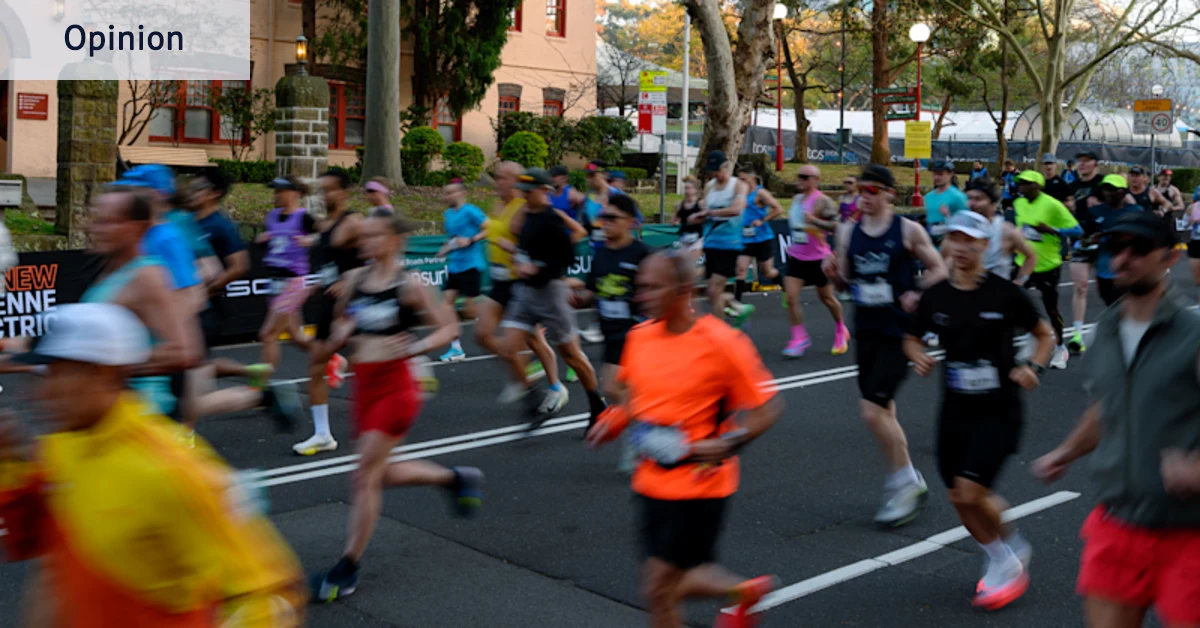
Messages of hate directed at Israelis during the Sydney Marathon have drawn criticism for bringing the Israel-Gaza conflict into an event intended to unite tens of thousands of runners.
More than 40,000 competitors took part in Sunday’s race, which began in North Sydney and finished at the Opera House after a 42.195km course through the city.
Among the field was a 50-strong Israeli delegation running to raise money and awareness for Shalva, an organisation providing support for people with disabilities and their families. The team said every member completed the marathon.
Small groups of pro-Palestinian protesters gathered at points along the route. They waved Palestinian flags and displayed placards condemning the participation of current and former Israeli military personnel, while some called for Israel-linked runners to be excluded from the event.
The race itself continued without disruption, according to reports from the event. But accusatory slogans directed at Israelis were described as especially jarring by Jewish participants and observers, who said the language risked treating individual runners as responsible for the actions of a government or military.
Orly Lavee, a Sydney-based doctor who ran in the marathon, said the signs were difficult to regard as separate from the current atmosphere surrounding Jewish and Israeli communities.
She argued that there was a distinction between legitimate criticism of the Israeli government and hostility towards people because of their nationality, ethnicity or perceived association with Israel.
“It was immediately dispiriting not because politics should be confined to parliament, or because protest should always be polite,” Dr Lavee wrote. “But protest is supposed to communicate something. At its best, it persuades, illuminates, demands, challenges or mobilises.”
She questioned whether confronting ordinary runners could advance the cause of Palestinian rights, particularly when those people had no power to change government policy and might not be the intended audience for the protest.
Shalva delegation leader Itamar Shevach said the team’s purpose was to support people with disabilities and their families in Israel and internationally. The organisation serves Jewish, Muslim, Christian and Druze Israelis.
The participation of the Israeli group had been opposed before race day by campaigners, who claimed that some members had served in the Israel Defence Forces. The Australian Centre for International Justice said at least 39 Israeli nationals had travelled to Australia for the marathon, including people reportedly deployed in Gaza, the West Bank or Lebanon.
Those claims were part of a wider campaign urging the Australian authorities and marathon organisers to prevent the delegation from taking part. The organisers nevertheless allowed the team to compete, and the event was completed peacefully.
The controversy has renewed debate over where criticism of Israel ends and antisemitism begins. Dr Lavee said neither issue should be reduced to simplistic opposing positions, but warned that public spaces could be damaged when people are expected to answer for governments, armies or political movements with which they are associated.
“Australia works, imperfectly but remarkably, because people can arrive carrying different histories, religions, languages, loyalties and inherited griefs and nevertheless meet one another in a public space without demanding that every person answer for everything done by someone who shares their ethnicity, nationality or faith,” she wrote.
