


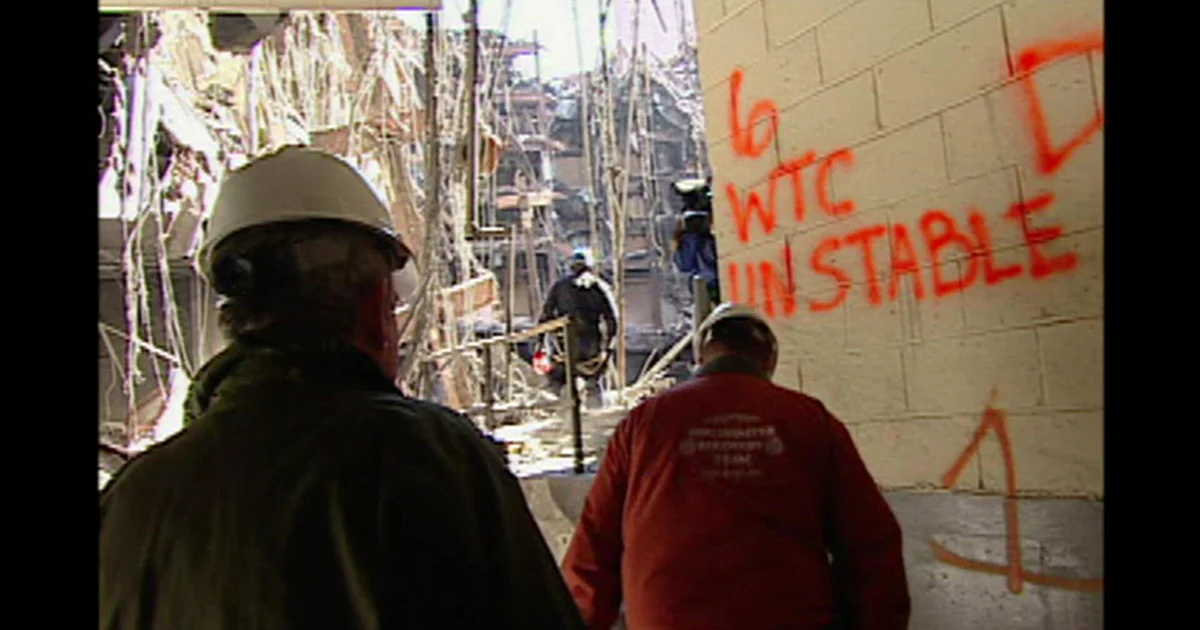
The dangerous underground cleanup at Ground Zero was under way several months after the 11 September attacks, as crews entered a shattered complex of basements, tunnels, garages and railway infrastructure beneath the World Trade Centre site.
A 60 Minutes II report broadcast on 31 October 2001 showed correspondent Dan Rather being taken below the ruins by Ken Holden, New York’s Department of Design and Construction commissioner and the official overseeing much of the recovery operation.
Large sections of the collapsed towers had punched through World Trade Centre Building 6 and continued down through the underground levels. Some pieces of the falling structure were estimated to weigh as much as 30 tons.
Inside, offices had been crushed into the basements, vehicles were left burnt out or hanging over collapsed parking structures, and daylight entered through holes created by the falling debris. Smoke remained in the air and fires were still burning below ground.
World Trade Centre underground cleanup faced collapse and flooding risks
The descent was made more dangerous by cracked walls, buckled concrete floors and unstable sections of the building. Rather was warned to avoid standing beneath concrete slabs that were being held in place only by wires.
The underground area had once been a busy city beneath the city, containing shops, restaurants, car parks and transport links. Thousands of people used the complex each day, including commuters travelling through the PATH terminal and the subway system.
The PATH station, six storeys below Ground Zero, was left deserted after the attacks. Trains and stations had been evacuated before the towers collapsed, preventing further deaths underground.
Engineers also faced the risk of losing the slurry wall, a vast underground retaining structure designed to keep water from the Hudson River out of the World Trade Centre’s six basement levels. The wall had been supported by the basement floors, many of which had buckled or disappeared.
Holden said engineers expected to drill into the wall and anchor it to bedrock with cables and concrete. More than 1,000 cables could eventually be required to prevent the barrier from giving way and flooding the site and nearby transport tunnels.
At the time of the broadcast, about 400,000 tons of debris had been removed, against an initial estimate of roughly 1.2 million tons. The operation had begun as a search for survivors before becoming a recovery effort for victims and evidence, alongside the clearance of the devastated site.
Later government assessments put the final volume of material removed at nearly 1.6 million tons. The debris was transported to Fresh Kills landfill on Staten Island, where it was screened and sorted for human remains, personal effects and evidence.
The clearance work continued around the clock and officially ended on 30 May 2002. By then, the underground structures and the unstable remains of the World Trade Centre had been painstakingly cleared, allowing the long process of rebuilding Lower Manhattan to begin.
