


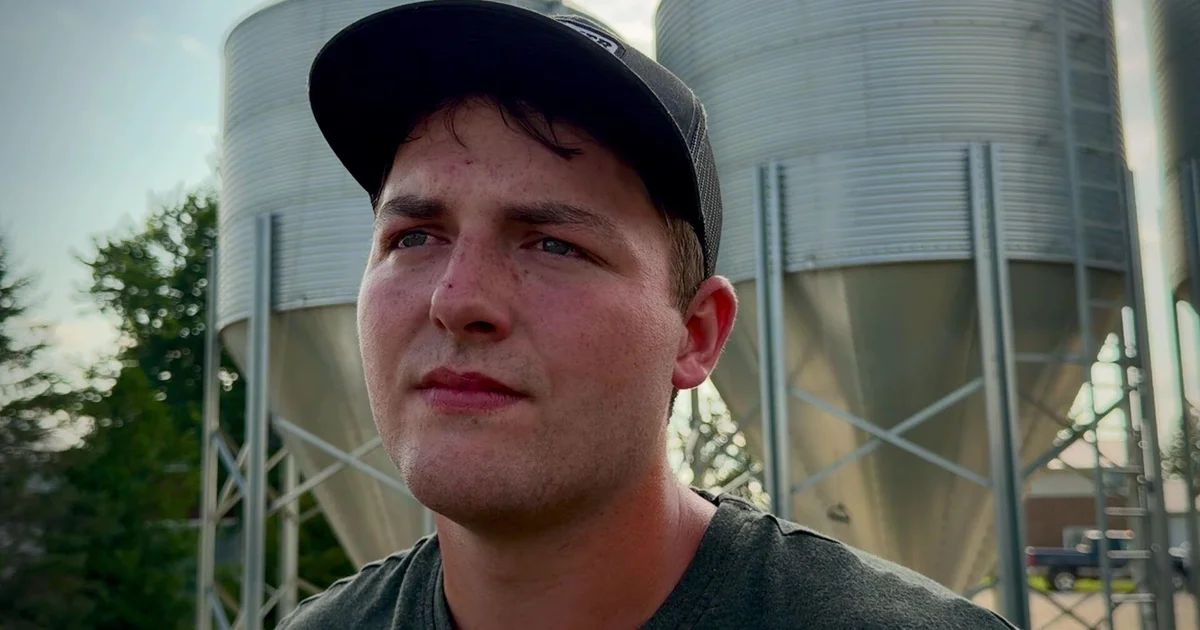
The son of an Iowa farmer convicted of murdering his wife has renewed his fight to clear his father, insisting that her death was a tragic accident rather than a deliberate killing.
Trysten Mullis was 13 when his mother, Amy, died on the family farm in November 2018. His father, Todd Mullis, was convicted less than a year later after prosecutors argued that he had attacked Amy with a corn rake.
Todd has always denied killing his wife. His new legal team says expert evidence overlooked at the original trial supports his account that Amy fell on the rake while retrieving a pet carrier from a shed.
An Iowa judge has rejected Todd Mullis’s application for a new trial, ruling that he had received a fair trial with competent legal representation. His lawyers are preparing an appeal.
The corn rake death on the Iowa farm
Amy had returned to work on the farm four days after a minor medical procedure. Trysten said she appeared dizzy and unsteady while cleaning glass light fittings in a hog barn.
She agreed to go back to the house and rest, but was asked to collect a pet carrier from a red shed. About an hour and a half later, Trysten went to look for it and found his mother on the ground with a corn rake in her back.
He called for his father and the pair placed Amy in a truck while contacting emergency services. She later died in hospital.
The state medical examiner, Dr Kelly Kruse, classified the death as homicide. Amy had suffered six puncture wounds, while the rake had four tines, and Dr Kruse told the trial that the injuries suggested she had been impaled at least twice.
Investigators argued that Todd had a motive because Amy was having an affair and intended to leave the marriage. Her brother said she had told him Todd would “flip out”, while a friend testified that Amy had been afraid he would kill her.
Prosecutors also pointed to searches on a Google account linked to Todd, including queries about unfaithful wives and killing cheating women. Todd said he had not made the searches and denied knowing about the affair.
At trial, Todd’s lawyer argued that Amy had been deliberately murdered, but said someone other than Todd was responsible. The defence did not present the accident theory that Todd’s new lawyers now say should have been investigated.
Son disputes the prosecution’s timeline
Trysten was the only other person working with Todd on the farm that morning, making his evidence central to the case. He initially told police he had been with his father throughout the morning, but later said he had briefly left twice to get a drink of water.
Prosecutors argued that Todd could have used the time when his son was out of sight to reach the shed, kill Amy and return. Trysten now says the breaks lasted only seconds and that his father could not have completed the journey without being seen or heard.
He said the alternative route involved travelling the length of the barn, crossing the farm and returning a distance equivalent to about four football fields. Todd, he added, did not appear out of breath, panicked or dishevelled when Trysten saw him.
“I know for a fact he didn’t do it,” Trysten said. “Because I was there, nobody else was there but me.”
Trysten also alleged that he had been pressured to answer “I don’t know” when questioned about how long his father had been out of sight. In an affidavit signed when he was 17, he said he had been threatened with juvenile detention and being removed from school if he did not give that answer.
Amy’s stepfather denied pressuring him, saying the family had only told the children to tell the truth. Trysten has said the issue remains sensitive and did not testify at the hearing, although a deposition was submitted.
Experts support accident theory
Todd’s new lawyers commissioned Dr Jennifer Hammers, a forensic pathologist, and Dr Valentina Ngai, a biomechanical engineer, to examine the evidence and reconstruct what happened.
They concluded that the pattern of injuries did not fit repeated blows from a swinging rake. Instead, they said, Amy may have fallen backwards on to it and injured herself further while trying to escape.
The experts argued that three of the rake’s tines could initially have pierced her coat and back. As Amy struggled to free herself, they said, the rake may have shifted, producing additional wounds from a different direction.
They also highlighted photographs of Amy’s coat which, they said, showed fewer holes than the number of puncture wounds in her body. That, they argued, was inconsistent with someone repeatedly striking her through her clothing.
Dr Hammers said the medicines Amy had been prescribed after her procedure could cause dizziness or sleepiness. The experts also identified the dark, narrow shed and farm equipment on the ground as possible factors in a fall.
Dr Kruse rejected the new interpretation when questioned at the hearing. She said there was no other way to account for the injuries and that the new evidence had not changed her opinion that Amy’s death was a homicide.
Family divided over Todd Mullis conviction
Todd’s relatives believe the new scientific evidence demonstrates that Amy’s death was accidental. His lawyers argue that the original defence failed to investigate that possibility and that a jury might have reached a different verdict had it heard the evidence.
Amy’s mother, brother and stepfather continue to support the murder conviction. Her brother described the accident theory as an attempt to retry the case using “alternate facts and alternate theories”.
The judge who considered Todd’s application said the original jury had found Dr Kruse credible and that her evidence was consistent with the other material on which it relied. Todd’s lawyers say the ruling summarised the new science without properly analysing it.
Trysten, now 21, attended the six-day hearing and saw his father for the first time in six years. He said he broke down when they met and remains determined to secure his release.
“I lost both of my parents at 13,” he said. “I’m fighting every day for you. I’m fighting to get you home.”
