


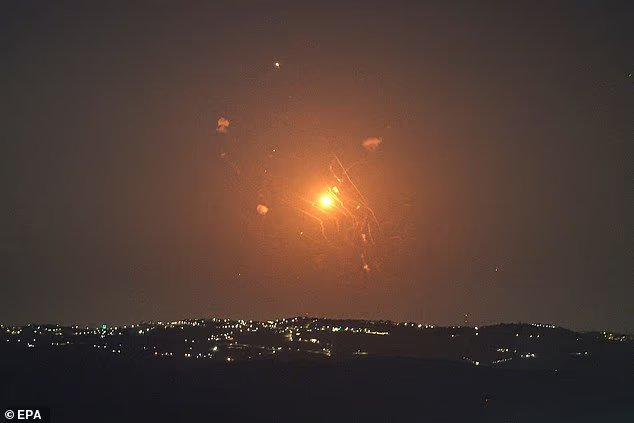
Iran has launched a new wave of attacks against US targets in the Middle East after American forces destroyed five Iranian oil tankers, intensifying a six-month-old conflict and sending oil prices towards $100 a barrel.
The Islamic Revolutionary Guard Corps said it had targeted US vessels attempting to pass through the Strait of Hormuz, while Iranian missiles were fired towards the Al-Azraq air base in Jordan, where American forces are stationed.
Jordan’s armed forces said their air-defence systems intercepted 18 of 20 ballistic missiles launched from Iran. The remaining two fell in unpopulated areas and no casualties were reported, according to the military.
The Revolutionary Guards claimed its missile barrage damaged facilities used to maintain and deploy US fighter aircraft, as well as aircraft shelters. The claims could not be independently verified.
A US official said the attack had been ineffective and that all American troops in Jordan were accounted for.
Iran threatens tankers in Gulf
The latest escalation followed US strikes on five Iranian crude carriers on Tuesday. US Central Command said the vessels’ crews had been ordered to abandon ship before the tankers were hit and rendered inoperable.
Washington said the strikes were retaliation for two attempted Iranian attacks on a US warship over the previous two days. No American personnel were injured.
Secretary of State Marco Rubio said Iran would pay an economic price whenever it targeted US naval forces.
“Iran continues to try to hit US naval ships. And for every time they do that or try to do that, they’re going to lose tankers,” Mr Rubio told reporters during a visit to Colombia.
Iran’s army chief of staff, Ali Abdollahi, had warned that US bases across the region would be targeted if Iranian tankers were attacked.
The Revolutionary Guards also warned crews aboard oil tankers near Kuwait and Bahrain to leave their vessels, saying the ships could become targets. The two countries host US forces and are key locations for energy shipments through the Gulf.
Oil prices rise as Strait of Hormuz remains choked
The confrontation has further disrupted traffic through the Strait of Hormuz, a crucial route for global oil and liquefied natural gas supplies. Iran has sought to control vessels using the waterway since the war began, requiring ships to obtain permission and pay transit fees.
Brent crude rose to $99.46 a barrel in Asian trading, while West Texas Intermediate, the main US benchmark, reached $94.45. Traders are increasingly concerned that further attacks on shipping could restrict supplies from the oil-rich Middle East.
US maritime authorities have warned that the risk of Iranian attacks on commercial vessels remains high across the Persian Gulf, the Strait of Hormuz and the Gulf of Oman.
Iran has also claimed to have seized an American unmanned underwater vessel in the strait. The US military said the drone had malfunctioned and was an older model carrying no sensitive information.
Iranian state television separately reported that the Revolutionary Guards had attacked two US destroyers with ballistic missiles. The US military had not immediately commented on that claim.
