


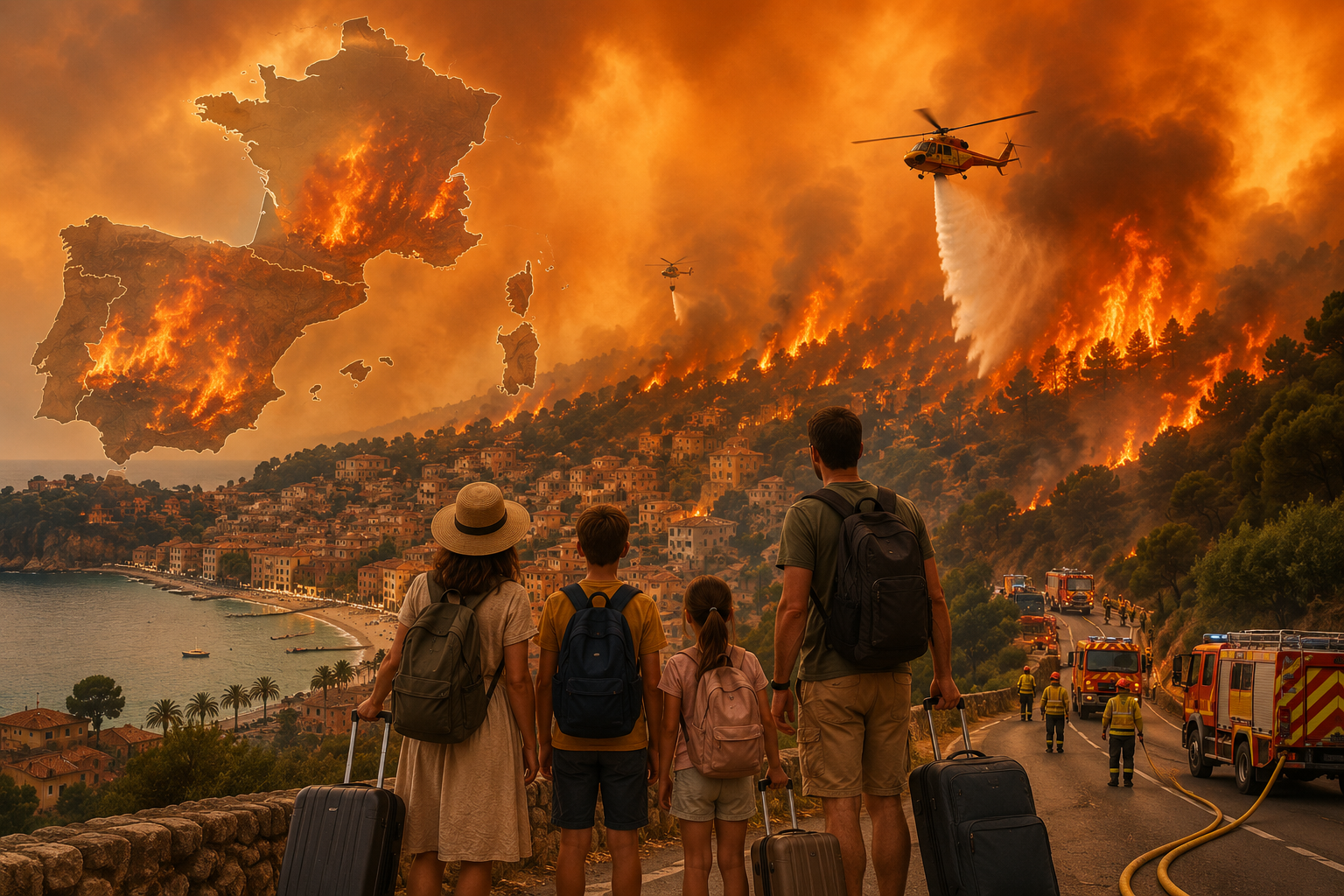
Europe is fighting one of its worst wildfire seasons in living memory, in the middle of the peak holiday season. By July 28, the fires had killed at least 16 civilians and three firefighters, forced more than 320,000 people from their homes in Spain and France alone, and burned an area well above the 20-year European average — with President Emmanuel Macron describing the blazes around Bordeaux as France’s worst fire disaster since the Second World War. But the picture varies enormously from country to country: some regions are in genuine emergency, while most of Europe’s holiday destinations are operating completely normally. Here is the country-by-country status, what official travel advice says, what your refund rights actually are — and why governments seem powerless to stop the flames.
Quick Answer: Is It Safe to Travel to Europe?
For the vast majority of destinations — yes. The UK Foreign Office (FCDO) has not advised against travel to any of the affected countries. The genuine danger zones are specific and limited: the Madrid–Ávila–Toledo area of central Spain, the Castellón area on Spain’s east coast, and the Gironde and Landes departments of south-west France around Bordeaux. Portugal and Greece fought serious fires earlier in July but have eased; Italy and Turkey are battling significant blazes away from most resorts. Coastal Spain, the islands, Paris, the French Riviera, the Greek islands and the Algarve are operating normally. Check the FCDO page for your destination before flying, and call 112 anywhere in Europe in an emergency.
Country-by-Country: Where the Fires Are (July 28)
Spain — national emergency around Madrid
Spain is fighting one of the largest wildfires in its recorded history west of Madrid, burning since July 20 across more than 111,000 acres, with a national emergency declared for the Madrid and Ávila regions and more than 63,000 people evacuated in the Madrid area. The worst-affected zones are western Madrid, Ávila and Toledo, plus an uncontrolled blaze near Castellón on the eastern coast. Prime Minister Pedro Sánchez, who said more than 170,000 hectares have burned in Spain this year — six times the figure at this point last year — admitted on July 26: “The scale of the disaster we are living through is very hard to accept.” There is cautious good news: Madrid’s regional president says the fires near the capital are improving little by little, and crews are using controlled burns near Cebreros to halt the spread. Tourist impact: Madrid city itself is not under evacuation, but smoke, road and rail disruption affect the wider region; the Mediterranean coast, Balearics and Canaries are unaffected.
France — the worst fire disaster since WWII
The Gironde region around Bordeaux is currently Europe’s biggest wildfire hotspot. The main fire had consumed some 42,000 hectares by July 26 — helping push France past roughly 115,000 hectares burned this year, a national record — and authorities have evacuated about 220,000 people from Gironde, 36,000 from Landes and around 3,000 from Var, with 4,000 more ordered out of the resort town of Lacanau on July 28. Two firefighters have died, more than 240 homes have burned in the village of Le Porge alone, and the fires are so intense they have generated “fire clouds” — a phenomenon never before recorded in France. Officials warn the blazes may smoulder for months, heat warnings now cover the fire zones, and millions of FFP2 masks are being distributed against the smoke. Tourist impact: the Atlantic coast south-west of Bordeaux — including Cap Ferret and Lacanau — should be avoided entirely; Gironde’s prefect has urged tourists to stay away. Paris, the Riviera, and the rest of France are unaffected, and tourism officials are urging visitors not to cancel trips elsewhere.
Portugal — eased after a brutal start
Portugal lost roughly 30,000 hectares earlier this season, including a 13,000-hectare blaze in the north that triggered EU assistance in early July — but fire activity has eased in recent days, and Portugal is now lending 129 firefighters and 41 vehicles to Spain. Tourist impact: Lisbon, Porto and the Algarve are operating normally; stay alert in rural inland areas, where risk remains high.
Greece — quiet for now, but on alert
Greece battled serious fires in early July — including a blaze that sent toxic smoke over Thessaloniki and another west of Athens — but activity has eased, and Greek crews and aircraft are currently helping Spain. With temperatures forecast to climb again, however, Greece remains on elevated alert. Tourist impact: Athens and the islands are operating normally; monitor local alerts during the coming heatwave.
Italy — significant fires, one firefighter dead
Italy is battling significant blazes, and one Italian firefighter has died in the effort — even as Italy sends water bombers and personnel to Spain. Rising temperatures this week put central and southern regions at further risk. Tourist impact: no major tourist region is currently under evacuation, but check local alerts, especially in the south and on the islands.
Turkey — fighting fires while sending help
Turkey is contending with significant wildfires of its own this season while still promising additional aircraft to Spain. Fire danger across parts of the country is rated very high as the new heatwave builds. Tourist impact: the main resort coasts are operating normally; follow local guidance inland.
UK, Ireland and the Balkans — the surprise entries
In a sign of how far Europe’s fire map is spreading, smaller wildfires have been reported in the UK, and the EU’s official fire danger maps currently show pockets of very extreme conditions across the British Isles and Ireland, with elevated danger in the western Balkans. None of these currently threaten travel — but a continent where Britain appears on the wildfire danger map is the clearest evidence of how the climate has shifted.
What Official Travel Advice Says
The FCDO updated its Spain and France guidance on July 24. It has not advised against travel to any affected country — the threshold that unlocks automatic refunds — but confirms Spain’s national emergency, urges travellers to follow local authorities, and lists the Europe-wide emergency number 112 (or 18 for the French fire service). France runs a wildfire information line for travellers: +33 (0)9 70 80 90 40 (09:00–17:00, option 1 for Gironde). The US Embassy in Spain has warned its citizens against all unnecessary travel around the Madrid outskirts, relaying local advice to stay indoors with windows shut, avoid outdoor exertion and consider masks outside.
Can I Cancel My Holiday and Get a Refund?
The rule most travellers don’t know: if the FCDO has not advised against travel to your destination, you have no automatic right to cancel and get your money back. Refunds generally become available in only three situations:
- Official advice changes — if the FCDO advises against travel to your specific area, package holiday firms must refund or rebook you.
- The fire directly affects your booking — accommodation inside an evacuation zone, or a blaze within a defined radius of it; contact your operator immediately.
- Your transport is cancelled — flights or trains cancelled because of the fires trigger a refund or rerouting under passenger rights rules.
Nervousness about smoke in the region doesn’t qualify: that counts as “disinclination to travel,” which standard insurance excludes. Better moves: ask your operator about free date changes (many offer goodwill flexibility during emergencies), check whether your policy has a travel-disruption extension, and wait until nearer departure before cancelling unilaterally — official advice can change fast.
Why Is This Happening?
Three ingredients aligned in the worst order. First, June’s record heatwave — which caused thousands of excess deaths and which scientists at World Weather Attribution say would have been virtually impossible without climate change — left the continent tinder dry, with a fourth heatwave of the summer now arriving and 40C+ forecast for Seville and Bordeaux. Second, an unusually wet winter grew vegetation thick across southern Europe, which the heat then cured into fuel. Third, humans supplied the sparks: most wildfires begin with carelessness — barbecues, cigarettes, equipment — or arson. Extreme heat doesn’t start fires; it turns every mistake into a catastrophe.
Why Can’t Governments Stop the Fires?
The question filling social media deserves a straight answer — and it’s structural, not one government’s failure:
1. The fires have outgrown the firefighting. Mega-fires now jump firebreaks and motorways, generate their own weather — France’s “fire clouds” — and burn beyond what water-bombers can extinguish. When authorities say the Gironde fires may not be out for months, they are admitting that at this scale the strategy becomes containment and evacuation, not extinction.
2. Everyone is burning at once. Europe’s safety net is the EU Civil Protection Mechanism: countries share crews and aircraft when one is overwhelmed. This summer stress-tested it to the limit. The rescEU fleet pre-positioned its largest force ever — 777 firefighters, 22 planes and 5 helicopters across 12 countries — and by late July the traffic ran in every direction at once: Italy, Portugal, Greece and Turkey sending help to Spain, rescEU aircraft surging into France, ten Spanish regions reinforcing Madrid. It still wasn’t enough to prevent the emergency. When four countries burn simultaneously, solidarity arithmetic stops working.
3. Money goes to fighting fires, not preventing them. Fire scientists have argued for years that budgets flow overwhelmingly to suppression — planes, trucks, summer crews — while the unglamorous work that actually limits mega-fires goes underfunded: clearing deadwood, thinning forests, firebreaks, controlled burns. Prevention is cut in quiet years and regretted in loud ones.
4. The countryside emptied out. Decades of rural depopulation across Spain, Portugal, France and Italy left millions of hectares of abandoned farmland and forest that nobody clears or grazes. Where working villages once broke up the landscape, continuous fuel now runs for miles — which is exactly how single fires reach 40,000 hectares.
5. The climate is outpacing the response. Fire seasons start earlier, run later and reach further north every decade — this year even Britain and Ireland appear on the EU’s extreme-danger maps. Rebuilding forestry policy and emergency capacity takes decades; the conditions are changing in years. Governments aren’t ignoring the problem — they’re losing a race whose speed they don’t control.
If You’re Traveling Anyway: Safety Rules
Never approach or photograph an active fire zone — you endanger crews as well as yourself. Obey evacuation orders instantly, keep your phone charged with local alerts enabled, and build slack into transfers, because road and rail closures appear without warning. If smoke reaches your resort: indoors, windows shut, exertion down, mask on if provided.
Traveling to Spain for the August 12 solar eclipse? The path of totality crosses northern Spain, away from the current Madrid-region fires — but with extreme fire danger forecast through August, re-check the FCDO page and local alerts in the days before you fly, and keep your viewing plan flexible.
FAQ: Europe Wildfires 2026
Which countries are affected by the 2026 wildfires?
Spain and France are the epicentre, with a national emergency around Madrid and record-breaking fires near Bordeaux. Portugal and Greece fought major fires earlier in July but have eased; Italy and Turkey are battling significant blazes; and smaller fires plus extreme fire-danger ratings have even reached the UK and Ireland.
Is it safe to travel to Spain right now?
Yes, for most of the country. The FCDO has not advised against travel. Avoid the Madrid–Ávila–Toledo emergency zone and the Castellón fire area; the Mediterranean coast, Balearics and Canaries are unaffected.
Is it safe to travel to France?
Yes, outside the south-west. The danger is concentrated in Gironde and Landes around Bordeaux, where officials have told tourists to stay away and evacuated resort areas including Lacanau. Paris, the Riviera and the rest of France are operating normally.
Are Greece, Italy, Portugal and Turkey safe for holidays?
Broadly yes. Greece and Portugal’s fires have eased, and no major resort area in Italy or Turkey is under evacuation — but all four remain on elevated alert as the next heatwave builds, so monitor local warnings.
Can I get a refund if I cancel my holiday because of the wildfires?
Usually not, unless the FCDO advises against travel to your destination, your accommodation is directly affected or evacuated, or your flight is cancelled because of the fires. General worry counts as disinclination to travel, which insurance doesn’t cover — ask your operator about flexible rebooking instead.
How bad are the 2026 wildfires compared to previous years?
Among the worst on record. At least 19 people have died, more than 320,000 have been evacuated in Spain and France, France has set a national record with about 115,000 hectares burned, Spain has lost six times more land than at this point last year, and the EU’s total burned area is running well above the 20-year average — approaching the record pace of 2025.
