


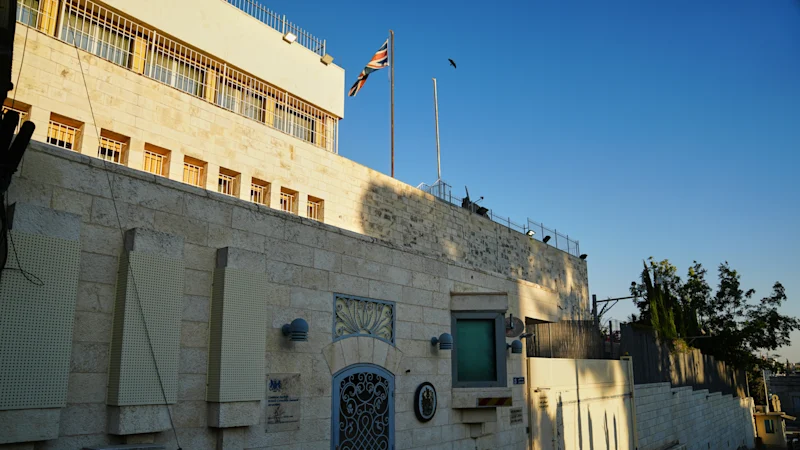
Israel has ordered the closure of the British consulate in East Jerusalem and announced further reprisals after the UK joined an international coalition imposing trade restrictions on goods from Israeli settlements in the occupied West Bank.
Foreign minister Gideon Sa’ar condemned the measures as “morally distorted” and accused Britain of interfering in Israel’s sovereignty and electoral process. Israel also said it would bar several British MPs from entering the country, end UK involvement in training Palestinian security forces and exclude British representatives from a US-led Gaza coordination mission.
The retaliation followed Ed Miliband’s announcement in the House of Commons that Britain would ban imports from illegal settlements and prevent companies from providing services linked to their expansion, including construction, infrastructure, finance, property and advertising.
The new British sanctions regime is expected to come into force within six to nine months. The government has also imposed immediate sanctions on further Israeli settlers accused of supporting or inciting violence against Palestinian communities.
Mr Miliband said Israel’s policies in the West Bank were helping to make a future Palestinian state impossible. He cited the planned E1 settlement project, which includes more than 1,200 homes and would cut across the territory between East Jerusalem and the rest of the West Bank.
“The British government agrees that there is ethnic cleansing of Palestinians in areas of the West Bank, perpetrated by settler terrorists,” he told MPs.
He said the UK supported Israel’s right to defend itself against terrorism but argued that this did not justify the destruction in Gaza or the treatment of Palestinians in the West Bank. He also backed calls for accountability over alleged violations of international humanitarian law.
Israel accuses Britain of political interference
Mr Sa’ar said the Israeli public overwhelmingly supported Jewish communities in the West Bank and opposed the creation of a Palestinian state there. Referring to the Balfour Declaration of 1917, he argued that Israel had historical and national rights to what it calls Judea and Samaria.
“Not only will you fail to harm us, you will harm yourselves and your own influence,” he said of the British measures.
Israel’s President Isaac Herzog described the sanctions as a “grave miscalculation” and said they risked interfering in the democratic elections of a sovereign country. The vote is due to take place on October 27.
The British action was announced jointly with France and Canada. Denmark, Finland, Iceland, Ireland, Norway, Poland, Portugal, Spain and Sweden are supporting restrictions or considering further measures, while the Netherlands, Belgium and Ireland are among the countries that have already introduced or begun implementing restrictions on settlement goods.
The British government said the measures were aimed at protecting the prospect of a two-state solution. It has also condemned the expansion of settlements and rising settler violence, saying that Israel must investigate allegations against its forces and hold those responsible for attacks to account.
The move has exposed divisions in both countries. Britain’s Chief Rabbi, Ephraim Mirvis, called it a “dark day for British Jews”, while the Conservative Party opposed the measures. The Green Party said the government had not gone far enough.
In Israel, Yair Lapid, leader of the opposition Yesh Atid party, rejected the sanctions but criticised Benjamin Netanyahu’s government for failing to anticipate the scale of the international response.
“For a whole week, the government has been preparing us for sanctions from Britain, and then it turns out that another 10 important countries have joined it and no one knew,” Mr Lapid said.
The dispute marks a sharp deterioration in relations between Britain and Israel, although Mr Miliband stressed that the government’s criticism was directed at the conduct of the Israeli government rather than the Israeli people. Britain has also reiterated its opposition to Hamas playing any role in the future governance of Gaza.
